OIL: Oil Delivers a Fourth Weekly Gain on Russian Sanction Risk.
Jan-17 03:21
- Oil came off near term highs overnight as speculation that the potential drop in supply from further Russian sanctions could see the release of up to 1.2m b/d of supply from OPEC+.
- As markets adjust to the news of Russian sanctions and seek to understand the new administration’s stance on them, what is clear is the incoming President’s focus on Canada and that raises the potential for tariffs on Canadian oil.
- News of a potential ceasefire between Israel and Hamas appears to be lacking support by key ministers in Israel yet at this stage is set to begin this coming Sunday.
- Oil’s ascent on Russian sanctions took a breather in overnight price action with WTI coming off the highs yesterday of US$80.77 to fall throughout the session to close at $78.77 before steadying at $79.09 during Asian trading day.
- For the week, WTI has gained +3.3%, marking a stellar run for the commodity in 2025.
- Brent saw highs yesterday of US$82.63 and fell gradually throughout the day to at $81.35 into the close, before steadying at $81.60.
- For the week, Brent too is up for the fourth successive week, by 2.2%.
- BP PLC announced that it will shed about 5% of its workforce and that it has stopped or paused up to 30 new projects to focus on existing ones that provide the most value add as its share price flounders relative to peers.
- Incoming nominee for Treasury secretary Scott Bessent said he would support the increased sanctions against Russia in a bid to end the Ukraine conflict.
- The increase in sanctions announced this week has seen evidence of a shift in demand dynamics with Saudi Aramaco receiving inquiries from Indian and Chinese buyers for their product whereas South Korean buyers are turning to the US.
Want to read more?
Find more articles and bullets on these widgets:
Historical bullets
NZD: NZD/USD Falls To Fresh Yearly Lows
Dec-18 03:09
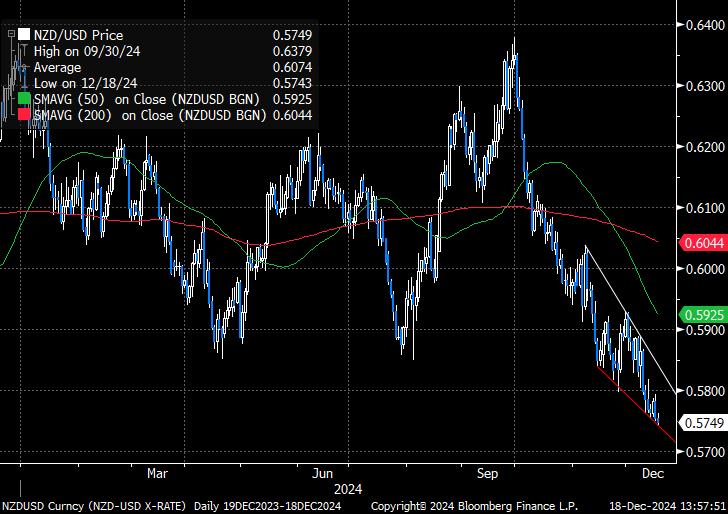
- NZD/USD continues to make fresh lows today, now trading down to 0.5750. The NZD/USD appears stuck in a falling wedge within a broader bearish trend, showing mixed signals with Monday’s morning star pattern followed by Tuesday’s bearish reversal. Buyers are currently active around 0.5750 area, but further support is limited until 0.5600 a break of this level would open a move to the 2022 lows of 0.5500, while any bounce above 0.5800 is likely to face selling pressure. RSI at 34 and MACD are trending lower, with traders favoring a strategy of selling into rallies and bearish breakouts.
Chart. NZD/USD In Falling Wedge Pattern
JPY: USD/JPY Dips Have Tended To Be Supported Post BoJ Meetings In 2024
Dec-18 02:35
USD/JPY sits slightly higher in latest dealings, last 153.65/70, but remains comfortably within recent ranges. We are some distance from the 20-day EMA support point, 152.24. Recent highs rest at 154.48. We have key event risks coming up in terms of the Fed decision later today and then tomorrow's BoJ meeting outcome.
- The clear market bias is for the Fed to cut and the BoJ to hold steady. This is also the market pricing skew, which may leave the respective outlooks presented by these central banks as the bigger USD/JPY driver.
- Looking back at USD/JPY trends before and after 2024 BoJ meeting outcomes we have generally seen USD/JPY dips supported post the meeting outcomes.
- The chart below plots USD/JPY in the 10days before and after each meeting outcome (with the pair indexed to 100 on the meeting day). Indeed, on average USD/JPY is around 0.75% higher in the two weeks after BoJ meetings this year.
- The main two exceptions were the April and July meetings. The July meeting delivered a surprise hike.
- We could of course see the Ueda led board deliver a surprise hike tomorrow but after the July experience, where Japan asset markets sold off aggressively (in part due to the BoJ move), the central bank may be cautious around delivering another fresh surprise.
- The general outlook around a resilient US economic backdrop (and the subsequent flow on effect to the Fed), coupled with a gradual BoJ approach to tightening policy, has supported USD/JPY dips in 2024. History may repeat tomorrow if we don't see Ueda hawkish enough relative to current market expectations.
Fig 1: USD/JPY Performance Around BoJ Meetings This year - Trading Days

Source: MNI - Market News/Bloomberg
EQUITIES: Equities Edge Higher, Focus On Upcoming Central Bank Meetings
Dec-18 02:24
- Asian shares turned higher as investors awaited the Fed's policy decision, with a regional gauge rising 0.3%, led by gains in Hong Kong, China, and South Korea, while Japanese equities fluctuated. The Hang Seng Index rose 0.9%, boosted by Tencent Holdings and Li Auto, even as news of a pending US trade investigation into Chinese semiconductors weighed on chipmakers.
- Japan’s Nikkei 225 declined 0.5% earlier, how it has since pared most of those losses to trade just 0.15% lower. Losses in US semiconductor stocks overnight and cautious sentiment ahead of the BoJ's policy meeting tomorrow caused the initial sell off. Nissan shares soared 24% on news of a potential merger with Honda, while Mitsubishi Motors jumped 17%.
- The ASX 200 gained 0.3% as mining stocks outperformed, while New Zealand's NZX 50 fell 0.30%. In South Korea, the Kospi is trading 0.90% higher, as Samsung sees a small bounce, but lingering political uncertainty following President Yoon's impeachment remains a drag. Taiwan TAIEX is 0.30% higher, however there are no notable moves to mention.
- The Philadelphia SE Semiconductor Index fell 1.64% overnight, however it traded up over 5% the prior two sessions. The Biden administration is launching a trade investigation into Chinese semiconductors under Section 301, potentially leading to tariffs or restrictions on older chips and related products. The move aims to protect the US semiconductor industry from cheap Chinese imports and leaves the option for further trade measures to the incoming Trump administration. Biden has prioritized bolstering domestic chip production, raising tariffs to 50% on legacy Chinese semiconductors by 2025, as per BBG.


