BONDS: NZGBS: Finished Slightly Mixed, Underperformance To $-Bloc Continued
Jan-17 03:41
NZGBs ended the session slightly mixed, with the 2-year yield rising by 2bps, while the 10-year yield declined by 1bp.
- The underperformance of the NZGB 10-year relative to its $-bloc counterparts persisted, as the NZ-US and NZ-AU yield differentials widened by 4bps and 2bps, respectively. Over the past week, the NZ-US differential has expanded by 20bps, recovering from its lowest level since late 2020. Similarly, the NZ-AU differential has widened by 16bps during the same period.
- This occurred despite NZ’s manufacturing activity remaining subdued in December, marking 22 consecutive months of contraction—the longest streak since the global financial crisis, excluding the pandemic. The BusinessNZ PMI for December registered at 45.9, a slight improvement from 45.2 in November, but still well below the 50-point threshold indicating expansion.
- Swap rates closed unchanged, 3-4bps higher than the session’s lows.
- RBNZ dated OIS pricing closed little changed. 46bps of easing is priced for February, with a cumulative 109bps by November 2025. With respect to end-2025 rate expectations, NZ has been the $-blocs worst performer, with the expected OCR some 25bps firmer than last Friday’s close.
Want to read more?
Find more articles and bullets on these widgets:
Historical bullets
BONDS: NZGBS: Bull-Flattener Ahead Of FOMC, Q3 GDP Tomorrow
Dec-18 03:37
NZGBs closed showing a modest bull-flattener, with yields flat to 3bps lower across benchmarks.
- NZ Q3 GDP is released tomorrow with the production measure forecast to fall 0.2% q/q, the second consecutive quarterly decline. This would leave the annual rate at -0.4% slightly better than Q2’s -0.5%. While consensus is in line with the RBNZ’s November forecast, local banks are more pessimistic. Either way, further monetary easing is likely, including a possible 50bp at the February 19 meeting.
- Projections from analysts surveyed by Bloomberg are between +0.1% and -0.4% q/q with annual growth +0.1% to -0.5%. Most are forecasting a contraction of 0.2-0.4% q/q.
- ASB, ANZ, BNZ and Westpac all expect an outcome worse than consensus at -0.4% q/q & -0.5% y/y, while Kiwibank is projecting -0.3% q/q and -0.4% y/y. This trend in domestic forecasts signals a possible downside surprise to Bloomberg consensus.
- If GDP is in line with consensus, then the NZ economy would be in a technical recession, which last occurred over Q4 2022/Q1 2023. Growth has stagnated since then.
- Swap rates closed 2-3bps lower.
- RBNZ dated OIS pricing shows 45bps of easing is priced for February, with a cumulative 110bps by November 2025.
- Tomorrow, the local calendar will also see ANZ Business Confidence.
NZD: NZD/USD Falls To Fresh Yearly Lows
Dec-18 03:09
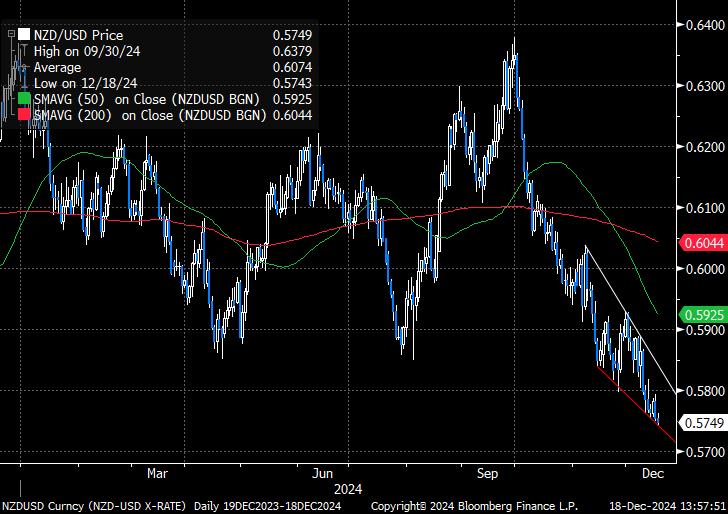
- NZD/USD continues to make fresh lows today, now trading down to 0.5750. The NZD/USD appears stuck in a falling wedge within a broader bearish trend, showing mixed signals with Monday’s morning star pattern followed by Tuesday’s bearish reversal. Buyers are currently active around 0.5750 area, but further support is limited until 0.5600 a break of this level would open a move to the 2022 lows of 0.5500, while any bounce above 0.5800 is likely to face selling pressure. RSI at 34 and MACD are trending lower, with traders favoring a strategy of selling into rallies and bearish breakouts.
Chart. NZD/USD In Falling Wedge Pattern
JPY: USD/JPY Dips Have Tended To Be Supported Post BoJ Meetings In 2024
Dec-18 02:35
USD/JPY sits slightly higher in latest dealings, last 153.65/70, but remains comfortably within recent ranges. We are some distance from the 20-day EMA support point, 152.24. Recent highs rest at 154.48. We have key event risks coming up in terms of the Fed decision later today and then tomorrow's BoJ meeting outcome.
- The clear market bias is for the Fed to cut and the BoJ to hold steady. This is also the market pricing skew, which may leave the respective outlooks presented by these central banks as the bigger USD/JPY driver.
- Looking back at USD/JPY trends before and after 2024 BoJ meeting outcomes we have generally seen USD/JPY dips supported post the meeting outcomes.
- The chart below plots USD/JPY in the 10days before and after each meeting outcome (with the pair indexed to 100 on the meeting day). Indeed, on average USD/JPY is around 0.75% higher in the two weeks after BoJ meetings this year.
- The main two exceptions were the April and July meetings. The July meeting delivered a surprise hike.
- We could of course see the Ueda led board deliver a surprise hike tomorrow but after the July experience, where Japan asset markets sold off aggressively (in part due to the BoJ move), the central bank may be cautious around delivering another fresh surprise.
- The general outlook around a resilient US economic backdrop (and the subsequent flow on effect to the Fed), coupled with a gradual BoJ approach to tightening policy, has supported USD/JPY dips in 2024. History may repeat tomorrow if we don't see Ueda hawkish enough relative to current market expectations.
Fig 1: USD/JPY Performance Around BoJ Meetings This year - Trading Days

Source: MNI - Market News/Bloomberg


