FOREX: NZD Slides Into RBNZ Decision, BoJ Hike Patterns in Focus
- Through the London close JPY printing fresh pullback lows, helping trigger a new alltime high for EURJPY for a second session at 176.36. The JPY leg remains dominant for now, and Takaichi's ability to quell concern among junior coalition partners should prove key to any near-term JPY bounce
and challenge to the JPY weakening bias. - BoJ rate hike timing should also prove key here: the fading odds for an October hike have worked against JPY near-term, but more assertive messaging
for a December hike may mean JPY weakness is limited here on out. We flagged earlier today the rising risk of a correction lower in JPY
crosses, which now screen overbought in many crosses on the 14-day RSI for the first time since mid-September. - The medium-term run higher in gold has continued, helping spot to new record highs of 3985.7 (although in futures space, COMEX gold has now shown above $4,000 for the first time), but the strength in gold looks pretty isolated: silver, oil prices and base metals are all seen lower, which may be limiting the bounce off lows for AUD/USD, which is yet to bounce back above 0.6600. NZD remains the underperformer into the RBNZ rate decision, and with 36bps of easing priced for Wednesday's meeting and a cumulative 63bps by November, markets may be erring in favour of a more sizeable rate cut this week.
- A return lower for NZD would re-open upside in AUD/NZD through to 1.1355-67 resistance, clearance above which returns focus to the bull trigger and cycle high at 1.1418.
- Despite a strong start to Tuesday trade, equity futures slipped sharply following the opening bell, opening a decent gap with the alltime highs posted across a number of markets in recent weeks. Small cap names underperformed, evident in the Russell 2000 slipping faster than the S&P 500. The government shutdown extended into a 7th day, and a lack of breakthrough by the end of this week will begin to prompt furloughed workers to miss paycheques, adding pressure to lawmakers to come to a resolution. House Dem Leader Jeffries painted a bleak picture of the hopes of near-term talks, suggesting there remains a very large gap between lawmakers on resolving the government shutdown - he noted a proposal to extend ACA credits for one year as "laughable" and unacceptable.
- German industrial production data is the data highlight Wednesday, while the FOMC minutes are set to follow, providing the FOMC's latest views on policy ahead of the government shutdown from one week ago. Several central bank speakers are due, including ECB's Escriva, Muller & Elderson, BoE's Pill and Fed's Musalem, Barr & Kashkari.
Want to read more?
Find more articles and bullets on these widgets:
Historical bullets
LOOK AHEAD: US Macro: PPI (Wed) and CPI (Thu) Inflation
US PPI inflation is released on Wednesday before CPI inflation on Thursday, an unusual ordering that should see core PCE implications dialled in after the CPI release rather than the usual wide range waiting for specific PPI details. PPI will be watched more closely than usual this month after a far stronger than expected jump in last month’s July report fired a warning short over tariff-based cost pressures starting to feed through. That included a 0.6% M/M increase in our preferred core series of PPI ex food, energy & trade services, which strips out items such as the then booming portfolio management & investment advice category following the strength in equity markets. It's too early to gauge an accurate sense of analyst expectations for August.
CPI inflation on Thursday will then be the last major release ahead of the Sep 17 FOMC decision. Consensus looks for core CPI at 0.3% M/M after the 0.32% M/M in July, another monthly increase comfortably above a pace consistent with 2% inflation. August should in theory start to see the largest tariff impacts along with September and possibly October. Returning to July’s report, core goods inflation was softer than expected, at a still solid (by core goods standards) 0.2% M/M for a second month running but about half that of 0.4% expected by analysts. Instead, non-housing core services surprised higher. The latter was a “dangerous” development in the words of a usually dovish Chicago Fed’s Goolsbee (’25 voter), who speaking after Friday’s payrolls report is still undecided on a September cut whilst looking for August inflation data “to get more information”.
LOOK AHEAD: US Macro: Payrolls Preliminary Benchmark Revisions (Tue)
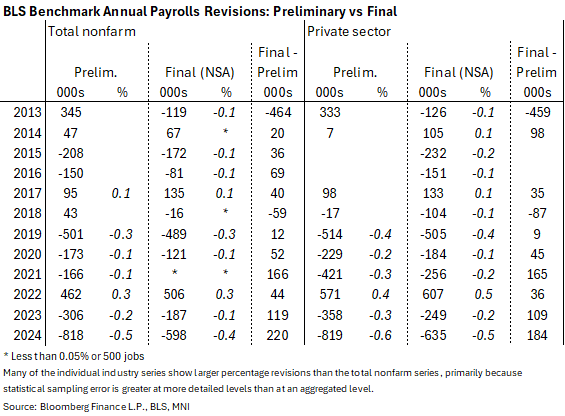
- The BLS on Tuesday will publish preliminary estimates of benchmark revisions, based off QCEW data for Q1.
- These will give an indication of the actual benchmark revisions on the Mar 2025 level of payrolls due with the Jan 2026 payrolls report released in early February.
- Bear in mind that the final benchmark estimate tends to nearly always be more negative than the preliminary figure – see historical values to the right.
- That doesn’t mean they can’t be large again after last year’s historically negative revision that lowered the level of payrolls by ~600k. Initial estimates we’ve seen look for another large downward revision, with the smallest being worth -550k but with wide ranges higher.
FED: Barclays Adds A Cut To 2025 Fed View
Barclays analysts now expect three Fed cuts in the remainder of the year, adding October to their pre-existing call for 25bp reductions in September and December. "Given the disappointing August employment report, we expect the FOMC to see more elevated downside risks to the employment side of the mandate."
- As for a 50bp September cut, "we think that the FOMC will view [that] as sending too strong a signal that labor market conditions are deteriorating. Indeed, we think that participants such as Powell understand that the slower pace of payroll employment reflects at least, in part, slower labor supply, which does not translate into increased labor market slack."
- For 2026 they continue to expect 25bp cuts in March and June to 3.00-3.25%, but "we do not think the FOMC will be able to cut rates more than twice next year, as we think that activity will show some slight acceleration, with the economy adapting to the new tariff environment and fiscal policy providing some support, and the unemployment rate will revert down amid limited increase in labor supply."


