ASIA: November Growth Up But Domestically Driven, Export Demand Weak
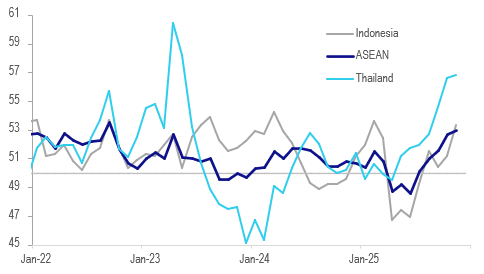
S&P manufacturing PMIs across most of ASEAN were higher in November signalling stronger growth in activity across the sector. Only in the Philippines did it contract due to typhoon-related disruptions, while in Malaysia it stagnated. The aggregate ASEAN PMI rose to 53.0 from 52.7, the best performance since September 2022, with Thailand again posting the fastest growth followed by Vietnam. ASEAN economies are showing resilience following the reduction in global trade uncertainty but it appears to be domestically driven with export orders contracting. There were signs of cost pressures in the data though.
ASEAN S&P manufacturing PMIs
Source: MNI - Market News/Bloomberg Finance L.P.
- ASEAN manufacturing activity was driven by higher domestic orders as overseas contracted. Production was up driving an increase in purchasing but employment was steady.
- Thailand continued to outperform at 56.8 (October 56.6), highest since May 2023 with manufacturers also very positive about the outlook. Growth was driven by stronger production and domestic orders and subsequent hiring. However, overseas demand contracted at a faster pace. Cost inflation rose in November but wasn’t passed on with output inflation steady.
- Indonesia saw a material improvement with the PMI up to 53.3 from 51.2, the highest since February and back above ASEAN as a whole. The move was due to the fastest growth in new orders in over 2 years driven by domestic demand as overseas fell at the sharpest in over a year. Domestic strength drove an increase in employment and purchasing activity though. The outlook remains positive but less so than last month.
- Indonesian cost pressures increased due to the weaker IDR and raw materials and were passed on resulting in highest selling inflation in more than 18 months. Rates have been cut 125bp this year and inflation has turned higher.
Want to read more?
Find more articles and bullets on these widgets:
Historical bullets
AUSSIE 10-YEAR TECHS: (Z5) Returns Lower
- RES 3: 95.982 - 76.4% retracement Sep’24 - Nov’24 downleg
- RES 2: 95.960 - High Apr 7 (cont.)
- RES 1: 95.900 - High Oct 17
- PRICE: 95.670 @ 16:16 GMT Oct 31
- SUP 1: 95.510 - Low Sep 3
- SUP 2: 95.415/95.300 - Low May 15 / Low Jan 14
- SUP 3: 95.275 - Low Nov 14 (cont) and a key support
Aussie 10-yr futures slipped lower Wednesday on the back of hotter-than-expected Australian inflation. This returned prices lower despite nascent signs of a technical recovery as recently as last week. The sustainability of the pullback will be dependent on prices holding above key short-term support at 95.510, the Sep 3 low. Near-term resistance remains 95.780, the Sep 12 high. A clear break of this level signals scope for a continuation higher and opens 95.960, the 76.4% retracement level for the Sep’24 - Nov’24 downleg.
AUSSIE 3-YEAR TECHS: (Z5) Struck by Strong CPI
- RES 3: 97.796 - 1.618 proj of the Sep 3 - 12 - 15 price swing
- RES 2: 96.780 - High Jun 26 (cont)
- RES 1: 96.700 - High Sep 12
- PRICE: 96.375 @ 16:13 GMT Oct 31
- SUP 1: 96.280 - Low May 15 (cont.)
- SUP 2: 95.900 - Low Jan 14 (cont.)
- SUP 3: 95.760 - Low 14 Nov ‘24
Having bounced well on the back of the mild US CPI print, Aussie 3-yr futures reversed course Wednesday on strong domestic inflation data containing RBA cut pricing through 2026. This keeps prices well below prior resistance at 96.615, the Sep 12 high, and refocuses attention on 96.280 as the next major support.
FED: Gov Waller: Still Advocating For A December Rate Cut
Gov Waller, one of the FOMC's more prominent doves, makes clear in an appearance on Fox Business that he supports a follow-up rate cut in December. He makes reference to Chair Powell's press conference comment that the Fed could skip a cut at the December meeting due in part to a lack of official government data during the federal shutdown (Powell: “what do you do if you are driving in the fog? You slow down").
- Waller says today: "Right now, we know that the labor market has been weak... We know inflation is going to come back down. Inflation expectations are anchored, and in that world, the standard of central bank wisdom is to look through it and proceed with worrying about the labor market. So in my view, we should just look at what the data is telling us and proceed on policy that way.... So this is why I'm still advocating that we cut policy rates in December, because that's what all the data is telling me to do. The fog might tell you to slow down. It doesn't tell you to pull over to the side of the road. You still have to go. You may want to be careful, but it doesn't mean to stop, and ... the right thing to do with policy is to continue cutting."
- This is of particular interest since he appeared to suggest he would have a more cautious outlook on further easing after cutting in October.


