ASIA STOCKS: Net Outflows Strong Last Week, Rolling Monthly Outflows Large
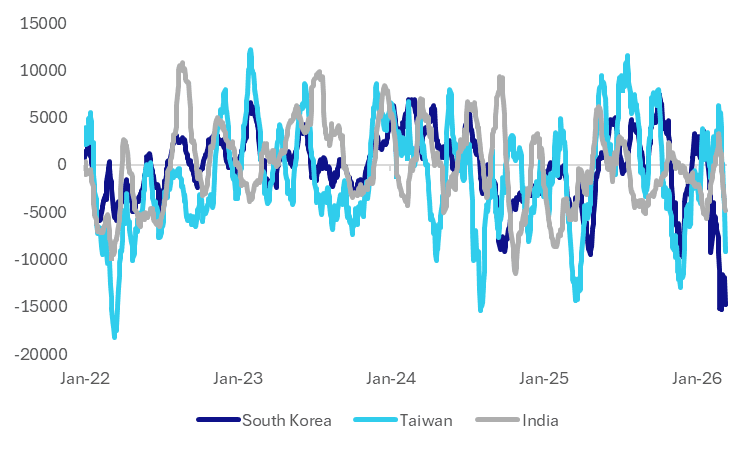
It has been a fairly consistent theme of net selling by offshore investors over the past week, albeit with a few days of net inflows into South Korea and Indonesia. Cumulative outflows stand at -$16bn as markets grapple with the oil price shock from the Iran conflict. As we noted earlier in the week, outside of South Korea, markets in the region aren't at previous cycle lows in terms outflow pressures on a rolling 1 month sum basis. We are getting close though, see the updated chart for South Korea, Taiwan and India below. Taiwan net outflows for the past trading month are nearing -$10bn, India is close to -$5bn.
- Sentiment may remain cautious though, with little signs, on the surface at least, of de-escalation in terms of the Iran conflict.
- In South East Asia, we have seen some stability in Indonesian outflow pressures, but it is mostly outflow momentum elsewhere.
- Thailand net inflows for 2026 to date continue to be pared back, now just over +$1bn (the peak was just under $1.9bn).
Table 1: Asian Markets Net Equity Flows
| Yesterday | Past 5 Trading Days | 2026 To Date | |
| South Korea (USDmn) | -2061 | -5942 | -20826 |
| Taiwan (USDmn) | -2423 | -6157 | -4230 |
| India (USDmn)* | -643 | -3020 | -5906 |
| Indonesia (USDmn) | 59 | -102 | -523 |
| Thailand (USDmn) | -75 | -687 | 1057 |
| Malaysia (USDmn) | -35 | -55 | 338 |
| Philippines (USDmn) | -8 | -50 | 307 |
| Total (USDmn) | -5186 | -16013 | -29784 |
| * Data Up To Mar 11 |
Source: Bloomberg Finance L.P./MNI
Fig 1: South Korea, Taiwan & India Net Equity Flows, Rolling 1month Sum (USD Mn)
Source: Bloomberg Finance L.P./MNI
Want to read more?
Find more articles and bullets on these widgets:
Historical bullets
MNI: CHINA JAN CPI +0.2% Y/Y VS MEDIAN +0.4%; DEC +0.8%: NBS
- CHINA JAN CPI +0.2% Y/Y VS MEDIAN +0.4%; DEC +0.8%: NBS
- CHINA JAN CPI +0.2% M/M VS +0.2% M/M DEC
- CHINA JAN FOOD PRICES -0.7% Y/Y VS +1.1% Y/Y DEC
- CHINA JAN NON-FOOD PRICES +0.4% Y/Y VS +0.8% Y/Y DEC
- CHINA JAN PPI -1.4% Y/Y VS MEDIAN -1.5%; DEC -1.9%: NBS
- CHINA JAN PPI +0.4% M/M VS +0.2% M/M DEC
CHINA: Central Bank Injects CNY403.5bn via OMO
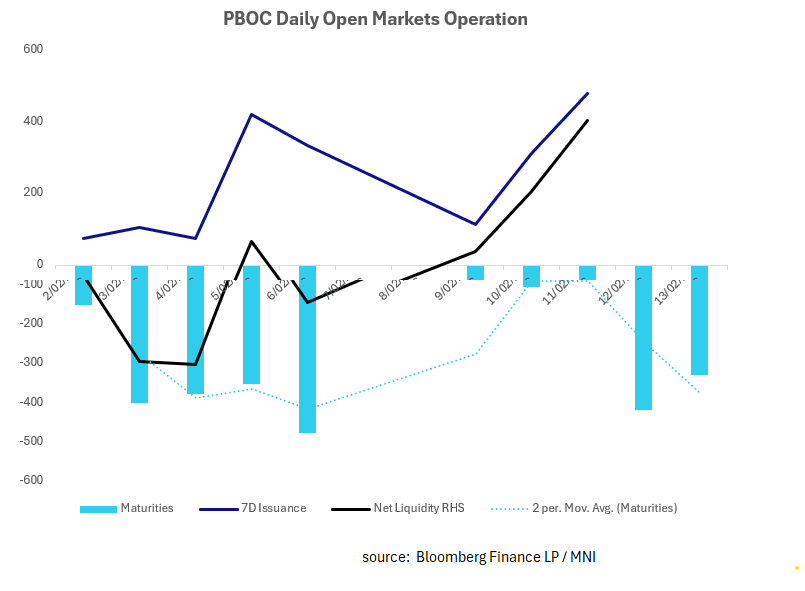
As expected and ahead of the Lunar New Year break the PBOC continues to inject liquidity, today adding further 14-day reverse repo. This takes the total injection this week alone to almost CNY650bn, with sizeable maturities still to come this week.
- The PBOC issued CNY78.5bn of 7-day reverse repo at 1.4% during this morning's operations.
- The PBOC issued CNY400bn of 14-day reverse repo during this morning's operations.
- Today's maturities CNY75bn.
- Net liquidity injection CNY403.5bn.
- The PBOC monitors and maintains liquidity in the interbank system through the issuance of reverse repo.
- The CFETS Pledged Repo Deposit Institutions 7 Day Weighted is at 1.47%, from prior close of 1.55%.
- The China overnight interbank repo rate is at 1.35%, from the prior close of 1.34%.
- The China 7-day interbank repo rate is at 1.47%, from the prior close of 1.57%.
CHINA PRESS: Authorities To Prioritise Fiscal And Monetary Coordination
Chinese authorities will prioritise closer fiscal and financial coordination to support the expansion of domestic demand in 2026, the latest report from the People’s Bank of China indicated. The central bank will integrate its relending tools with fiscal interest subsidy policies, Financial News said, noting that budgetary and monetary authorities will jointly share a portion of corporate financing risks to strengthen financial institutions’ willingness to extend credit. The People’s Bank of China has established risk-sharing tools for technological innovation and private enterprise bonds, while the central government has allocated fiscal funds to participate in risk sharing, experts noted.


