MNI US MARKETS ANALYSIS - Fedspeak in Spotlight
Highlights:
- Treasury curve sits bear flatter, USD/JPY briefly pierces Y140.00
- Fedspeak in greater focus as questions raised on independence
- Stock bounce is shallow, pointing to continued fragile sentiment after Trump's Powell missive
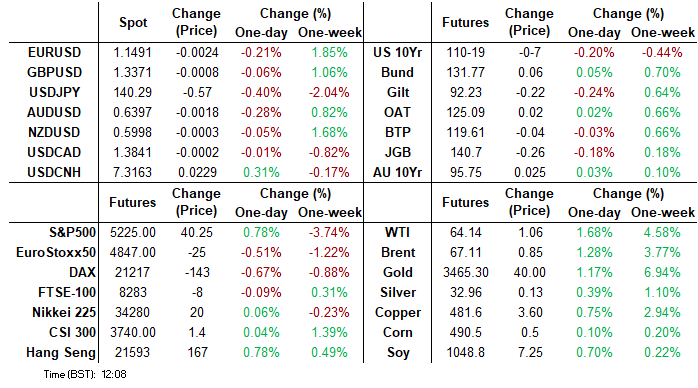
US TSYS: Bear Flatter With 2Y Supply And Fedspeak Watched
- Treasuries trade bear flatter as investors continue to weigh US President Trump’s latest pressure on the Fed to cut rates yesterday. It adds to the mix of the front end being under pressure from further gains for crude oil futures and $69bn of 2Y supply later on.
- Earnings are increasingly of note this week with tariff impacts eyed, including Tesla, Verizon and Lockheed Martin today before Boeing, IBM and Philip Morris tomorrow.
- Cash yields are 0.5bp to 4.5bp higher on the day, with 2s leading the increases.
- It sees some pulling back from yesterday’s latest steepening, including 2s10s at 62bp (-3bp) vs above 66bp yesterday.
- TYM5 has recently touched lows of 110-17 (-08+), back to levels last seen on Apr 15 amidst modest volumes of 280k.
- The pullback from Thursday’s 111-17+ supports the notion that prior gains were corrective, with support seen at 110-15 (Apr 15 low) before a bear trigger at 109-08 (Apr 11 low).
- Data: Philly Fed non-mfg Apr (0830ET), Richmond Fed mfg Apr (1000ET)
- Fedspeak: Jefferson (0900ET), Harker (0930ET), Kashkari (1340ET), Barkin (1430ET) and Kugler (1800ET) – see STIR bullet
- Coupon issuance: US Tsy $69B 2Y Note auction - 91282CMY4 (1300ET)
- Bill issuance: US Tsy $70B 6W bill auction (1130ET)
STIR: Senior FOMC Officials In The Spotlight
- Fed Funds implied rates sit within yesterday’s Easter Monday holiday-thinned ranges as markets assess the latest of US President Trump’s attempts at pressuring the Fed to cut interest rates.
- Cumulative cuts from 4.33% effective: 3.5bp May, 18.5bp Jun, 41bp Jul, 60bp Sep and 91bp Dec.
- Yesterday’s timely MNI policy team exclusive with Lev Menand looked at options away from just Fed Chair Powell’s role (see Fed Independence Facing Imminent Risk – Menand, published 1613ET).
- That sees today’s various scheduled Fedspeakers in particular focus in an another quiet data docket, with messages either of continued caution against cutting rates too soon or a more dovish tone both of note. We imagine permanent voters Jefferson and Kugler will be watched most closely, although Kugler is late on.
- 0900ET – Vice Chair Jefferson (permanent voter) on economic mobility and the dual mandate (text only). He said Apr 3 that there was no need to hurry to adjust rates and that is was crucial to assess the full effect of Trump administration changes. That said, he noted growth was solid but saw signs of slowing and that persistent uncertainty may constrain the economy.
- 0930ET – Harker (retiring June) on economic mobility and regional economies (fireside chat)
- 1340ET – Kashkari (’26 voter) at Chamber of Commerce Global Summit (Q&A only)
- 1430ET – Barkin (non-voter) fireside chat at innovation summit (Q&A only)
- 1800ET – Gov. Kugler (permanent voter) on monetary policy transmission (text + Q&A). She said Apr 7 that inflation was now the more pressing issue with regards to tariffs and that the Fed needs to make sure it doesn’t rise. She warned the tariff impact should be consequential.

CROSS ASSET: Threats To Fed Independence Promotes Fresh “Sell the US” Dynamics
Yesterday’s concurrent selloff in the US dollar, US Treasuries and US stocks was the seventh such session this year, and the largest one-day fall in “US assets” since March 2009 (see below for more). The selloffs were driven by US President Trump’s continued threats against Fed Chair Powell’s position and lingering tariff-related stagflation concerns.
- Although markets are generally conditioned to expect the dollar and USTs to rally when stocks fall, and soften when stocks, the top left chart indicates that situations where US assets move in the same direction are not uncommon. What is more notable is that this year’s simultaneous selloffs have been of a greater average magnitude than most of the last 40 years (save for 1987, 1990 and 2008) – see the top right chart.
- Crudely summing yesterday’s 0.96% fall in the DXY, 2.36% fall in the S&P and 0.32% fall in US Treasury futures gives the largest one-day fall in “US assets” since March 2009.
- While yesterday’s moves may have been exacerbated by lower liquidity given the EU/UK public holidays, it is still suggestive of a broad-based shunning of US assets amongst investors, a trend that will continue to be monitored in the coming weeks/months.
- In US Treasuries, term premium estimates (as indicated by the Adrian Crump and Moench model) have lurched higher since Trump’s April 2 reciprocal tariff announcement, given heightened policy uncertainty and more recent questions around the future of the Fed’s independence.
- Although the DXY is over 10% off its January highs at typing, Citi’s US real effective exchange rate index is still 3.4% above its five-year average, and 7.2% above its ten-year average. As such, there remains room for a more significant dollar correction if current dynamics extend.
- The clear beneficiaries of a diversification away from US assets as reserves/safe havens have been the likes of gold and the Swiss Franc, with the former reaching fresh all-time highs this morning and USDCHF extending 10-year lows yesterday.

FOREX: No Let-Up for FX Risk as Lagged Effects Keenly Felt by Corporates
- While front-end implied vols have abated from highs, the fresh cycle low in the USD Index and lagged impacts on corporates is still a major present risk. The histogram below shows that while 3m implied is off 12m highs, it remains well above the upper quartile for the majority of G10 FX.
- The effects of broad USD volatility are also being keenly felt in the corporate world: UK AIM-listed currency risk management firm Argentex have suspended their shares after FX volatility compromised their short-term liquidity position. In an RNS release they note that if FX vols persist its liquidity position would be "significantly stretched". Full RNS post here: https://www.londonstockexchange.com/news-article/AGFX/financial-position-suspension-of-trading/16998959
- Firms like Argentex sell FX hedging products including forwards and options to corporate clients, who are then subject to margin calls should markets move against their position. In turn, the firm hedges its cumulative exposure in the wholesale market via major banking partners - but are then exposed to the same margin call risk through times of volatility. That appears to be the scenario playing out here - and is unlikely to be a one-off case.
- Distressed liquidity among corporate service providers is an effective proxy for the underlying client - and serves as a further reminder of the dangers to economic activity from even brief spells of extended FX vol.

ECB: Q2 SPF Partially Incorporates US Tariffs; Small Negative GDP Impact Exp
ECB Survey of Professional Forecasters here
- "Expectations for headline HICP inflation were revised slightly upwards for 2025 and 2026 but remained unchanged for 2027 and the longer-term".
- "Expectations for HICPX were revised up by 0.1 percentage points for all horizons, including the longer term (to 2.0%)".
- "Respondents continued to expect a gradual strengthening of real GDP growth – from 0.9% in 2025 to 1.2% and 1.4% in 2026 and 2027, respectively".
- "In this round, SPF respondents were asked two special questions on (i) tariffs and protectionism and (ii) defence and fiscal spending".
- "In terms of baseline inflation expectations, tariffs were expected to have a small upward impact in the nearer term (2025 and 2026), while defence spending was expected to have a similar impact in the medium term (2026 and 2027)".
- "In terms of baseline real GDP growth expectations, tariffs were expected to have a downward impact in the nearer term (2025 and 2026), while defence spending was expected to have an upward impact in the medium term (2026 and 2027)"
- "Respondents’ risk assessments for these factors largely corresponded to the direction of the impact on their baseline expectations. This suggests that respondents may have been cautious when incorporating these factors into their baselines and expressed this caution by accounting for risks in the same direction".
- Note: Deposit rate expectations do not account for the latest dovish repricing in EUR rates: "Forecasters expected the ECB’s deposit facility rate (DFR) to fall to around 2.25% in the second quarter of 2025 and to decrease further, to around 2.00%, by the third quarter of 2025 and into 2026, before increasing to 2.25%, on average, by 2029".
- "The survey was conducted between 1 and 4 April 2025"

UK DMO UPDATE: Remit revision due tomorrow
- An updated gilt remit is expected tomorrow following the release of the UK public sector finance data which will confirm the CGNCR outturn for 2024/25. There is an expected release time of 7:30BST (this is not confirmed but is the precedent set in previous years).
- Expectations are for an upward revision to the FY25/26 remit but most of the analyst notes we have seen on this are non-specific in terms of the numbers. We have only seen three estimates with numbers on from the sell side: Lloyds and Citi look for around GBP10bln (although Lloyds looks for this to be in bills rather than gilts, while Citi looks for it in gilts). Deutsche Bank looks for GBP10-15bln with a point estimate of GBP12bln but run three scenarios which see risks range from GBP8.7-17.9bln; Deutsche sees the revision being in gilts but see "some meaningful risk" of a GBP2bln increase UKTBs.
- We think that the bar to increasing linker issuance is relatively high. Anything up to around GBP10.6bln could be achieved by increasing the number of short, medium and long conventional auctions by one (and maintaining the current average sizes). An increase of GBP8.5bln could be achieved without an extra long auction.
- We think there is also the potential to add more to UKTB issuance, too, as demand may well increase as reserves become more scarce as QT continues and the TFSME continues to wind down. The DMO may prefer to add a little to UKTB issuance rather than increase long-dated issuance.
- And the wildcard is there is also more flexibility in the unallocated bucket given programmatic gilt tenders.
- For reference last year's remit revision was GBP12.4bln (all in gilts, no UKTB change) comp[rised of:
- GBP5.4bln of additional shorts with one extra auction
- GBP3.9bln of additional mediums with one extra auction
- GBP1.0bln of additional longs with one extra auction
- GBP1.1bln of additional linkers with one extra auction
- GBP1.0bln of additional unallocated
EUROPE ISSUANCE UPDATE:
Austria syndication: Mandate
- "The REPUBLIC OF AUSTRIA has mandated [a set of banks] to lead manage its upcoming triple-tranche issuance consisting of a tap of its RAGB 2.5% Oct 2029 (ISIN AT0000A3EPP2), a tap of its RAGB 3.2% Jul 2039 (ISIN AT0000A3D3Q8) and a tap of its RAGB 3.15% Oct 2053 (ISIN AT0000A33SK7)."
- "The transaction is expected to be launched and priced in the near future, subject to market conditions."
From market source - We had noted the possibility of this in April in our EGB Issuance, Redemption and Cash Flow Matrix last week.
Slovakia auction results
- E77mln of the 3.00% Feb-28 SlovGB. Avg yield 2.0815% (bid-to-cover 2.78x).
- E242mln of the 3.75% Mar-34 SlovGB. Avg yield 3.3824% (bid-to-cover 3.06x).
- E255mln of the 3.75% Feb-35 SlovGB. Avg yield 3.4369% (bid-to-cover 2.38x).
- E61mln of the 2.00% Oct-47 SlovGB. Avg yield 4.0021% (bid-to-cover 1.82x).
Germany auction results
- Another soft German auction (German auctions have been soft for three weeks now).
- The bids received were the lowest since August 2023 (albeit broadly similar to the volumes seen in January 2024).
- Indeed, to put it into perspective, there has only been one Schatz bid-to-cover below 2x over the past year before today (1.97x in July 2024). Today's 1.69x was therefore much softer, with the bid-to-offer at 1.29x.
- There's been no notably wider market reaction from the auction - but it is worth noting that we have now seen soft auctions in Schatz, Bobls, 10-year Green and 30-year Bunds.
- E5bln (E3.814bln allotted) of the 1.70% Jun-27 Schatz. Avg yield 1.67% (bid-to-offer 1.29x; bid-to-cover 1.69x).
EUR: Trade-Weighted Exchange Rate At Fresh Record Highs
- Adding to earlier comments on EURUSD, US President Trump’s continued attempt to weigh-in on Fed decisions helped see the euro step to fresh record highs in nominal trade-weighted terms yesterday (using Citi’s daily series).
- It’s someway off past highs in real terms, with lower historical inflation than many of its trading partners, yet is still trading at its 99th percentile over both five- or ten-year rolling periods that we often look at – see table.
- Interestingly though, whilst it’s unsurprisingly the most stretched DM currency vs these historical ranges, GBP, CHF and SEK (just) see a more elevated REER relative to its five-year average. GBP leads on this alternative approach, sitting 6.2% and 7.5% higher than five- and ten-year averages vs 3.9% and 4.7% for the euro.
- Back on EURUSD specifically, you can see the clear disconnect between fundamental driver such as rate differentials and relative terms of trade, with this new safe haven factor likely at play since Trump's Apr 2 “Liberation Day” tariff announcements.

FOREX: USD/JPY Cracks Y140 Support in Latest USD Leg Lower
- The EUR is among the poorest performing currencies early Monday as markets continue to consider the sharp FX moves seen across holiday-thinned Monday trade. EUR/USD has edged back below the $1.1500 handle, but remains well within range of the weekly - and cycle - highs of 1.1573 posted yesterday. The moves prompted spot to break some notable trendlines on top of important pivot resistance level at 1.1495.
- US equity futures are holding the bulk of the Monday losses, pointing to only a marginally higher open on Wall Street later today. As such, the JPY is firmer against all others in G10, having broken through Y140 support in Asia-Pac trade.
- EUR/GBP's squeeze higher appears to have concluded, with the cross consolidating either side of the 0.8600 level. BoE's Greene speaking this morning appeared to drop her guidance of "cautious" in her approach to interest rates, which may firm expectations for 3 x 25bps rate cuts this year.
- The next leg of the USD trade will likely be contingent on the FOMC's stance on policy in the face of Presidential calls for rate cuts. As such, much focus will likely be paid to Fedspeak this week after the US President stepped up his critique of Fed chair Powell over the extended weekend.
- This week sees over 10 separate Fed speaker events before the media blackout period kicks in at the close on Friday. Market will be carefully watching for any firm pushback against the President's messaging on interest rates, in which Trump called for a swifter return to policy easing.
EQUITIES: Eurostoxx 50 Futures Remain Contained Within Last Week's Range
- Eurostoxx 50 futures continue to trade above their recent lows. The latest bounce highlights a corrective cycle and this is allowing an unwinding of the recent oversold trend condition. Resistance levels to watch are 4978.63, the 20-day EMA, and 5113.20, the 50-day EMA. Key support and the bear trigger has been defined at 4444.00, the Apr 7 low. A break of this level would confirm a resumption of the downtrend.
- A reversal higher in S&P E-Minis on Apr 9 highlighted the start of a correction. The trend condition has been oversold following recent weakness and gains have allowed this to unwind. The contract remains below important resistance points and the trend condition is bearish. The latest move down signals the end of the corrective cycle. Sights are on 4832.00, the Apr 7 low and bear trigger. Initial resistance to watch is 5437.24, the 20-day EMA.
EQUITIES: Busy Week for Earnings, With Alphabet, Tesla in Focus
First earnings of the week filtering through in a busy few sessions for corporate reports. So far today:
- 3M - Beats on EPS
- General Electric - Beats on EPS, affirms FY view
Major names due this week including:
Tuesday: Tesla, Verizon, Lockheed Martin
Wednesday: Boeing, IBM, Philip Morris
Thursday: Alphabet, P&G, T-Mobile
Friday: Abbvie
Full schedule including EPS, revenue expectations and timings here: https://media.marketnews.com/MNIUSEARNINGS_210425_3ed710b2f3.pdf

COMMODITIES: Gold Hits New Record High Above $3500 Mark
- A bearish theme in WTI futures remains intact and the recovery since Apr 9 is - for now - considered corrective. The move higher is allowing an oversold trend condition to unwind. Recent weakness has resulted in the breach of a number of important support levels, reinforcing a bearish threat. A resumption of the bear cycle would open $53.72, a Fibonacci projection. Initial firm resistance is seen at $64.49, the Mar 5 low and a recent breakout level.
- The trend needle in Gold continues to point north and this week’s fresh cycle highs confirm a resumption of the primary uptrend. The yellow metal has traded to another fresh all-time high. Note too that moving average studies are unchanged, they remain in a bull-mode position highlighting a dominant uptrend. The next objective is $3499.0, a Fibonacci projection. Initial firm support lies at 3163.5, the 20-day EMA.
| Date | GMT/Local | Impact | Country | Event |
| 22/04/2025 | 1230/0830 | * |  CA CA | Industrial Product and Raw Material Price Index |
| 22/04/2025 | 1230/0830 | ** |  US US | Philadelphia Fed Nonmanufacturing Index |
| 22/04/2025 | 1255/0855 | ** | US | Redbook Retail Sales Index |
| 22/04/2025 | 1300/0900 | US | Fed Vice Chair Philip Jefferson | |
| 22/04/2025 | 1330/0930 | US | Philly Fed's Pat Harker | |
| 22/04/2025 | 1400/1000 | ** | US | Richmond Fed Survey |
| 22/04/2025 | 1400/1600 | ** |  EU EU | Consumer Confidence Indicator (p) |
| 22/04/2025 | 1700/1900 | EU | ECB's De Guindos at MIT/ICADE Finance Club | |
| 22/04/2025 | 1700/1300 | * | US | US Treasury Auction Result for 2 Year Note |
| 22/04/2025 | 1740/1340 | US | Minneapolis Fed's Neel Kashkari | |
| 22/04/2025 | 1830/1430 | US | Richmond Fed's Tom Barkin | |
| 22/04/2025 | 2200/1800 | US | Fed Governor Adriana Kugler | |
| 23/04/2025 | 2300/0900 | *** |  AU AU | Judo Bank Flash Australia PMI |
| 23/04/2025 | 2301/0001 | * |  GB GB | Brightmine pay deals for whole economy |
| 23/04/2025 | 0030/0930 | ** |  JP JP | Jibun Bank Flash Japan PMI |
| 23/04/2025 | 0600/0700 | *** | GB | Public Sector Finances |
| 23/04/2025 | 0630/0730 | GB | DMO remit revision following FY24/25 CGNCR | |
| 23/04/2025 | 0715/0915 | ** |  FR FR | S&P Global Services PMI (p) |
| 23/04/2025 | 0715/0915 | ** | FR | S&P Global Manufacturing PMI (p) |
| 23/04/2025 | 0730/0930 | ** |  DE DE | S&P Global Services PMI (p) |
| 23/04/2025 | 0730/0930 | ** | DE | S&P Global Manufacturing PMI (p) |
| 23/04/2025 | 0800/1000 | ** | EU | S&P Global Services PMI (p) |
| 23/04/2025 | 0800/1000 | ** | EU | S&P Global Manufacturing PMI (p) |
| 23/04/2025 | 0800/1000 | ** | EU | S&P Global Composite PMI (p) |
| 23/04/2025 | 0800/1000 | EU | ECB Wage Tracker | |
| 23/04/2025 | 0830/0930 | *** | GB | S&P Global Manufacturing PMI flash |
| 23/04/2025 | 0830/0930 | *** | GB | S&P Global Services PMI flash |
| 23/04/2025 | 0830/0930 | *** | GB | S&P Global Composite PMI flash |
| 23/04/2025 | 0900/1100 | ** | EU | Construction Production |
| 23/04/2025 | 0900/1100 | * | EU | Trade Balance |
| 23/04/2025 | 1030/1130 | GB | BOE's Pill speech at University of Leeds | |
| 23/04/2025 | 1100/0700 | ** | US | MBA Weekly Applications Index |
| 23/04/2025 | 1300/0900 | US | Chicago Fed's Austan Goolsbee | |
| 23/04/2025 | 1330/0930 | US | St. Louis Fed's Alberto Musalem | |
| 23/04/2025 | 1330/0930 | US | Fed Governor Christopher Waller | |
| 23/04/2025 | 1345/0945 | *** | US | S&P Global Manufacturing Index (Flash) |
| 23/04/2025 | 1345/0945 | *** | US | S&P Global Services Index (flash) |
| 23/04/2025 | 1400/1000 | *** | US | New Home Sales |
| 23/04/2025 | 1430/1030 | ** | US | DOE Weekly Crude Oil Stocks |
| 23/04/2025 | 1530/1130 | ** | US | US Treasury Auction Result for 2 Year Floating Rate Note |
| 23/04/2025 | 1700/1300 | * | US | US Treasury Auction Result for 5 Year Note |
| 23/04/2025 | 1715/1815 | GB | BOE's Bailey at Institute of International Finance | |
| 23/04/2025 | 1800/1400 | US | Fed Beige Book | |
| 23/04/2025 | 1800/1900 | GB | BOE's Breeden on Monetary Policy and Financial Stability | |
| 23/04/2025 | 1915/2115 | EU | ECB's Lane in panel on Central Bankers' Dilemmas Amid Changing Liquidity | |
| 23/04/2025 | 1945/2145 | EU | ECB's Cipollone in panel on Tokenization and the Financial System | |
| 23/04/2025 | 2230/1830 | US | Cleveland Fed's Beth Hammack |


