MNI US MARKETS ANALYSIS - Bowman, Jefferson Make Rare Speeches
Highlights:
- Fedspeak again a focus; rare updates from Bowman & Jefferson should highlight
- JPY stronger again as verbal jawboning continues
- Biggest one-day gain for USDINR in months as RBI intervention slows
US TSYS: Data-Driven Losses Broadly Consolidated, Fedspeak Eyed
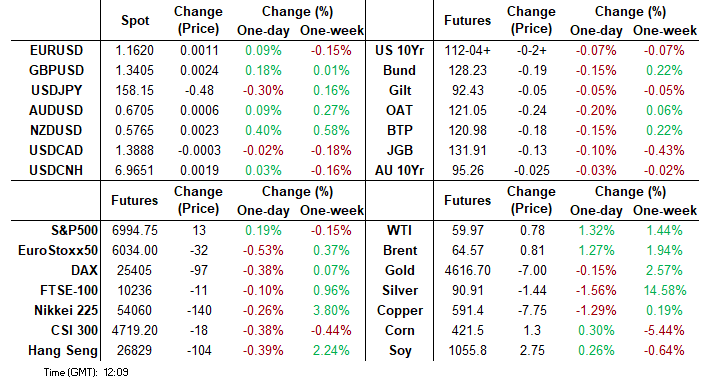
Treasuries sit towards lower levels for the session but broadly consolidate yesterday’s sell-off on strong US data, 30s aside which have pushed a little lower. It’s a reminder of the bear threat deemed present for TYH6 although we’re yet to resume a test of 4.20% 10Y yields seen in the days ahead of Tuesday’s Dec CPI report. Today's calendar is lighter, with pre-blackout Fedspeak headlining, before Martin Luther King Day sees closures on Monday.
- Cash yields are 0.3-0.9bp higher, led by the long end.
- 10Y yields, whilst firming since yesterday’s stronger data, at 4.175% are still a way off troubling the 4.20% level after short-lived breaches in the days ahead of the Dec CPI report on Tuesday.
- TYH6 trades close to session lows of 112-04 (-03) on lighter cumulative volumes of 250k, matching yesterday’s brief low.
- In a reminder of the bear threat that remains present, it moves closer to 111-29 (Dec 10 low, bear trigger) although it has recently found some support around 111-31 in levels that chimed with tests of the 4.20% yield. Clearance here could open 111-19 (Fibo projection) whilst to the upside, resistance is seen at 112-22 (Jan 7 high).
- Data: NY Fed services Jan (0830ET), IP/Cap Util Dec (0915ET), NAHB Jan (1000ET)
- Fedspeak: Collins (1050ET), Bowman (1100ET), Jefferson (1530ET) – see FED/STIR bullets
- Politics: Trump in rural health roundtable (1000ET), Trump in dedication ceremony in Florida (1515ET) – TBD what time he departs for Florida
- Martin Luther King Day on Monday will see cash closed and an early close for futures.
STIR: Fed Rates Near Most Hawkish In Recent Months, Pre-Blackout Fedspeak Ahead
- With today’s data calendar consisting of lower tier releases, we expect greater focus on today’s Fedspeak from permanent voters Bowman and Jefferson in the last updates before the FOMC blackout starts at the weekend.
- Whilst they are unlikely to sway extremely low market expectations of a cut in two weeks, any surprises could have a greater impact further out. We suspect Jefferson could carry more impact, being closer to the central view of core FOMC leadership, coming late in the session.
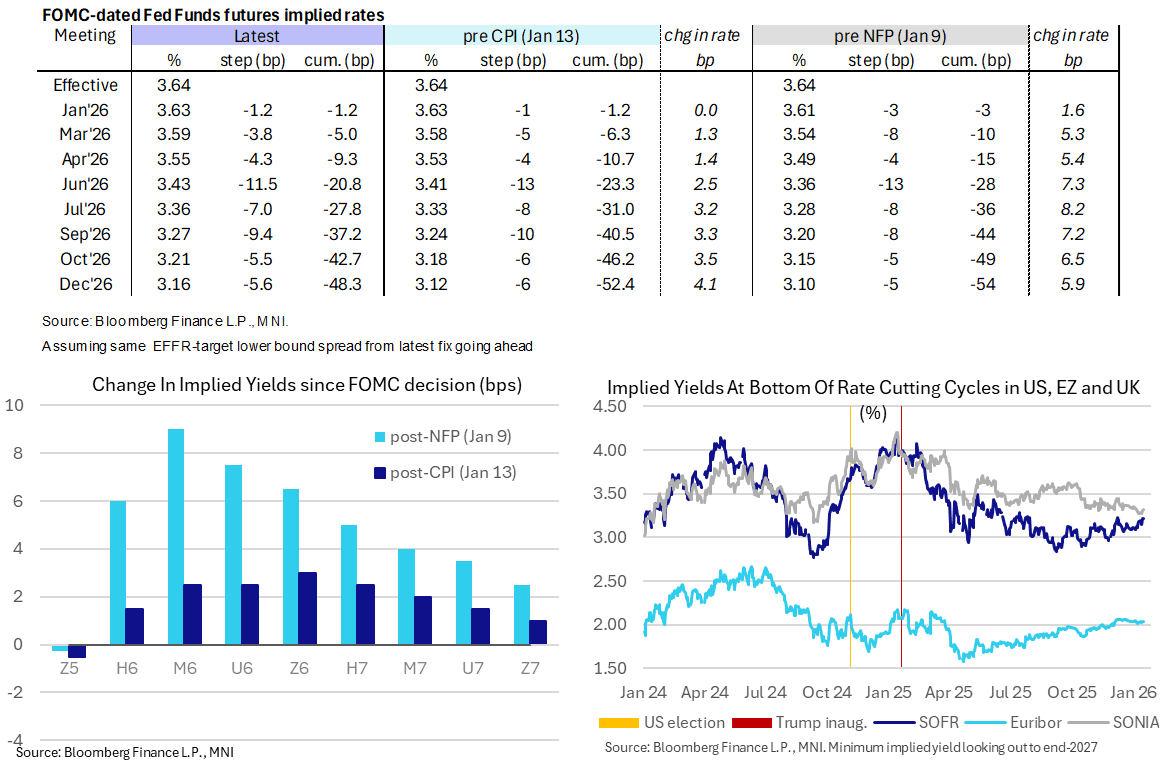
- US rates are little changed on the day as they hold yesterday’s hawkish shift sparked primarily by surprisingly low weekly jobless claims data, shifting further away from fully pricing a next cut in June.
- Cumulative cuts from 3.64% effective: 1bp Jan, 5bp Mar, 9.5bp Apr, 21bp Jun, 28bp Jul, 37bp Sep, 48.5bp Dec.
- SOFR futures are little changed overnight, with a terminal implied yield of 3.215% (currently H7) after yesterday’s 3.22% marked a fresh high since the day ahead of the Dec FOMC, and having last been higher in July.
Fedspeak Headlined By Rare Updates From Bowman And Jefferson
Today’s Fedspeak is clearly headlined by permanent voters Bowman and Jefferson, for their first monetary policy relevant updates in three and two months respectively. In our guess of where these core FOMC members sat in the Dec dot plot, we suspect Jefferson was one of four dots at 3.125% for 2026 (i.e. 50bp of cuts) for a notch below the median and assume that Bowman penciled in 2.375% (125bp of cuts) for 2026 with only Miran lower at 2.125%. The media blackout ahead of the Jan 27-28 FOMC meeting then starts on Saturday at 0001ET.
- 1050ET – Boston Fed’s Collins (next votes 2028) welcoming remarks
- 1100ET – VC Supervision Bowman (voter, dove) on the economic outlook and mon pol (text + Q&A). With her role focused on regulation, these are rare remarks on mon pol having last touched on the rate outlook three months ago. The former hawk turned clear dove, she at the time saw two more rate cuts before year-end in Oct and Dec meetings having in September called for the need to act decisively and proactively in order to protect jobs.
- 1530ET – VC Jefferson (voter) on the economic outlook and mon pol in a keynote address at an AIER conference on “Fed Policy Under Pressure” (text + Q&A). He sounded on the cautious side for prospects of further easing on Nov 17. He highlighted "increased downside risks to employment compared to the upside risks to inflation, which have likely declined somewhat recently" but also that there is a "need to proceed slowly as we approach the neutral rate."
US TSY FUTURES: Positions Built Across The Curve On Thursday
OI data points to net short setting dominating through UXY futures on Thursday, while net long setting was noted in WN futures as the curve twist flattened.
- The largest DV01 equivalent positioning move came in the US contract (~$1.9mln), but it is hard to provide any real colour here given the unchanged price status for the contract come settlement.
- Exposure ticked higher in all contracts on the day.
| 15-Jan-26 | 14-Jan-26 | Daily OI Change | OI DV01 Equivalent Change ($) |
TU | 4,508,355 | 4,465,481 | +42,874 | +1,624,848 |
FV | 6,758,287 | 6,735,041 | +23,246 | +1,006,943 |
TY | 5,649,317 | 5,637,175 | +12,142 | +804,320 |
UXY | 2,614,156 | 2,604,339 | +9,817 | +880,797 |
US | 1,825,657 | 1,811,737 | +13,920 | +1,937,615 |
WN | 2,117,603 | 2,115,165 | +2,438 | +443,560 |
|
| Total | +104,437 | +6,698,084 |
SOFR: Net Short Setting Most Prominent In Futures On Thursday
OI data points to net short setting dominating through the green pack on the SOFR futures curve as contracts settled lower in the wake of the latest round of weekly jobless claims, regional economy activity and import price data released on Thursday.
- The main exception came via apparent net long setting in SFRZ5. Meanwhile, there were some modest, isolated rounds of net long cover through the greens.
- Net long cover then moved to the fore in the blues.
- The most sizeable positioning move came via net short setting in SFRM6.
| 15-Jan-26 | 14-Jan-26 | Daily OI Change |
| Daily OI Change In Packs |
SFRZ5 | 1,403,904 | 1,401,425 | +2,479 | Whites | +56,736 |
SFRH6 | 1,418,391 | 1,425,017 | -6,626 | Reds | +31,932 |
SFRM6 | 1,241,238 | 1,187,885 | +53,353 | Greens | +8,101 |
SFRU6 | 1,274,642 | 1,267,112 | +7,530 | Blues | -13,006 |
SFRZ6 | 1,287,114 | 1,278,364 | +8,750 |
|
|
SFRH7 | 908,143 | 908,240 | -97 |
|
|
SFRM7 | 789,969 | 773,285 | +16,684 |
|
|
SFRU7 | 775,421 | 768,826 | +6,595 |
|
|
SFRZ7 | 847,405 | 844,996 | +2,409 |
|
|
SFRH8 | 478,193 | 471,122 | +7,071 |
|
|
SFRM8 | 412,955 | 415,350 | -2,395 |
|
|
SFRU8 | 381,419 | 380,403 | +1,016 |
|
|
SFRZ8 | 357,223 | 361,211 | -3,988 |
|
|
SFRH9 | 201,855 | 207,598 | -5,743 |
|
|
SFRM9 | 203,715 | 205,579 | -1,864 |
|
|
SFRU9 | 168,014 | 169,425 | -1,411 |
|
|
FOREX: USDJPY Moderates Again as Verbal Jawboning Continues
- Finance Minister Katayama was back on the wires overnight, adding to prior comments in the week relating to the weakening yen and the ability of the MOF to deal with rapid speculatory moves. Katayama expressed that the current agreement with the US means they are able to intervene to address rapid moves in the JPY. Bullish momentum for USDJPY has certainly had the wind taken out of its sails over the past three sessions, and overnight weakness for the pair extended on a break of the prior session lows at 158.23 and 158.10 to print a session low of 157.98.
- Additionally, Japan's main opposition CDP of Japan and Komeito agreeing to form a new political party has also acted as a moderate yen
tailwind, offering some potential resistance to the market concerns surrounding the Takaichi-led fiscal outlook. - The fact that domestic economic factors have been so influential on the latest Yen slide is likely to keep dips for cross/JPY very well supported, with initial USDJPY support moving up to 157.20, the 20-day EMA. Immediate targets for a resumption of USDJPY strength include 159.60 and 160.00, both Fibonacci projection points.
- Outside of the JPY, the USD is mixed against most others after hitting a new year-to-date high on Thursday. The data-tripped dollar rally sees the USD Index within 1% of the strongest levels since May of last year and reflects the hawkish repricing of the front-end of the USD curve and reminds us of the sensitivity of markets to any evidence showing a more stable labour market.
- The dollar will likely follow these cues with a bias to rally amid geopolitical uncertainty (specifically toward Iran and Greenland), further exposing the likes of EURUSD, GBPUSD and AUDUSD.
- Industrial and manufacturing production data from the US is the data highlight Friday, but neither release is likely to sway market conviction from the view that the Fed are unlikely to change policy rates at their Jan28 meeting. This should keep focus instead on the Fed speaker schedule: Fed's Collins, Bowman and Jefferson are all due, and the latter two appearances are set to address the economy and monetary policy directly. Bowman is now only a very outside chance to be nominated as Fed Chair by Trump (Polymarket prices 2% odds), but her view remains influential on the FOMC.
INR: Biggest One-Day Drop for INR Since Nov, RBI Intervention “Limited”
- USDINR has risen 0.6% following yesterday’s market closure, marking the biggest 1-day gain for the pair since November. That takes spot to its highest level since Dec 17, with Reuters noting that strong dollar demand at the fix weighed on the rupee. Central bank support was described as “limited” by Bloomberg.
- As we have noted previously, any comments citing progress in US-India trade talks have done little to move the needle given the lack of concrete, substantive outcomes from such talks – yesterday, India’s Commerce Minister said a deal is ‘very near’ but he still offered no exact timeline.
- At the same time, persistent outflows from local stocks remain key headwind for the rupee – foreign investors have sold close to $2bn of local equities in 2026 so far, adding to the $17bn of outflows seen in 2025.
- Preliminary PMIs for January highlight the local calendar next week on Friday. In December, the manufacturing PMI extended the sharp drop from October’s 59.2 to 55.0.
OPTIONS: Expiries for Jan16 NY cut 1000ET (Source DTCC)
- EUR/USD: $1.1575(E729mln), $1.1600(E1.8bln), $1.1660-75(E3.1bln), $1.1685-00(E3.5bln), $1.1725-30(E1.3bln), $1.1800(E2.1bln)
- GBP/USD: $1.3415-25(Gbp1.1bln)
- USD/JPY: Y155.00($2.1bln), Y158.00($2.1bln), Y158.75-85($1.6bln), Y159.00-15($2.1bln), Y159.50($2.0bln), Y160.00($4.6bln)
- AUD/USD: $0.6600(A$2.0bln), $0.6640(A$1.2bln), $0.6800(A$2.5bln)
- USD/CAD: C$1.3950($932mln), C$1.3970-75($888mln)
EQUITIES: Eurostoxx Futures Remain Close to This Week's Cycle Highs
- A bull cycle in Eurostoxx 50 futures is intact and the contract is holding on to its recent gains. Note that moving average studies are in a bull-mode position, highlighting a dominant uptrend. The 6000.00 handle has been breached, sights are on 6086.99 next, a Fibonacci projection. Initial firm support to watch is 5889.39, the 20-day EMA. A pullback would be considered corrective and allow an overbought condition to unwind.
- The trend structure in S&P E-Minis is unchanged, it remains bullish and the latest pullback appears to have been a correction. Recent gains confirm a resumption of the primary uptrend and maintain the bullish price sequence of higher highs and higher lows. Sights are on 7036.74, a Fibonacci projection point. On the downside, initial support to watch lies at the 20-day EMA (pierced) - currently at 6952.17. The 50-day EMA lies at 6898.30.
COMMODITIES: WTI Bull Cycle Intact Despite Latest Pullback
- A bull cycle in WTI futures remains intact for now and the rally earlier this week reinforces a bull theme. The move lower from Wednesday’s high appears corrective - for now. Price has traded through a key S/T resistance at $61.25, the Oct 25 high. This strengthens the bull phase and highlights a stronger reversal of the recent downtrend. Sights are on $62.59 next, a Fibonacci retracement. Initial firm support lies at $58.64, the 50-day EMA.
- The trend structure in Gold is unchanged, it remains bullish and this week’s fresh cycle highs reinforce current conditions. The move higher confirms a resumption of the primary uptrend and maintains the bullish price sequence of higher highs and higher lows. Sights are on the $4696.3 next, a Fibonacci projection. Initial firm support to watch lies at $4459.2, the 20-day EMA. A break of the average would signal the start of a corrective phase.
| Date | GMT/Local | Impact | Country | Event |
| 16/01/2026 | 1315/0815 | ** |  CA CA | CMHC Housing Starts |
| 16/01/2026 | 1330/0830 | * | CA | International Canadian Transaction in Securities |
| 16/01/2026 | 1415/0915 | *** |  US US | Industrial Production |
| 16/01/2026 | 1500/1000 | ** | US | NAHB Home Builder Index |
| 16/01/2026 | 1550/1050 | US | Boston Fed's Susan Collins | |
| 16/01/2026 | 1600/1100 | US | Fed Vice Chair Michelle Bowman | |
| 16/01/2026 | 1800/1300 | ** | US | Baker Hughes Rig Count Overview - Weekly |
| 16/01/2026 | 1800/1300 | ** | US | Baker Hughes Rig Count Overview - Weekly |
| 16/01/2026 | 1800/1300 | ** | US | Baker Hughes Rig Count Overview - Weekly |
| 16/01/2026 | 2030/1530 | US | Fed Vice Chair Philip Jefferson |


