MNI US MARKETS ANALYSIS - Big Beautiful Bill Voting in Focus
Highlights:
- Trump's Big Beautiful Bill still sees hurdles, but vote potentially today
- UK CPI surprises higher, but implications for BoE are complex from here onward
- Kremlin denies claims of dragging out Ukraine peace process
US TSYS: 30Y Yields Eye Highs Since 2023 With Trump Bill Vote Potentially Today
- Treasuries trade bear steeper with fiscal policy in focus amidst ongoing deliberations around President Trump’s “big, beautiful bill”.
- Today's 20Y auction again offers a test of US duration demand.
- Bloomberg wrote overnight that Trump is losing patience with the SALT caucus demands to significantly boost the deduction cap (BBG story here).
- However, since then, our political risk team notes that House Speaker Johnson had made progress with tentative agreements that could unlock support for a final vote as soon as today.
- Cash yields are 2.5-5.7bp higher on the day, with increases led by 30s. 5bp of the 5.7bp increase in 30Y yield is from real yields.
- 10Y and 30Y yields are back above their notable 4.50% and 5.00% levels, with 30s currently at 5.0269% with an eye on Monday’s 5.0353% that marked highs since Oct/Nov 2023 and before that 2007.
- 5s30s has lifted to 91.8bp but remains within the ytd high of 100bp on May 1.
- TYM5 trades at 109-26+ (-12) on solid volumes of 380k considering Bloomberg technical issues.
- The bear threat is still present, with last week’s low of 109-18+ (May 15 low) marking another step back towards a key support at 109-08 (Apr 11 low). Resistance is seen at 110-24+ (50-day EMA).
- Data: Weekly MBA applications (0700ET)
- Fedspeak: Barkin & Bowman in Fed Listens event (1215ET)
- Coupon issuance: US Tsy $16B 20Y Bond sale - 912810UL0 (1300ET)
- Bill issuance: US Tsy $60B 17W bill auction (1130ET)

STIR: Nearing Fewest Cuts Priced For Oct FOMC Since February
- Fed Funds implied rates are up to 1.5bp higher on the day for 2025 meetings, with 34bp of cuts priced for the October FOMC for close to recent hawkish extremes.
- The lift is helped by higher oil futures (WTI +1.4%) on a report that Israel is preparing to strike Iran and some spillover from stronger than expected UK CPI inflation.
- Cumulative cuts from 4.33% effective: 1.5bp Jun, 7bp Jul, 20bp Sep, 34bp Oct and 51bp Dec.
- The implied rate
- SOFR implied yields are 3bps higher in late 2026 contracts, with the terminal yield of 3.365% (SFRZ6) keeping within recent ranges.
- Today sees a thinner session for Fedspeak, with just Barkin (non-voter) and Bowman (voter) in a Fed Listens event. Bowman won’t offer any remarks.
- Barkin didn’t touch on monetary policy in a speech yesterday. He noted on May 9 that consumer spending and business investment is still very solid although it’s not a given that firms can raise prices on tariffs.
- Yesterday saw Daly, Hammack and Bostic say that a proposal for the FOMC to publish economic scenarios and reaction functions in a quarterly report may be confusing and difficult to accomplish practically. Even if the FOMC published scenarios, the public "may not be able to process it, they may not be able to understand," Hammack said, adding, "But I'm open to ideas about how to be more transparent in our process."


STIR: Mix Of SOFR Positioning Swings Seen Tuesday
OI data points to net long cover dominating in the SOFR whites on Tuesday, before a mix of net long setting and short cover came to the fore further out, with twist flattening seen on the strip.
| 20-May-25 | 19-May-25 | Daily OI Change |
| Daily OI Change In Packs |
SFRH5 | 1,037,181 | 1,039,794 | -2,613 | Whites | -34,286 |
SFRM5 | 1,219,874 | 1,231,506 | -11,632 | Reds | -8,940 |
SFRU5 | 1,084,216 | 1,079,922 | +4,294 | Greens | +9,986 |
SFRZ5 | 1,099,801 | 1,124,136 | -24,335 | Blues | +4,807 |
SFRH6 | 770,459 | 775,989 | -5,530 |
|
|
SFRM6 | 724,987 | 724,319 | +668 |
|
|
SFRU6 | 746,434 | 742,477 | +3,957 |
|
|
SFRZ6 | 887,243 | 895,278 | -8,035 |
|
|
SFRH7 | 720,423 | 712,340 | +8,083 |
|
|
SFRM7 | 597,455 | 598,906 | -1,451 |
|
|
SFRU7 | 382,175 | 380,540 | +1,635 |
|
|
SFRZ7 | 406,807 | 405,088 | +1,719 |
|
|
SFRH8 | 268,937 | 266,110 | +2,827 |
|
|
SFRM8 | 193,588 | 192,451 | +1,137 |
|
|
SFRU8 | 153,614 | 152,321 | +1,293 |
|
|
SFRZ8 | 165,756 | 166,206 | -450 |
|
|
STIR: SONIA/Euribor Dec '25 Spread Widens Further Above 200bp
As we have already noted, the SONIA/Euribor December ’25 spread has registered the first close above 200bp since January, with the widening extending further today.
- The next upside level of note is located at the January 14 close (213.5bp).
- While an element of sensitivity to U.S. policy/market moves has factored into the widening, the BoE’s hawkish vote split at its May decision, subsequent hawkish commentary from BoE chief economist Pill and this morning’s UK CPI have provided domestic impulses on the SONIA side.
- Meanwhile, ECBspeak has remained fairly non-committal when it comes to the potential need to cut rates below neutral (base of the rough neutral range located at 1.75%), although some of the traditional hawkish voices within the ECB GC have softened their opposition to the idea of such a move.
- We have also flagged downside risks to the ECB’s June inflation projections, largely stemming from energy price developments, which adds another dovish input into the mix.
- While these risks appear to tilt the risks towards further widening, pricing of further BoE cuts is looking quite shallow at this stage, while ongoing macro volatility and beta to moves in U.S. rates add further layers of complication.
Fig. 1: SONIA/Euribor December ’25 Spread

Source: MNI - Market News/Bloomberg
G7: Finance Ministers & Central Bank Governors' Meeting To Get Underway
The G7 Finance Ministers and Central Bank Governors' meeting gets underway in earnest today in Banff, Alb. in western Canada.
- Wednesday schedule: A welcoming ceremony and group photograph will take place at 0815 local time (1015ET, 1515BST, 1615CET), followed by an official opening at 0900 local (1100ET, 1600BST, 1700CET). Working sessions on global economy, economic resilience and security, and the situation in Ukraine, among others, get underway 30 mins later, continuing through to 1600 local.
- Thursday schedule: Ministers and governors hold working sessions on financial crime and artificial intelligence from 0830 local (1030ET, 1530BST, 1630CET) before Canadian Finance Minister Francois-Philippe Champagne and Bank of Canada Governor Tiff Macklem hold a closing press conference from 1230 local (1430ET, 1930BST, 2030CET).
- Leaders of the International Monetary Fund, World Bank and Organisation for Economic Co-operation and Development will also be in attendance at the meeting.
- Ministers from across the G7 are likely to hold sideline meetings with US Treasury Secretary Scott Bessent as they look to push for deals to avoid the re-imposition of reciprocal tariffs.
- On 20 May, Champagne kicked off the meeting with a press conference alongside his Ukrainian counterpart Sergii Marchenko. Champagne told reporters that G7 ministers stand "shoulder to shoulder" with Ukraine, adding, "It sends a strong message to the world that we are, all of us, are recommitting to support Ukraine. We're going to hold Russia to account and we're also going to talk about what we're going to be doing in terms of reconstruction."
RUSSIA: Kremlin Denies Claims Of 'Dragging Out' Ukraine Peace Process
Speaking to reporters, Kremlin spox Dmitry Peskov says that "a lot of work on a possible Ukraine peace deal is going on behind closed doors", and claims that "no one is interested in dragging out the process." This contrasts with comments from Kyiv and Ukraine's allies, claiming that President Vladimir Putin is "playing for time" in talks with the US.
- On 20 May, Italian PM Giorgia Meloni claimed that her gov't would be ready to help assist the Vatican in hosting peace talks after the new pontiff, Pope Leo XIV, said last week that the Holy See is "always ready" to bring together adversaries and "make every effort" for peace. Talks at the Vatican are seen as an unlikely outcome, with Peskov telling reporters, "so far, no decision has been made on the venue [for talks]."
- The lengthy call between Putin and US President Donald Trump on 19 May has seen the US again raise the prospect of walking away from the peace process, with Trump changing tack having previously said that only a meeting between he and the Russian president could solve the crisis. Trump now says that while he does not want to step away he has a "red line in his head", adding "Big egos involved, but I think something's going to happen. And if it doesn't, I'll just back away and they'll have to keep going."
- While the EU has imposed its 17th package of sanctions on Russia, the prospect of previously-threatened US banking or secondary sanctions on Russia appears to have dissipated.
EUROPE ISSUANCE UPDATE:
Germany auction results
- E4bln (E3.052bln allotted) of the 2.50% Feb-35 Bund. Avg yield 2.66% (bid-to-offer 1.85x; bid-to-cover 2.42x).
UK auction results
- GBP4.25bln of the 4.00% Oct-31 Gilt. Avg yield 4.401% (bid-to-cover 2.74x, tail 0.7bp).
FOREX: CPI Support for GBP Proves Short-Lived
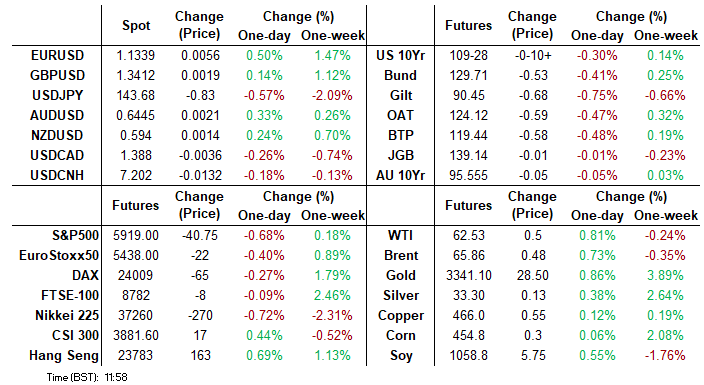
- UK CPI data came in ahead of expectations, with tax changes for transport and the timing of Easter driving price gains well ahead of both market and BoE expectations. GBP/USD rallied in response, with the pair hitting a new multi-year high at 1.3469 in response. These gains were short-lived, however, despite a further contraction of rate cut pricing across UK OIS markets.
- NOK is the strongest currency in G10, rallying against all others and pressing EUR/NOK to test 11.50 for a new multi-day low. Meanwhile the USD is backtracking, with the USD Index helping support EUR/USD north of 1.1300 having broken above the handle during Asia-Pac trade.
- No tier one data is set for Wednesday release, and the handful of Fed speakers due are unlikely to rock the boat given the sensitivities around the passage of the US' Big Beautiful Bill, which continues to see several hurdles around SALT allowances.
GBP Narrative Unchanged Despite CPI Beat
We noted yesterday that GBP/USD has struggled to maintain gains above the 1.34 handle on several occasions already this year, as well as in 2024, 2019 and 2020. Spot gains today saw a brief print at 1.3469, but markets have already reversed ~60 pips off the high to contain the overall bullish breakout. The keeps focus on the bearish tweezer candle formation printed on April 28/29, which could mark a near-term top. 1.3342 undercuts as first support, ahead of the more meaningful 50-day EMA at 1.3137. A move through here would challenge the near-term bullish trend narrative.
- Today's inflation print is yet to challenge that dynamic, with spot now back below pre-inflation levels and signalling that today’s CPI print may not be a near-term game changer for the current bull trend.
- HSBC write that until services CPI and wage growth fall consistently back towards target levels, the BoE is likely to remain in cautious easing mode, supporting GBP against both EUR and USD.
- ING see reasons for the BoE to look through the print, however see a cautious BoE keeping the EUR/GBP rate differential wide and think a break below 0.8400 remains a tangible possibility.
- Deutsche Bank see the MPC as finding solace in “almost everything else” outside of easter impacts and tax changes to the transport basket. As such, they do not see this as the end of the quarterly cutting cycle, leaving August as a likely rate cut, in their view.
FOREX: USD Slips as Markets Recorrelate with Long-End Weakness
A phase of dollar sales is helping pressure USD/JPY toward the overnight lows, with the dollar again pressured by weakness in the US long-end. The US curve is again steepening, with 30y yields higher by near 6bps on the day and equities weakening as the 'Sell the US' theme resumes.
- As has been the case in recent weeks, EUR is main beneficiary here - keeping $1.14 as the S/T upside target. EUR/GBP has printed a new high at 0.8459, shrugging off the entirety of the UK CPI tripped weakness to keep focus on 0.8470 the 50-dma.
- After a sluggish start hindered by Bloomberg Terminal connectivity problems, volumes in currency futures are picking up here, with near 7,000 contracts traded in JPY futures on the move. That's near $600mln cash equivalent on the latest USD/JPY sales.
OPTIONS: Sizeable EUR Strikes Could Contain Range into NY Cut
FX options set to expire at tomorrow's cut include sizeable strikes in EUR/USD that could encourage range-play, while lumpier notional rolls off in GBP/USD on Thursday, after tomorrow's consequential CPI print. Full list here:
Expiries for May21 NY cut 1000ET (Source DTCC)
- EUR/USD: $1.1140-50(E1.3bln), $1.1200(E809mln), $1.1250(E1.1bln), $1.1270(E500mln), $1.1390-05(E2.1bln)
- USD/JPY: Y142.00($878mln), Y144.50($610mln)
OPTIONS: Larger FX Option Pipeline
- EUR/USD: May22 $1.1175(E1.9bln); May23 $1.1145-50(E1.1bln), $1.1180-85(E1.1bln), $1.1300(E1.0bln), $1.1330-50(E1.3bln), $1.1400(E1.1bln)
- USD/JPY: May23 Y144.00($1.5bln), Y145.00($2.0bln); May26 Y150.00($1.8bln)
- GBP/USD: May22 $1.3260-70(Gbp1.5bln)
- USD/CAD: May22 C$1.4050($1.3bln); May23 C$1.4000-15($1.2bln); May26 C$1.4000-15($1.2bln)
EQUITIES: Bullish Trend Condition in E-Mini S&P Remains Intact
- A bullish theme in Eurostoxx 50 futures remains intact and price is trading at its recent highs. The contract is extending the recent breach of 5263.01, 76.4% of the Mar 3 - Apr 7 bear leg, and maintains the sequence of higher highs and higher lows. Sights are on 5516.00, the Mar 3 high and the key bull trigger. Key support to watch lies at 5201.23, the 50-day EMA. Clearance of this level would signal a possible reversal.
- A bullish trend condition in S&P E-Minis remains intact and the contract is trading closer to its recent highs. An important resistance at 5837.25, the Mar 25 high and a bull trigger, has been cleared. This has strengthened the current bullish theme, and paves the way for a continuation near-term. Sights are on the 6000.00 handle next. Initial firm support to watch lies at 5703.54, the 50-day EMA.
COMMODITIES: WTI Futures Trade to Fresh Short-Term Cycle High
- WTI futures have traded to a fresh short-term cycle high today and maintain a bullish theme. However, the recovery since Apr 9, still appears corrective. Key resistance to watch is $62.87, the 50-day EMA. It has been pierced, a clear break of it would highlight a stronger reversal. This would open $65.82, the Apr 4 high. For bears a reversal lower would refocus attention on $54.33, the Apr 9 low and bear trigger.
- Gold has recovered from its recent lows and is trading higher today. The climb signals the end of the corrective phase between Apr 22 - May 15. Medium-term trend signals remain bullish - moving average studies are in a bull-mode position highlighting a dominant uptrend. A continuation would open $3435 next, the May 7 high. Key support and the bear trigger has been defined at $3121.0, the May 15 low.
| Date | GMT/Local | Impact | Country | Event |
| 21/05/2025 | 1100/0700 | ** |  US US | MBA Weekly Applications Index |
| 21/05/2025 | 1430/1030 | ** | US | DOE Weekly Crude Oil Stocks |
| 21/05/2025 | 1600/1800 |  EU EU | ECB's Lane at Monpol Panel Discussion | |
| 21/05/2025 | 1615/1215 | US | Richmond Fed's Tom Barkin, Fed Gov. Michelle Bowman | |
| 21/05/2025 | 1620/1220 | US | Fed Governor Michelle Bowman | |
| 21/05/2025 | 1700/1300 | ** | US | US Treasury Auction Result for 20 Year Bond |
| 22/05/2025 | 2300/0900 | *** |  AU AU | Judo Bank Flash Australia PMI |
| 22/05/2025 | 2350/0850 | * |  JP JP | Machinery orders |
| 22/05/2025 | 0030/0930 | ** | JP | Jibun Bank Flash Japan PMI |
| 22/05/2025 | 0600/0700 | *** |  GB GB | Public Sector Finances |
| 22/05/2025 | 0645/0845 | ** |  FR FR | Manufacturing Sentiment |
| 22/05/2025 | 0715/0915 | ** | FR | S&P Global Services PMI (p) |
| 22/05/2025 | 0715/0915 | ** | FR | S&P Global Manufacturing PMI (p) |
| 22/05/2025 | 0730/0930 | ** |  DE DE | S&P Global Services PMI (p) |
| 22/05/2025 | 0730/0930 | ** | DE | S&P Global Manufacturing PMI (p) |
| 22/05/2025 | 0800/1000 | *** | DE | IFO Business Climate Index |
| 22/05/2025 | 0800/1000 | ** | EU | S&P Global Services PMI (p) |
| 22/05/2025 | 0800/1000 | ** | EU | S&P Global Manufacturing PMI (p) |
| 22/05/2025 | 0800/1000 | ** | EU | S&P Global Composite PMI (p) |
| 22/05/2025 | 0830/0930 | *** | GB | S&P Global Manufacturing PMI flash |
| 22/05/2025 | 0830/0930 | *** | GB | S&P Global Services PMI flash |
| 22/05/2025 | 0830/0930 | *** | GB | S&P Global Composite PMI flash |
| 22/05/2025 | 1000/1100 | ** | GB | CBI Industrial Trends |
| 22/05/2025 | 1050/1150 | GB | BOE's Breeden On Climate Panel | |
| 22/05/2025 | 1100/1200 | GB | BOE's Dhingra On UK Productivity Panel | |
| 22/05/2025 | 1130/1330 | EU | ECB April Minutes Released | |
| 22/05/2025 | 1200/0800 | US | Richmond Fed's Tom Barkin | |
| 22/05/2025 | 1230/0830 | *** | US | Jobless Claims |
| 22/05/2025 | 1230/0830 | ** | US | WASDE Weekly Import/Export |
| 22/05/2025 | 1230/0830 | * |  CA CA | Industrial Product and Raw Material Price Index |
| 22/05/2025 | 1230/1330 | GB | BOE's Pill At MonPol Conference (Text 16:30BST) | |
| 22/05/2025 | 1300/1500 | ** |  BE BE | BNB Business Confidence |
| 22/05/2025 | 1345/0945 | *** | US | S&P Global Manufacturing Index (Flash) |
| 22/05/2025 | 1345/0945 | *** | US | S&P Global Services Index (flash) |
| 22/05/2025 | 1400/1000 | *** | US | NAR existing home sales |
| 22/05/2025 | 1400/1000 | * | US | Services Revenues |
| 22/05/2025 | 1430/1030 | ** | US | Natural Gas Stocks |
| 22/05/2025 | 1500/1100 | ** | US | Kansas City Fed Manufacturing Index |
| 22/05/2025 | 1500/1700 | EU | ECB's Elderson Dinner Speech at Biodiversity Day | |
| 22/05/2025 | 1530/1130 | ** | US | US Bill 04 Week Treasury Auction Result |
| 22/05/2025 | 1530/1130 | * | US | US Bill 08 Week Treasury Auction Result |
| 22/05/2025 | 1535/1735 | EU | ECB's de Guindos Speech in Madrid | |
| 22/05/2025 | 1700/1300 | ** | US | US Treasury Auction Result for TIPS 10 Year Note |
| 22/05/2025 | 1800/1400 | US | New York Fed's John Williams | |
| 22/05/2025 | 1900/1500 | US | New York Fed's Roberto Perli |


