MACRO ANALYSIS: MNI US Macro Weekly: Navigating Murky Waters
We've just published our latest US Macro Weekly - Hidden PDF
- The federal government shutdown that began October 1 is all but certain to extend through the middle of the month, with prediction markets eyeing just a one-in-three chance it’ll be concluded by Oct 22.
- The actual economic fallout is not expected to be extensive (yet), but it’s left the data schedule somewhat lacking. What readings we have received don’t really change the underlying narrative.
- We will have to wait indefinitely to get the September Employment report but jobless claims (cobbled together from state-level readings) continue to portray a low-hiring, low-firing labor market, and various higher-frequency measures of economic activity suggest that growth maintained an above-potential pace at least through early October even as consumer confidence remains limp.
- We, as well as the Fed and market participants, are increasingly eyeing "Alternative" data sources that are mainly private-sector indicators that offer insight into trends in key areas of the economy, including the Labor Market, Retail Sales/Consumer, Inflation, Housing, and Economic Activity. Our calendar - linked to below - includes some of these indicators and the document includes expected release dates and links.
- With data proving limited in its market-moving ability, the standout move in the week was a strong rally in US rates Friday on President Trump threatening more extensive tariffs on China. A 25bp Fed rate cut at the end of the month remained assured, particularly with only limited data to dissuade.
- The biggest headline out of the September FOMC minutes release is that "most" participants "judged that it likely would be appropriate to ease policy further over the remainder of this year". But that’s not a surprise given the Dot Plot, and the minutes also arguably had a bit of a cautious tone, as it portrayed a Committee that is wary but not overly concerned about the state of the labor market.
- The list of potential Fed chairs was whittled down to 5 per reports, with NEC director Hassett considered a narrow favorite over Blackrock Fixed Income CIO Rick Rieder and ex-Fed Gov Warsh, with current Fed Board members Waller and Bowman slightly behind per prediction markets.
Want to read more?
Find more articles and bullets on these widgets:
Historical bullets
US FISCAL: Tariffs Partially Offsetting Deficit Expansion So Far
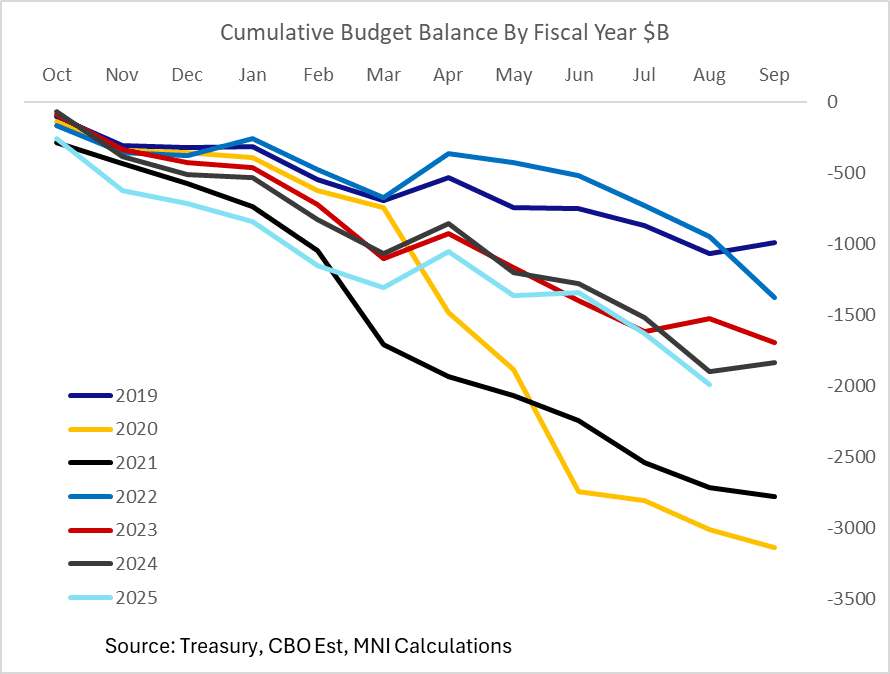
With one month remaining in the fiscal year (Oct-Sep), the Congressional Budget Office is estimating a cumulative deficit of $1.989T through August, including a $360B deficit for August itself. That's about $92B above last year's cumulative total to this point. While the Treasury's official August tally will only be released Thursday at 2pm ET, the CBO's estimate is usually very close to the mark.
- When accounting for timing shifts in outlays, however, the deficit is only about $11B bigger than it was at this point.
- Year-to-date, accounting for timing shifts, outlays are up 5% for a total $310B Y/Y in the 11 months through August, of which $223B is mandatory spending and $72B is net interest on the public debt. The estimate is flattered to the downside by a $110B fall in Department of Education outlays, about half of which is related to adjustments to student loans. And FDIC outlays fell $63B, vs 2024 which was hit by bank failures in the wake of the Silicon Valley Bank debacle.
- And in terms of timing-adjusted receipts, they're up $299B Y/Y in the fiscal year-to-date, or 7%. While corporate taxes are a little lower (largely due to timing shifts), individual income taxes are up 8% ($181B) - and "other receipts" soared 45% ($102B).
- It should be no surprise that within that category, customs duties made up $95B (+137% Y/Y) of that total, marking a $165B total for the fiscal year so far, in the wake of the Trump administration's tariff increases.
- The deficit is still tracking above most analyst expectations we've seen of $1.8-1.9T (was $1.83B in FY2024), though September tends to be a mixed month in terms of net outlays and there is of course the new monthly boost of tariffs (not including any negative dynamic effects on growth from said tariffs). We will get more details after the official Treasury statement expected Thursday.
USDCAD TECHS: Bullish Theme
- RES 4: 1.4111 High Apr 10
- RES 3: 1.4019 38.2% retracement of the Feb 3 - Jun 16 bear leg
- RES 2: 1.3925 High Aug 22 and the bull trigger
- RES 1: 1.3868 High Aug 26
- PRICE: 1.3850 @ 16:38 BST Sep 10
- SUP 1: 1.3782/27 50-day EMA / Low Aug 27 and a bear trigger
- SUP 2: 1.3709 61.8% retracement of the Jul 23 - Aug 22 bull cycle
- SUP 3: 1.3658 76.4% retracement of the Jul 23 - Aug 22 bull cycle
- SUP 4: 1.3637 Low Jul 25
A bull cycle in USDCAD remains intact. The recovery from the Aug 29 low highlights a potential early reversal signal and if correct, marks the end of the corrective pullback between Aug 22 - 29. An extension higher would open the bull trigger at 1.3925, the Aug 22 high. Support lies at 1.3727, the Aug 29 low. Clearance of this level would instead reinstate a short-term bear theme and expose 1.3709 initially, a Fibonacci retracement.
US OUTLOOK/OPINION: Wells Fargo: Sticky Services To Continue
Wells Fargo is on the low end of sell-side expectations for unrounded core CPI, seeing a 0.29% M/M increase in August, but still expect “sticky services inflation alongside the rebound in goods prices” continuing.
- Core goods are set to rise 0.25% M/M: “New vehicle inflation, which has been tame, is poised to strengthen as a rebound in auto sales has helped to reduce inventory and the use of incentives has slowed. Price growth for other import-heavy items, such as apparel, recreational goods and communication hardware, should remain solid as well with another 0.3% increase.”
- Meanwhile core services prices to rise 0.30% M/M: “Travel-related service prices started to rebound in July, and we estimate another solid gain in August (+1.0%), led by lodging away from home. While spending on discretionary services remains generally weak, consumers' appetite for travel shows signs of rebounding with hotel occupancy and TSA screenings up again on a year-ago basis, suggestive of some stabilization in consumer demand.”
- However, medical care services could moderate after July’s jump and primary shelter inflation “should run a touch under its 0.31% year-to-date average through the remainder of 2025”.


