MNI US Macro Weekly: More Noise Than Signal From Key Data

Dec-19 20:48By: Tim Cooper and 1 more...
US+ 1
Download Full Report Here
EXECUTIVE SUMMARY
- A highly unusual payrolls report saw multiple caveats that drove a swift fade of an initially dovish reaction.
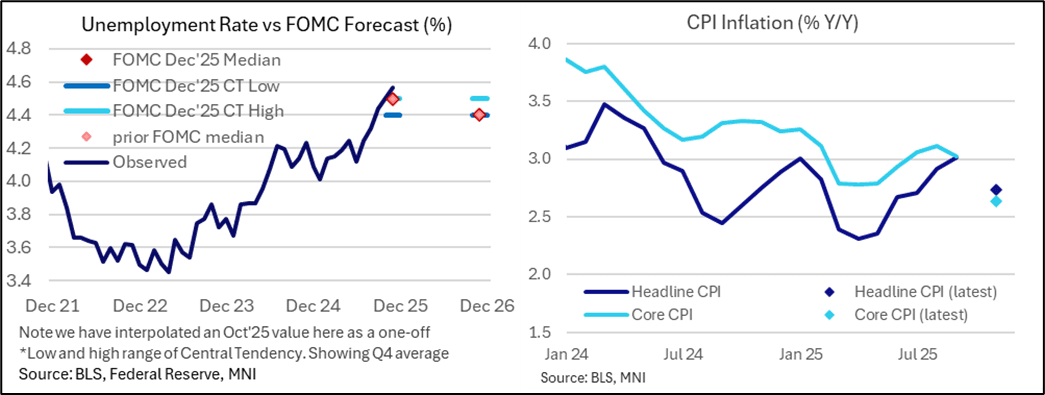
- The highlight was the surprise push higher in the unemployment rate to 4.56% in November from 4.44% in September, with NY Fed’s Williams since estimating it was boosted 0.1pp by distortions.
- Subsequent labor indicators saw initial jobless claims remain at a very healthy level in a payrolls reference week whilst QCEW data suggest downward NFP revisions look on track for Powell's 60k/month estimate.
- Later in the week, the November CPI report was even messier than had been feared coming into its delayed release, leaving several lingering questions in its wake. On the surface, inflationary pressures appeared much softer than expected, but various factors appear to have downwardly biased the readings – and distortions look poised to reverberate for months to come.
- The FOMC will thus interpret these latest inflation readings with extreme caution, using the December CPI report due out before the January meeting to make more sense of underlying price dynamics.
- Elsewhere, core retail sales started Q4 with strong momentum but with more recent indicators somewhat mixed since then. Real GDP growth tracking for Q3 has been trimmed a little further but remains robust with GDPNow at 3.5% ahead of Tuesday’s long-awaited update.
- Business surveys meanwhile came in softer, including flash PMIs and regional Fed manufacturing for Dec.
- NEC’s Hassett remains a firm favorite for the next Fed Chair role despite reports of pushback from Trump officials in CNBC and Politico reporting. Trump expects to announce his pick in the next couple weeks.
- Speaking after CPI, NY Fed’s Williams signalled little urgency for a January cut after messy data (noting CPI looked understated) though Chicago Fed’s Goolsbee (next voting 2027) saw a “lot to like” in the November CPI report.
- Speaking after payrolls but before CPI, Gov. Waller sees the Fed being 50-100bp above neutral, noting that faster GDP growth isn’t inflationary amid supply side improvements.
- Next week sees a holiday-shortened calendar, highlighted by delayed Q3 GDP data along with durable goods orders/industrial production and various labor updates.
- A next Fed cut remains fully priced for the June FOMC under a new Fed Chair but has drifted closer to being fully priced for April (22bp currently). There is just 5bp of cuts priced for January and we suspect it will be difficult to materially shift from here until the December NFP and CPI reports on Jan 9 and 13.