MNI INTERVIEW: Tariff Price Boost Still Percolating - Schoenle

The effects of U.S. tariffs are still percolating through the costs facing business and consumers, but so far the inflation pickup has been manageable though without it price pressures would have receded closer to the Federal Reserve’s 2% goal, a former Fed researcher told MNI.
“This is definitely still going on because there was significant inventory building” ahead of the first tariff announcements in April, said Raphael Schoenle, former deputy director of the Cleveland Fed’s Center For Inflation Research.
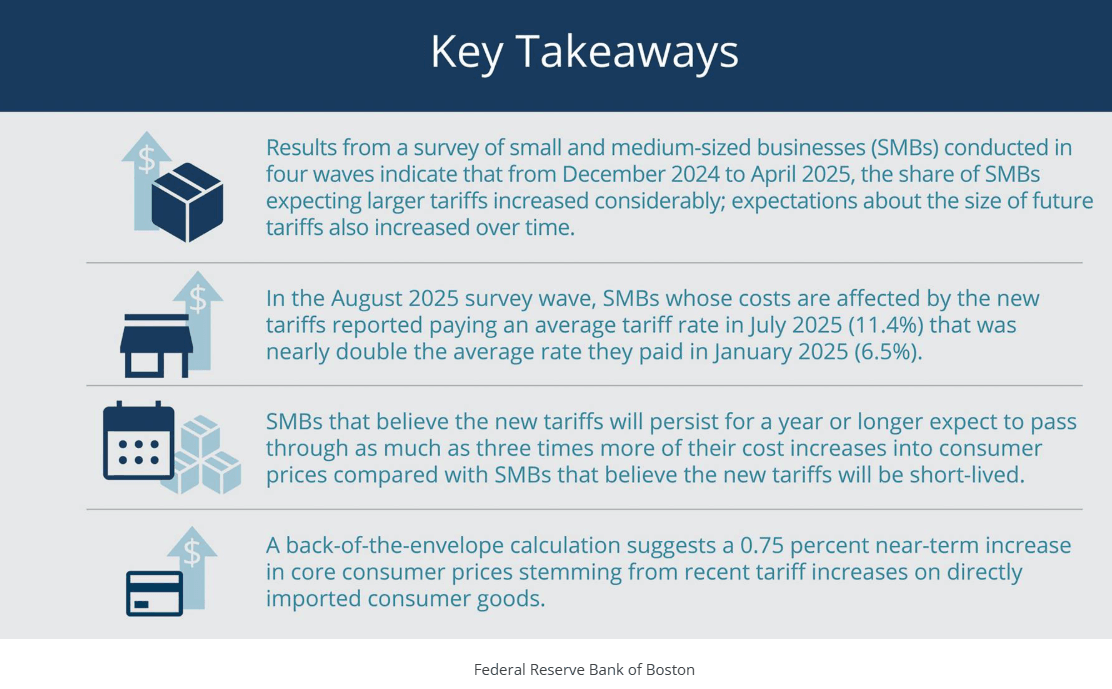
Yet while underlying inflation remains close to 3%, around a percentage point above the Fed’s target, that would be a different story if it weren’t for the hit from tariffs, he said. In a recent Boston Fed paper he co-authored, Schoenle calculates a cumulative 75 basis point increase in core inflation from tariffs.
“The Fed has done a remarkable job in getting inflation back down, it’s just not at 2%,” he said. “If you think of scenarios of how this could have gone, it has been a good landing. It’s hard to fine-tune and there is some persistence of these things.”
Whether the Fed can afford to look through inflation will depend on whether additional shocks to the economy – like potentially a fiscally-induced growth boom – make the tariff boost to prices more embedded. There are also other effects from tariffs which are a drag on growth and thus potentially disinflationary. (See MNI POLICY: Lingering Inflation Unease Tempers Fed Easing Push)
“You really need something big to happen to push you over some edge,” he said. “You asked about AI, we have a concurrent investment boom, that adds to income in the economy. We have a fiscal stimulus. So these are sort of stabilizing forces.”
JOB RISKS
Schoenle said Fed officials are right to also be focused on potential risks to the labor market at a time where conditions have become increasingly difficult to read. That’s true not just because the government shutdown has led to a dearth of official data but also because immigration curbs make it harder to decipher the extent to which lower payroll growth reflects a weaker market.
“The risks have clearly increased,” said Schoenle, a professor at Brandeis University. A slow-hiring, slow-firing environment means things could quickly shift in either direction, he added. “It’s not a bad labor market if you look back historically. It’s something to watch.”
PAPER FINDINGS
In the Boston Fed paper, Schoenle and his co-authors surveyed small- and medium-sized businesses over different time periods and compared their expectations about tariff levels and their ability to pass through cost increases.
They found that the longer a firm expects tariffs to last, the more likely they are to try to pass through to consumers.
“While many firms have reported taking the brunt of the financial hit from tariffs so far, the patterns we find in the survey responses suggest that as firms come to believe that the new tariffs are likely to endure, they will implement more price hikes, resulting in a greater impact on consumer prices,” the report said.