MNI EUROPEAN MARKETS ANALYSIS: Safe Haven FX Outperforms
- Equity jitters continued, led by the tech side, with US Nasdaq futures down close to 1%. This comes ahead of US data later, including payrolls. Regional equity sentiment has mostly been under pressure, again with tech sensitive plays underperforming.
- NZGBs closed stronger but well off the session’s best levels, seen around the release of revisions to the government bond program. US Tsy yields drifted down, in line with risk off tone.
- The USD was higher against higher beta plays, but JPY and CNH outperformed.
- Looking ahead, we have UK labour market data, as well Dec preliminary PMIs. PMIs are also out in the EU and US. The focus in the US will also be on Nov payrolls, while Oct retail sales are also due.
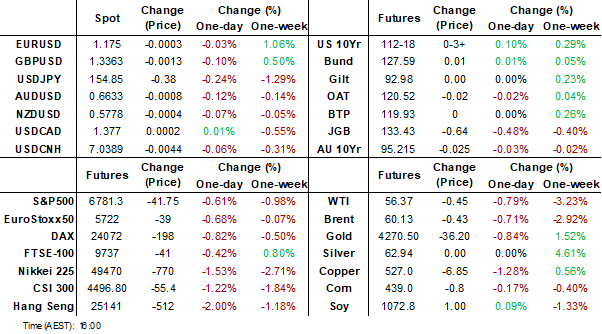
MARKETS
US TSYS: Yields Grind Lower as Equities Fall, Attention Turns to Data
Bond futures opened up this morning in Asia but with limited follow on. The US 10-Yr opened at 112-10+ and got to 112-12+ where it has stayed all day as it nears the topside resistance being the 100-day EMA of 112-14+.
Cash was stronger with yields -0.2 - 1.00bps lower across the curve with intermediate maturities the best performers.
- The 2-Yr is down -0.6bps at 3.497%
- The 5-Yr is down -0.9bps at 3.717%
- The 10-Yr is down -0.6bps at 4.17%
- The 30-Yr is down -0.2bps at 4.846%
US Non Farm Payrolls are the next focus for markets. Here is the MNI US Payrolls Preview: Double NFPs And A Single Unemployment Update
https://media.marketnews.com/USNFP_Nov2025_Preview_postshutdown_392dffc2d3.pdf
Tonight there is a US$75bn 6-week auction as the primary focus.
JGBS: Subdued Session, BOJ Hike On Friday Is Fully Priced
JGB futures are little changed compared to settlement levels.
- The BOJ is widely expected to raise its policy interest rate by 25 basis points to 0.75% at the upcoming December 18-19 Monetary Policy Meeting.
- Some analysts, however, caution that a December hike is not guaranteed. A 26 November Reuters article described a December move as merely “possible.” Goldman Sachs has emphasised that with only a limited number of companies having announced wage plans so far, there is a risk that insufficient information will be available by the December meeting. In that scenario, the BOJ may delay a hike until wage announcements by large firms later in December and the January Branch Managers’ meeting.
- Cash US tsys are slightly richer, with a steepening bias, in today's Asia-Pac session ahead of today's heavy US data schedule that includes headline NFP for November, weekly ADP, Retail Sales and S&P Global flash PMIs.
- Cash JGBs are little changed across benchmarks out to the 20-year, and ~2bps richer (30-year) beyond. The benchmark 10-year yield is 0.3bp lower at 1.956% versus the cycle high of 1.976%.
- Swap rates are little changed.
- Tomorrow, the local calendar will see Trade Balance and Core Machine Orders data alongside 1-year supply.
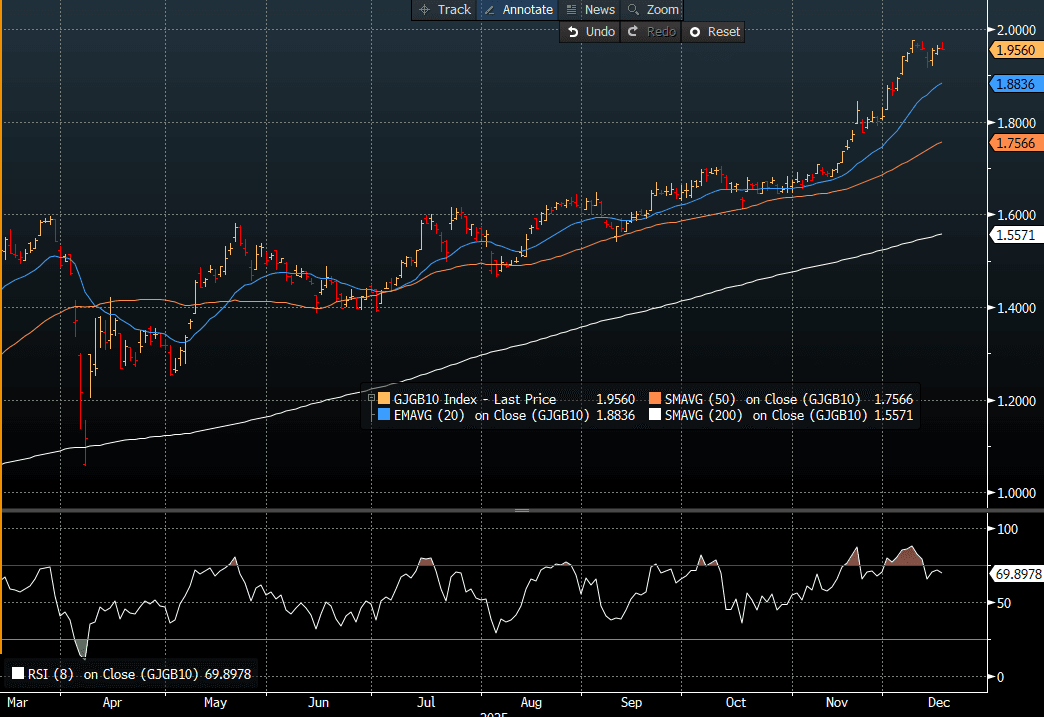
Source: Bloomberg Finance LP
JAPAN DATA: PMIs Mixed, But Manufacturing Rises, Back Close To 50.0
Japan S&P global preliminary PMIs for December were mixed. Most focus will likely rest with the manufacturing outcome, which rose to 49.7 from 48.7 prior. The services PMI eased to 52.5, from 53.2, while the composite reading was 51.5 (52.0 prior). On the manufacturing side, while still in contraction territory it is back near highs from the middle of this year. This fits with broader sentiment measures, like the Tankan survey, which have held up reasonably well. Fears of a significant negative impact (global slowdown etc) from higher US tariff levels haven't materialized. The higher PMI reading should support IP output all else equal, although IP growth has been outperforming softer PMI trends in recent months.
- In terms of the detail, the manufacturing new orders index rose to its highest level since June 2024 (per BBG).
AUSSIE BONDS: Modestly Weaker, Con Conf Up, Oct-36 Supply Tomorrow
ACGBs (YM -3.0 & XM -1.0 ) are modestly weaker and hovering near the session’s worst levels.
- The Westpac Consumer Sentiment Index fell back sharply in Dec, off 9% to 94.5. Recall that we saw a surge in the Nov print to 103.8, which was the highest sentiment reading since early 2022. This latest move corrects somewhat for that, but we remain above 2025 lows for sentiment, which were around 90.0.
- Cash US tsys are slightly richer, with a steepening bias, in today’s Asia-Pac session ahead of today’s heavy US data schedule that includes headline NFP for November, weekly ADP, Retail Sales and S&P Global flash PMIs.
- Cash ACGBs are 1-3bps higher with the AU-US 10-year yield differential at +56bps, ~6bps lower than its recent high.
- The bills strip has bear-flattened, with pricing -3 to -7.
- RBA-dated OIS pricing shows tightening across all meetings, with the probability of a 25bp hike rising from 41% for February to 98% by June and 153% by December 2026.
- Tomorrow, the local calendar will see Westpac Leading Index data.
- The AOFM plans to sell A$1000mn of the 4.25% 21 October 2036 bond on Wednesday. The new Oct-36 bond was issued at a yield to maturity of 4.36% versus its current level of 4.78%.
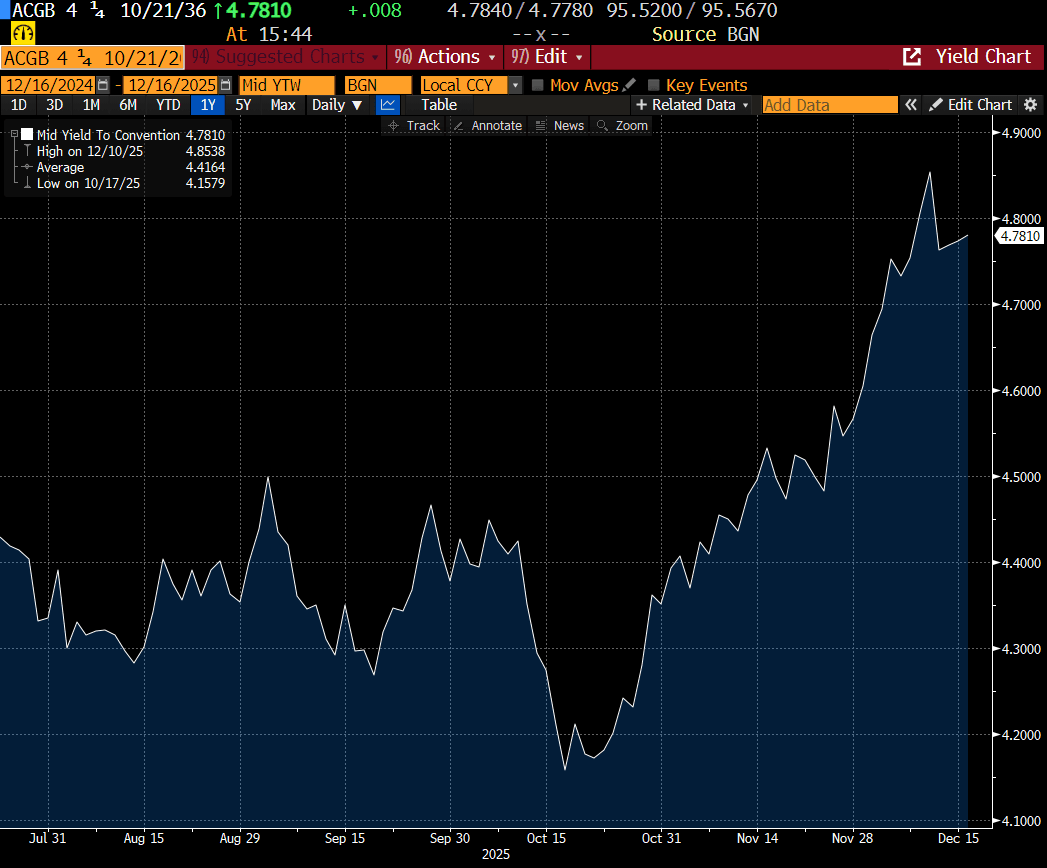
Bloomberg Finance LP
AUSTRALIA DATA: Services PMI Eases, Pointing To Slower Domestic Demand Growth
Australian preliminary S&P global PMI readings for Dec were mixed. Manufacturing improved to 52.2, from 51.6 in Nov. However, services eased to 51.0 from 52.8. This saw the composite index fall to 51.1, from 52.6 prior. The services PMI is now comfortably off 2025 highs (near 56, recorded in Aug). The chart below overlays the services PMI print versus Australian domestic demand growth q/q (which is the white line on the chart, services PMI is the orange line). The softer services PMI is suggesting slower domestic growth, but from a high base and still in positive territory.
- In terms of the detail, the services employment sub index still rose to 51.9 from 50.8 in Nov, while prices charged also edged up. On the manufacturing side, output eased to 51.2 from 51.4. New orders were up though versus the prior month (per BBG).
Fig 1: Australian S&P Global Services PMI & Domestic Demand Q/Q
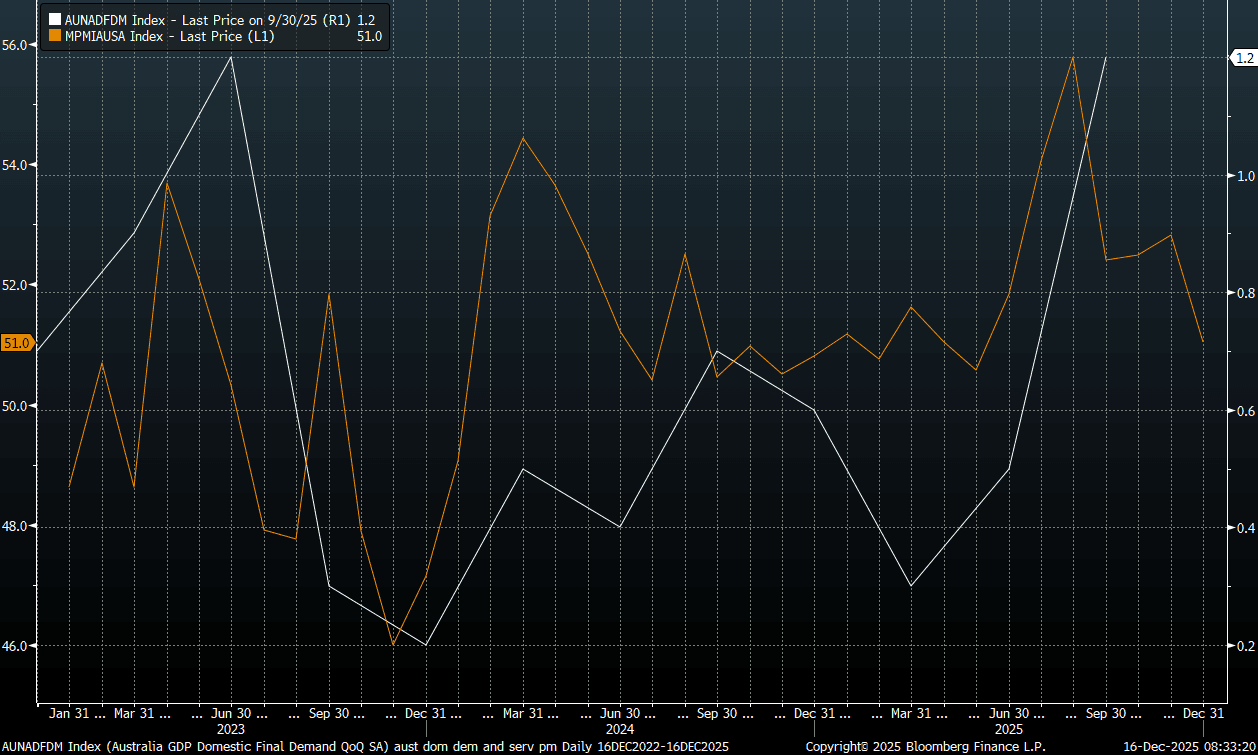
Sources: Bloomberg Finance L.P./MNI
NEW ZEALAND: Food Prices Fall Again In Nov, Gains In most Other Segments Though
New Zealand food prices fell a further 0.4%m/m in Nov, the third consecutive monthly fall. We sit at 4.4%y/y for Nov, slightly down from the 4.7%y/y pace seen in Oct. We are gradually moving off recent cycle highs for food inflation (around 5% recorded mid 2025). Fruit and vegetables fell by 4.5%, as the main source of weakness for this segment.
- In terms of the other segments, we saw positive m/m gains for Nov. Rents edged up 0.1%m/m, while gas and petrol were again up strongly, 2.2%m/m and 1.8%m/m respectively (electricity was +0.1%, but down from the 0.5% gain seen in Oct). Air travel, both domestic (+6.5%m/m) and international (+0.4%m/m), rebounded from falls in Oct. Accommodation services rose 1.3%m/m, down from the 4.8% rise in Oct.
- In y/y terms, besides food, rent y/y inflation moderated to 1.4% from 1.6% in Oct. Most other categories saw firmer y/y trends though, except from domestic air travel, which remained negative.
- New RBNZ Governor Breman stated yesterday, "We remain confident that annual headline consumers price index inflation will decline towards the 2 per cent target mid-point by the middle of next year.”
BONDS: NZGBS: Richer But Off Session Bests Sparked By Bond Program Revisions
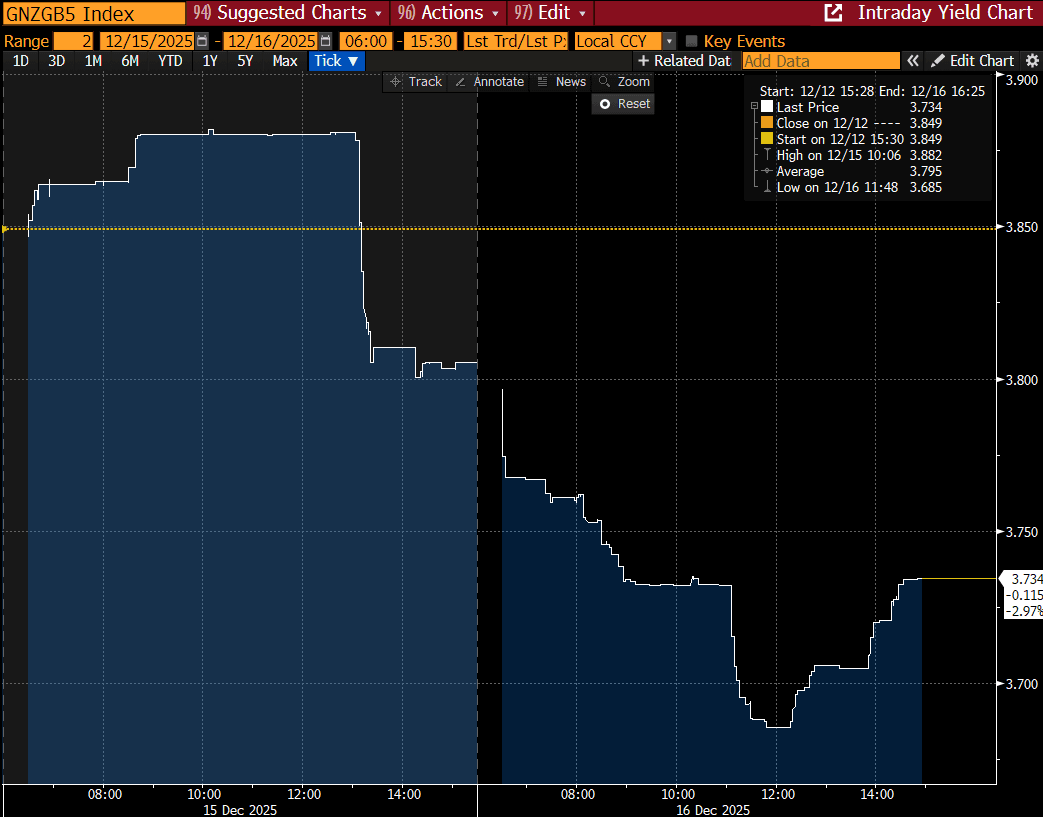
NZGBs closed stronger but well off the session’s best levels, seen around the release of revisions to the government bond program.
- NZ Treasury's half-year fiscal and economic update projects the operating balance will return to surplus in the year ending June 2030, a year later than the May Budget, which expected a surplus in 2029.
- The update projects a 2025-26 deficit of NZ$13.9bn (up from NZ$12.1bn in May), with deficits gradually declining to NZ$945mn in 2028-29 before reaching a NZ$2.3bn surplus in 2029-30. Net core Crown debt is expected to peak at 46.9% of GDP in 2027-28.
- NZDM has revised the government bond program, with planned issuance of NZ$35bn in 2025-26, down NZ$3bn from the Budget, and NZ$34bn in 2026-27, down NZ$2bn, before rising in later years.
- NZGB yields, led by the 5-year, declined as much as 12bps, before ending the session 4-7bps richer. The NZ-US and NZ-AU 10-year yield differentials closed 3bps lower.
- Swap rates close 2-4bps lower, with the 2s10s curve steeper.
- RBNZ-dated OIS pricing closed softer across meetings. No tightening is priced for February, while November 2026 assigns 44bps.
- Tomorrow, the local calendar will see Q3 Current Account Balance and Westpac Consumer Confidence. The RBNZ will also publish Decisions on Capital Settings.
Bloomberg Finance LP
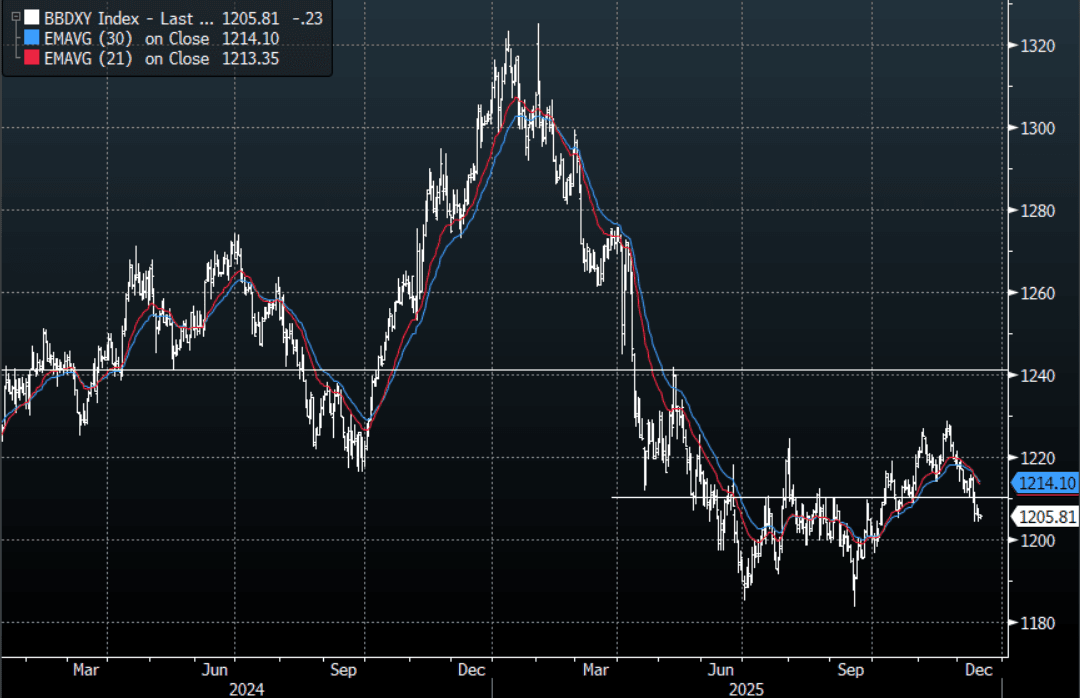
FOREX: USD - BBDXY Holds Above 1204-1205 For Now
The BBDXY has had a range today of 1205.04 - 1206.29 in the Asia-Pac session; it is currently trading around 1205, -0.05%. The USD continues to find support between 1204-1205 but has still failed to react to a weakening risk backdrop. Is it lagging or is it waiting for clarity from postponed US data tonight. The supreme court decision regarding tariffs looks like it might now be a problem for early 2026 but the tail risk of an early decision does still exist. On the day look for initial resistance again back towards the 1208-110 area and above here the more important 1213-1216 area where sellers should remerge initially. Support is in the 1204/05 area; a move below here would target 1198-1200.
- EUR/USD - Asian range 1.1747-1.1759, Asia is currently trading 1.1750. The pair is trading sideways trying to hold onto its gains above 1.1700. On the day, first support is toward 1.1710-1730 initially, if this does not hold, look for demand to then return in the 1.1640-1.1670 area.
- GBP/USD - Asian range 1.3362-1.3383, Asia is currently dealing around 1.3365. The pair stalled above 1.3400 at the end of last week. On the day GBP has initial support around the 1.3325-1.3345 area, if this does not hold look for a pullback to the more important 1.3250/80 area. I continue to watch for signs of GBP potentially topping out.
- Cross asset : SPX -0.50%, Gold $4287, US 10-Year 4.17%, BBDXY 1205, Crude Oil $56.48
- Data/Events : Germany HCOB Germany PMI’s/ZEW Survey Expectations, France HCOB France PMI’s, Spain Labour Costs YoY, Italy CPI, EZ HCOB Eurozone PMI’s/ZEW Survey Expectations/Trade Balance
Fig 1: BBDXY Spot Daily Chart
Source: MNI - Market News/Bloomberg Finance L.P
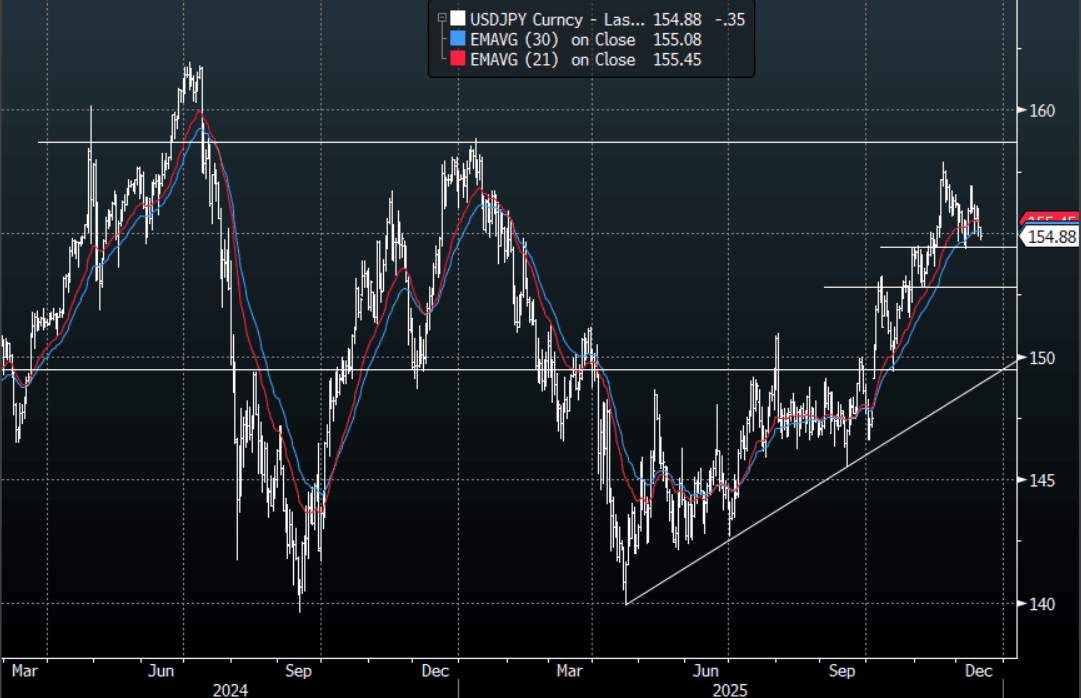
JPY: USD/JPY - Breaks Overnight Lows But Stops Short of Testing 154.30-154.50
The USD/JPY range today has been 154.71 - 155.26 in the Asia-Pac session, it is currently trading around 154.85, -0.25%. The pair has slid lower in our sessions as risk lurched lower in Asia. The market is pricing in a hike by the BOJ for this week, for the time being this is keeping the JPY contained and confined to a wider 154.50-157.00 range having capped its upward momentum. The market is awaiting the US data dump tonight which could increase the volatility. Technically USD/JPY is in an uptrend, the first big support is back toward the 152.50-154.50 area. On the day, can the pair hold below 155.00 ahead of the data and challenge the 154.30-154.50 support, if not then look for sellers to reemerge back toward the 155.40-155.70 area.
- MNI AU - BoJ Hike 95% Priced For This Week With Two By September-2026
- MNI AU - PMIs Mixed, But Manufacturing Rises, Back Close To 50.0 : Japan S&P global preliminary PMIs for December were mixed. Most focus will likely rest with the manufacturing outcome, which rose to 49.7 from 48.7 prior. The services PMI eased to 52.5, from 53.2, while the composite reading was 51.5 (52.0 prior). On the manufacturing side, while still in contraction territory it is back near highs from the middle of this year. This fits with broader sentiment measures, like the Tankan survey, which have held up reasonably well. Fears of a significant negative impact (global slowdown etc) from higher US tariff levels haven't materialized. The higher PMI reading should support IP output all else equal, although IP growth has been outperforming softer PMI trends in recent months.
- Options : Close significant option expiries for NY cut, based on DTCC data: 156.00($1.08b), 157.00($714m), 158.00($814m). Upcoming Close Strikes : 157.00($3.95b Dec 18 ), 158.00($4.78b Dec 18 ), 159.00($6.46b Dec 18 ) - BBG.
- The USD/JPY Average True Range(ATR) for the last 10 Trading days: 105 Points
Fig 1 : USD/JPY Spot Daily Chart
Source: MNI - Market News/Bloomberg Finance L.P
AUD/USD - Slips Lower With Risk
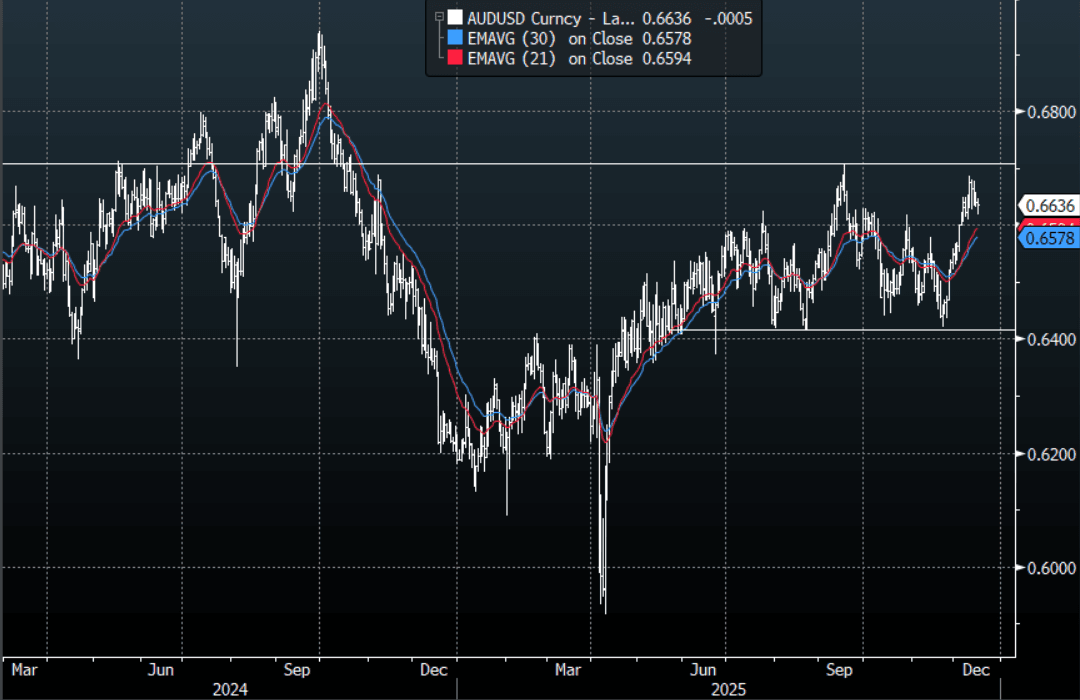
The AUD/USD has had a range today of 0.6618 - 0.6648 in the Asia- Pac session, it is currently trading around 0.6635, -0.10%. The AUD slipped lower as risk took a turn for the worst in Asia. The US stock market continues to show signs of exhaustion but the USD remains heavy as we approach some key US data. This data is old so I am not sure how relevant it is, but the market seems to think it could be important. The AUD price action remains very constructive but the wobble in risk has seen it slip. While the AUD remains above 0.6500-0.6550 I suspect dips should continue to be supported. On the day, the 0.6600-0.6630 area should continue to find demand. If this area does not hold it could signal a deeper pullback toward the 0.6550 area.
- Bloomberg reports: “Two of Australia’s top lenders expect the Reserve Bank to return to interest-rate increases in February to tackle persistent price pressures in the economy. Commonwealth Bank of Australia predicts one rate rise next year to 3.85%, while National Australia Bank Ltd. expects two hikes for a terminal rate of 4.1%.” {NSN T7CBO6KK3NYE <GO>}
- MNI AU - Consumer Sentiment Dips, Inflation/Interest Rate Outlook Weigh: The Westpac Consumer Sentiment Index fell back sharply in Dec, off 9% to 94.5. While this marks a clear improvement from the prolonged, deep pessimism that defined much of 2024, a sustained move into outright optimism remains elusive for the Australian consumer." Adding, "Overall, the sentiment mix and responses to questions on news recall suggests stronger results on inflation have sparked a renewed angst over the trajectory for interest rates, which is feeding more broadly into concerns over the economic outlook."
- Options : Closest significant option expiries for NY cut, based on DTCC data: 0.6500(AUD439m), 0.6640(AUD488m). Upcoming Close Strikes : 0.6550(AUD1.07b Dec 18 ), 0.6675(AUD1.1b Dec 19), 0.6700(AUD1.57b Dec 19) - BBG
- The AUD/USD Average True Range for the last 10 Trading days: 41 Points
Fig 1: AUD/USD spot Daily Chart
Source: MNI - Market News/Bloomberg Finance L.P
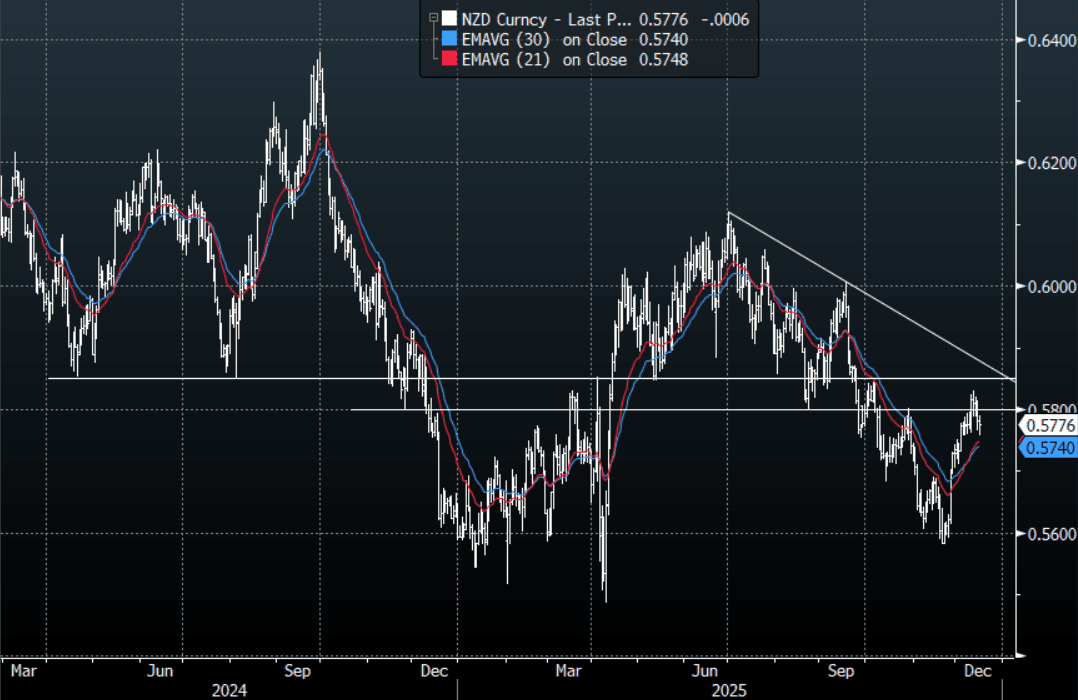
NZD/USD - Slips Lower, Finds Demand Again Toward The 0.5750 Area
The NZD/USD had a range today of 0.5758-0.5789 in the Asia-Pac session, going into the London open trading around 0.5775, -0.10%. The NZD has slid lower again in our day driven by risk moving lower ahead of some important US data. The NZD underperformed yesterday as well on the back of comments from the RBNZ’s Breman, but demand continues to be seen toward the 0.5750 area. On the day, I suspect we will consolidate in a range ahead of the US data dump, something like 0.5740 - 0.5810 should keep it contained until then.
- MNI AU - NZGBS: Sharp Rally As NZDM Revises Down Debt Issuance Outlook: The NZ government faces deeper budget deficits and a slower path back to surplus as the economic recovery lags. New Zealand Debt Management has revised the government bond program, with planned issuance of NZ$35bn in 2025-26, down NZ$3bn from the Budget, and NZ$34bn in 2026-27, down NZ$2bn, before rising in later years.
- Bloomberg - “The New Zealand government will head into an election year facing deeper budget deficits and a delayed return to surplus as an economic recovery takes longer to gather momentum.” {NSN T7C5DLT96OTD <GO>}
- Options : Closest significant option expiries for NY cut, based on DTCC data: 0.5850(NZD304m). Upcoming Close Strikes : 0.5630(NZD594m Dec 19), 0.5690(NZD531m Dec 18 ), 0.5860(NZD471m Dec 18 ) - BBG
- The NZD/USD Average True Range for the last 10 Trading days: 41 Points
Fig 1: NZD/USD Spot Daily Chart
Source: MNI - Market News/Bloomberg Finance L.P
ASIA: Tech Falls Weighing on Investor Sentiment
Asia equities are down again today with many key AI / Tech stocks dragging bourses lower. Ahead of anticipated US data (NF Payrolls) markets are cautious as the path for US interest rates remains uncertain. For the AI / Tech space, what started with Oracle's warning last week has grown into something more, exacerbated by highly stretched valuations. In China, mixed views on the economy are keeping equities at bay given what weak raft of data released yesterday and some strategists suggesting that more policy intervention is required. Stocks in Japan are under pressure ahead of the BOJ interest rate decision this week and an expected 25bps rate rise alongside tech weakness.
- The NIKKEI is down -1.30%, following yesterday's fall of -1.31% with key tech stock Softbank Group down -1.5%
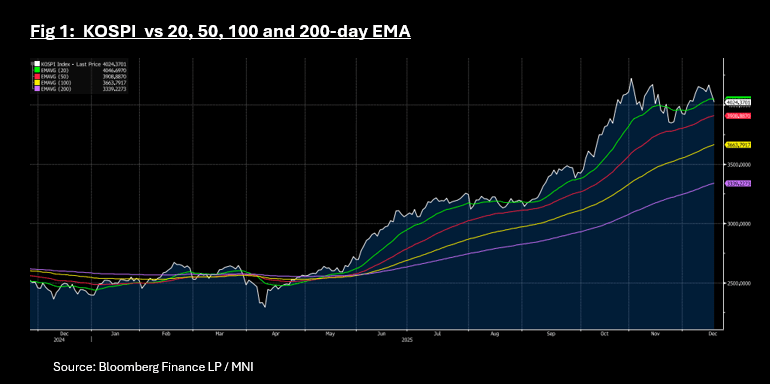
- The KOSPI is down -1.65% after falls of -1.84% yesterday with leading AI Tech stock SK Hynix down -7% today alone. The losses sees the KOSPI at 4025 and dip below the 20-day EMA of 4046. Downside resistance in the form of the 50-day EMA is at 3,908.
- China's bourses are all down -1.50% - 2.00% with the Hang Seng the biggest faller. Down -1.9% the HSI leads the CSI 300 down -1.35% and Shenzhen down -1.77%. The HSI is near the 25,000 resistance level that it last traded below in August
- Taiwan's TAIEX is down -1.5% as TSMC drags the index down with falls of -1.7%
- India's NIFTY 50 closed near flat yesterday after falling earlier in the day but has opened down -0.34% today, breaking below 26,000 to be at 25,935
- The FTSE Malay KLCI continues to appear lowly correlated to its Asian peers, rising today by +0.15% whilst the JCI in Indonesia is down -0.20%
THAILAND: MNI BoT December Preview: Macro Conditions Warrant Easing
- Bank of Thailand is likely to announce a 25bp rate cut on Wednesday 17 December, which would bring it to 1.25% and easing in 2025 to 100bp.
- With core inflation remaining below the bottom of BoT's target band, severe weather events, disappointing Q3 GDP, slowing export growth and continued baht strength, the central bank is likely to deem the timing this month as appropriate.
- The MPC has been careful given its limited policy room.
- See our full preview here
INDIA: Preliminary PMIs Continue to Moderate
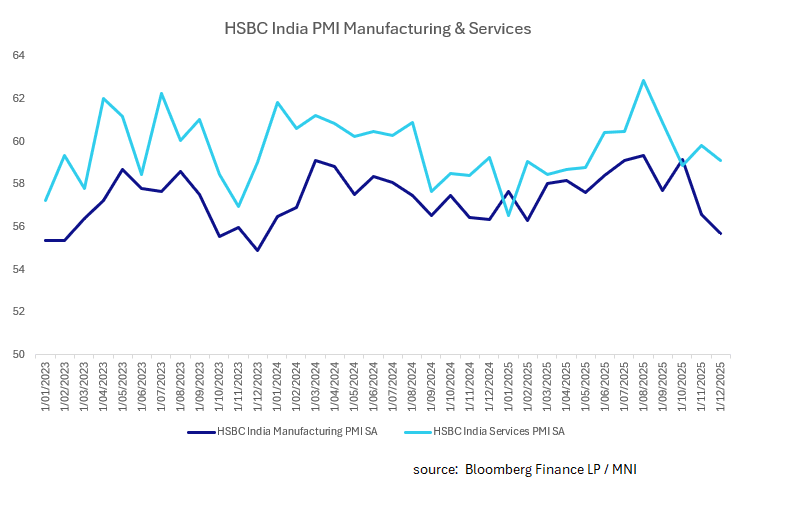
- Following record highs for India's PMIs in August, ongoing moderation in both the PMI Services and PMI Manufacturing has been a theme.
- India's PMI Manufacturing for December was released today and at 55.7, was the lowest reading since December 2023.
- Output fell to 58.4 (from 59.6 in November) and the decline in new orders sees them at their lowest since February.
- PMI Services declined to 59.1 from 59.8 in November, the lowest print since May 2022. Prices charged however rose relative to last month.
- These results are less than surprising given the strength of the data in the middle part of the year as PMIs hit new records. November exports have rebounded strongly up +19.4% following a decline in October, potentially allaying fears that US tariffs will start to show up in the otherwise robust data.
- With CPI still moderate but on an improving trend, the RBI's recent cut and move to neutral appears timely as economic data continues to show limited impact from the US trade tariffs.
MNI BI December Preview: BI Holds, Rupiah Stability Key
Download Preview Here:
We see the Bank Indonesia on Hold at its December meeting in what is a close call given:
- USDIDR has traded within a tight range since the last Central Bank meeting as per BI's focus.
- The transmission mechanism needs more time to allow the prior cuts to flow through to broader economy.
- Activity data has improved with PMIs highest since February.
- Last week's decision by the FOMC to cut rates reduces any perceived urgency to cut.
CNH: USD/CNH Fresh Lows Under 7.0400, Can We Test 7.00 Sooner Than Expected?
USD/CNH is just up from session lows (7.0373), last in the 7.0375/80region. The currency is only marginally stronger, but is outperforming some other North East Asia currencies so far today, with KRW and TWD under pressure amid fresh equity market weakness. USD/JPY is lower though, back to 154.75/80, so this may be seeing some positive spill over to CNH. USD/CNY spot is also down but remains above 7.0400 at this stage. The earlier USD/CNY fix was set above market forecasts but still comfortably below yesterday's outcome. Also via BBG: "dollar-buying by major Chinese banks softens, reducing resistance to further gains for the renminbi."
- Until we see greater push back on yuan gains the market remain comfortable to keep looking for downside in USD/CNH, with the 7.00 region the likely next focus point.
- BBG notes that a stronger yuan backdrop is also gaining traction onshore amongst economists and former central bank officials: see this link.
- Despite the break lower in USD/CNH, vol and risk reversal markets still look well behaved. The 1 month implied vol is a little higher, but at 2.44%, remains close to recent cycle lows. The 1 month RR is also up from recent lows, last -0.47.
- Focus remains on stronger yuan gains to address external imbalances, although expectations of a sharp rally in the yuan is not the consensus view point. The BBG survey only has CNY strengthening to 7.00 by Q3 2026.
UP TODAY (TIMES GMT/LOCAL)
| Date | GMT/Local | Impact | Country | Event |
| 16/12/2025 | 0700/0700 | *** |  GB GB | Labour Market - AWE & Unemployment |
| 16/12/2025 | 0700/0700 | *** | GB | Labour Market - Payrolls & Claimants |
| 16/12/2025 | 0700/0700 | *** | GB | Labour Market - AWE & Unemployment |
| 16/12/2025 | 0700/0700 | *** | GB | Labour Market - Payrolls & Claimants |
| 16/12/2025 | 0815/0915 | ** |  FR FR | S&P Global Services PMI (p) |
| 16/12/2025 | 0815/0915 | ** | FR | S&P Global Manufacturing PMI (p) |
| 16/12/2025 | 0830/0930 | ** |  DE DE | S&P Global Services PMI (p) |
| 16/12/2025 | 0830/0930 | ** | DE | S&P Global Manufacturing PMI (p) |
| 16/12/2025 | 0900/1000 | ** |  EU EU | S&P Global Services PMI (p) |
| 16/12/2025 | 0900/1000 | ** | EU | S&P Global Manufacturing PMI (p) |
| 16/12/2025 | 0900/1000 | ** | EU | S&P Global Composite PMI (p) |
| 16/12/2025 | 0900/1000 | ** |  IT IT | Italy Final HICP |
| 16/12/2025 | 0930/0930 | *** | GB | S&P Global Manufacturing PMI flash |
| 16/12/2025 | 0930/0930 | *** | GB | S&P Global Services PMI flash |
| 16/12/2025 | 0930/0930 | *** | GB | S&P Global Composite PMI flash |
| 16/12/2025 | 1000/1100 | * | EU | Trade Balance |
| 16/12/2025 | 1000/1100 | *** | DE | ZEW Current Expectations Index |
| 16/12/2025 | 1000/1000 | ** | GB | Gilt Outright Auction Result |
| 16/12/2025 | 1000/1100 | IT | Foreign Trade | |
| 16/12/2025 | 1330/0830 | *** |  US US | Employment Report |
| 16/12/2025 | 1330/0830 | *** | US | Employment Report |
| 16/12/2025 | 1330/0830 | *** | US | Employment Report |
| 16/12/2025 | 1330/0830 | *** | US | Employment Report |
| 16/12/2025 | 1330/0830 | *** | US | Retail Sales |
| 16/12/2025 | 1330/0830 | *** | US | Retail Sales |
| 16/12/2025 | 1355/0855 | ** | US | Redbook Retail Sales Index |
| 16/12/2025 | 1445/0945 | *** | US | S&P Global Manufacturing Index (Flash) |
| 16/12/2025 | 1445/0945 | *** | US | S&P Global Services Index (flash) |
| 16/12/2025 | 1500/1000 | * | US | Business Inventories |
| 16/12/2025 | 1500/1000 | * | US | Business Inventories |
| 16/12/2025 | 1745/1245 |  CA CA | BOC Gov Macklem speech in Montreal | |
| 17/12/2025 | 2350/0850 | * |  JP JP | Machinery orders |
| 17/12/2025 | 0001/0001 | * | GB | Brightmine pay deals for whole economy |
| 17/12/2025 | 0700/0700 | *** | GB | Consumer Inflation Report (1dp) |
| 17/12/2025 | 0700/0700 | *** | GB | Producer Prices |
| 17/12/2025 | 0700/1500 | ** |  CN CN | MNI China Money Market Index (MMI) |
| 17/12/2025 | 0700/0700 | *** | GB | Consumer Inflation Report (2dp) |
| 17/12/2025 | 0900/1000 | *** | DE | IFO Business Climate Index |
| 17/12/2025 | 1000/1100 | *** | EU | EZ HICP Final |
| 17/12/2025 | 1000/1100 | *** | EU | EZ HICP Final |
| 17/12/2025 | 1000/1100 | *** | EU | EZ HICP Final |
| 17/12/2025 | 1100/1100 | ** | GB | CBI Industrial Trends |
| 17/12/2025 | 1200/0700 | ** | US | MBA Weekly Applications Index |
| 17/12/2025 | 1315/0815 | US | Fed Governor Christopher Waller | |
| 17/12/2025 | 1330/0830 | * | CA | International Canadian Transaction in Securities |


