MNI EUROPEAN MARKETS ANALYSIS: Oil On Track For Weekly Rise
- The USD continues to edge higher ahead of the key US NFP print later, USD/JPY has risen to fresh YTD highs. CNH has outperformed though, aided by the CNY fixing.
- US Tsy yields have inched up amidst low volumes, while cash JGBs are holding a twist-flattening across benchmarks in today's session, with yields 2.2bps higher (5-year) to 4.2bps lower (40-year).
- Oil is on track for a solid weekly gain, as geopolitical tensions edge up and Iran protests remain a watch point.
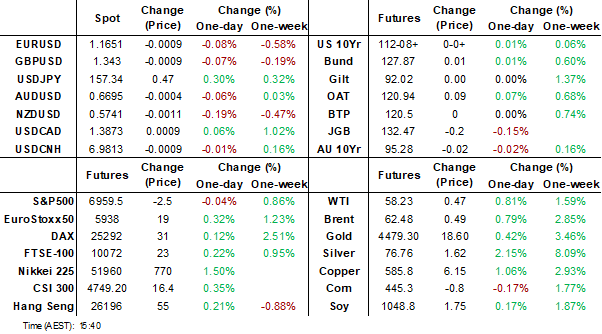
MARKETS
US TSYS: Markets Ready for NFP, Yields Inch Higher on Low Volumes
The US bond market remains focused on today's non-farm payrolls report, which is a critical guide for Federal Reserve policy expectations. Yields have been range bound over the last week with most maturities locked in a 2-3bps range and very little priced in for the January meeting.
Bond futures had a typical trading day ahead of NFP with low volumes and limited movements. The 10-Yr is up +01 at 112-09+ wedged between its topside resistance from the 100-day EMA of 112-14+ and downside resistance from the 200-day EMA of 112-00+.
Cash saw modestly higher yields of +0.5 - +0.9bps across the curve.
- The 2-Yr is up +0.5bps at 3.495%
- The 5-Yr is up +0.9bps at 3.738%
- The 10-Yr is up +0.8bps at 4.177%
- The 30-Yr is up +0.7bps at 4.846%
The outlier risks remain for a significantly below forecast release, given very little is priced into rate expectations for the end January meeting.
Please see our Non-Farm Payrolls preview here:
Hidden PDF
There are no government bond auctions of significance tonight
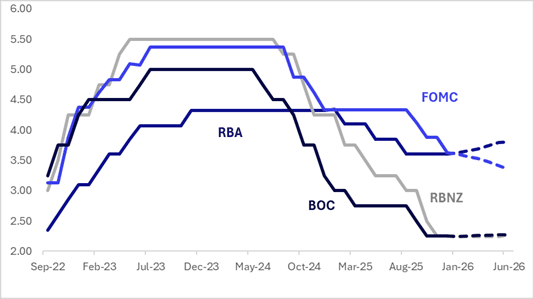
STIR: $-Bloc Pricing Little Changed Over Past Month, Except For NZ (1/2)
Interest-rate expectations across the $-bloc over the past month, looking out to June 2026, have been little changed overall, with the notable exception of New Zealand, where expectations softened by 16bps. Elsewhere, US pricing edged 3bps higher, while Australia and Canada eased by 5bps and 1bp, respectively.
- The key $-bloc event so far this week was Australia’s November CPI release. Trimmed-mean inflation moderated by 0.1pp to 3.2% y/y, in line with consensus, while headline CPI fell more than expected to 3.4% from 3.8%. Given the limited track record of the new monthly CPI series, the RBA is likely to place greater weight on the quarterly data for now, with Q4 CPI due on 28 January.
- Later today, attention turns to US and Canadian labour-market data. Consensus expects US nonfarm and private payrolls growth of 69k and 75k, respectively, with primary dealers slightly more optimistic on nonfarm payrolls. These outcomes would imply a return to more typical monthly job gains following the sharp October decline, which reflected the delayed impact of federal government deferred resignations. December’s report should carry greater signal for both markets and the Fed than November’s highly unusual print. As the final NFP release ahead of the late-January FOMC meeting, materially weaker-than-expected data would likely be required to prompt even consideration of another rate cut, with just 4bps currently priced.
- Canada’s December Labour Force Survey is expected to show flat-to-negative employment growth alongside a further uptick in the unemployment rate.
STIR: $-Bloc Pricing Little Changed Over Past Month, Except For NZ (2/2)
Interest-rate expectations across the $-bloc over the past month, looking out to June 2026, have been little changed overall, with the notable exception of New Zealand, where expectations softened by 16bps. Elsewhere, US pricing edged 3bps higher, while Australia and Canada eased by 5bps and 1bp, respectively.
- The next major regional policy events are the FOMC and BoC meetings on 28 January. Markets assign a roughly 5% probability of a BoC cut, while US pricing implies a 14% chance of a 25bp Fed cut.
- Looking ahead to June 2026, current market-implied policy rates expected are as follows: US (FOMC): 3.35%, -28bps; Canada (BOC): 2.28%, +3bp; Australia (RBA): 3.80%, +20bps; and New Zealand (RBNZ): 2.30%, +4bps.
Figure 1: $-Bloc STIR (%)
Source: Bloomberg Finance LP / MNI
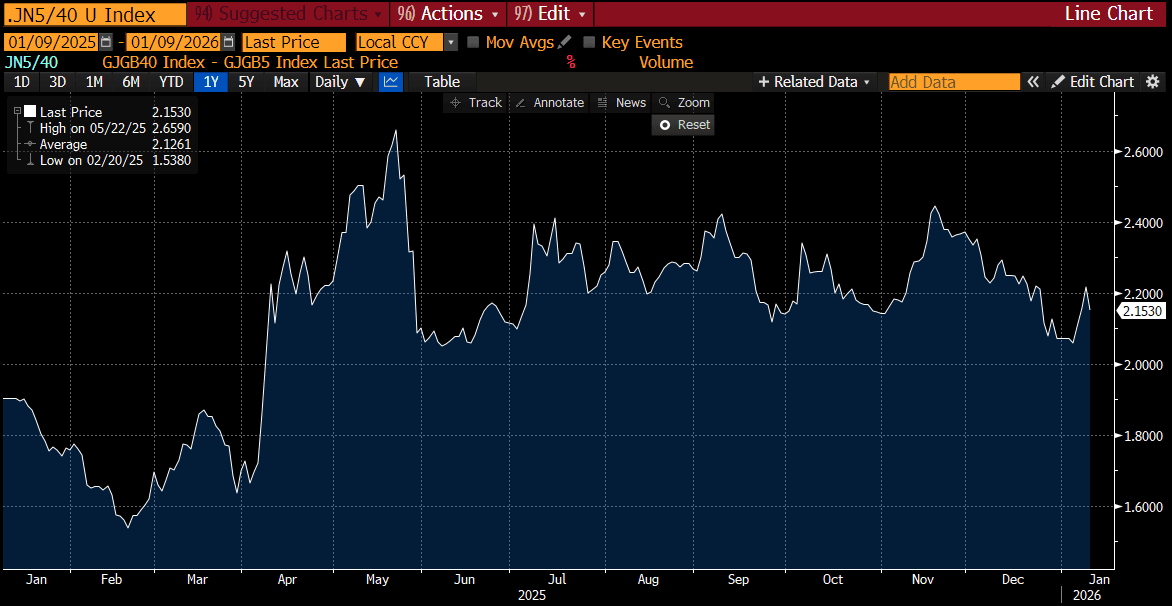
JGBS: Twist-Flattener, 5/40 Curve Flatter But Mid-Range
JGB futures are holding weaker, -19 compared to settlement levels, but have moved away from session cheaps seen in the aftermath of today’s stronger than expected household spending data.
- Japan real household spending rose 2.9%y/y in Nov, well above the -1.0% forecast and -3.0% Oct outcome. In m/m terms spending was up 6.2%, the strongest monthly rise since 2021.
- Real spending outcomes have been running ahead of the real cash earnings measure. This divergence widened in Nov. Whilst yesterday's labour earnings data was disappointing, the BoJ regional economic report still pointed to positive wage momentum for 2026 - via our policy team: many branch managers reported expectations for sustained pay increases, with several pointing to wage growth at levels similar to or higher than those seen in 2025.
- Cash US tsys are slightly cheaper in today's Asia-Pac session, with consensus looking for nonfarm/private payrolls growth of 69k/75k. The December data will carry more signal to the market and Fed than the highly unusual November report.
- Cash JGBs are holding a twist-flattening across benchmarks in today's session, with yields 2.2bps higher (5-year) to 4.2bps lower (40-year) (see chart).
- Swap rates are 1bp higher to 3bps lower, with the curve flatter.
- The local market is closed on Monday for a holiday.
Source: Bloomberg Finance LP
JAPAN DATA: Household Spending Jumps In Nov, Outpacing Weaker Earnings
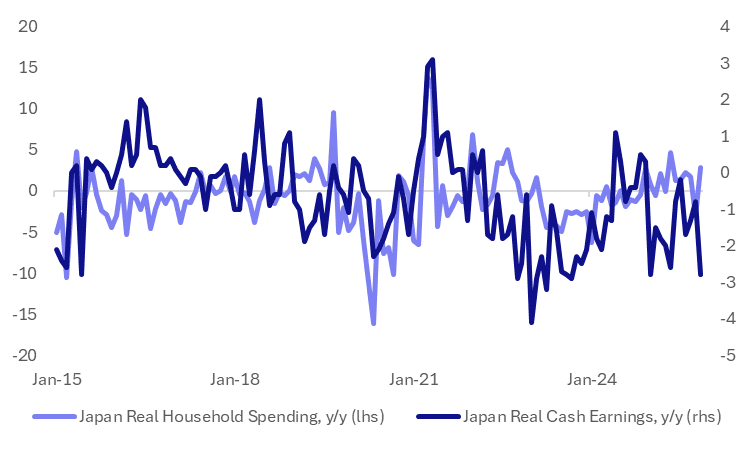
Japan real household spending rose 2.9%y/y in Nov, well above the -1.0% forecast and -3.0% Oct outcome. In m/m terms spending was up 6.2%, the strongest monthly rise since 2021. The chart below updates real spending y/y versus real labour earnings, also in y/y terms. The two series tend to follow each other from a trend standpoint, but for much of 2025, spending outcomes were running ahead of the real cash earnings measure. This divergence widened in Nov. Whilst yesterday's labour earnings data was disappointing, the BoJ regional economic report still pointed to positive wage momentum for 2026 - via our policy team: many branch managers reported expectations for sustained pay increases, with several pointing to wage growth at levels similar to or higher than those seen in 2025.
- In terms of the detail on today's spending update, food spending rose 0.9%y/y from -1.1% in Oct. Spending on transport, communication also surged to 20.4%y/y from -9.2%.
Fig 1: Japan Real Household Spending & Labour Earnings Y/Y
Source: Bloomberg Finance L.P./MNI
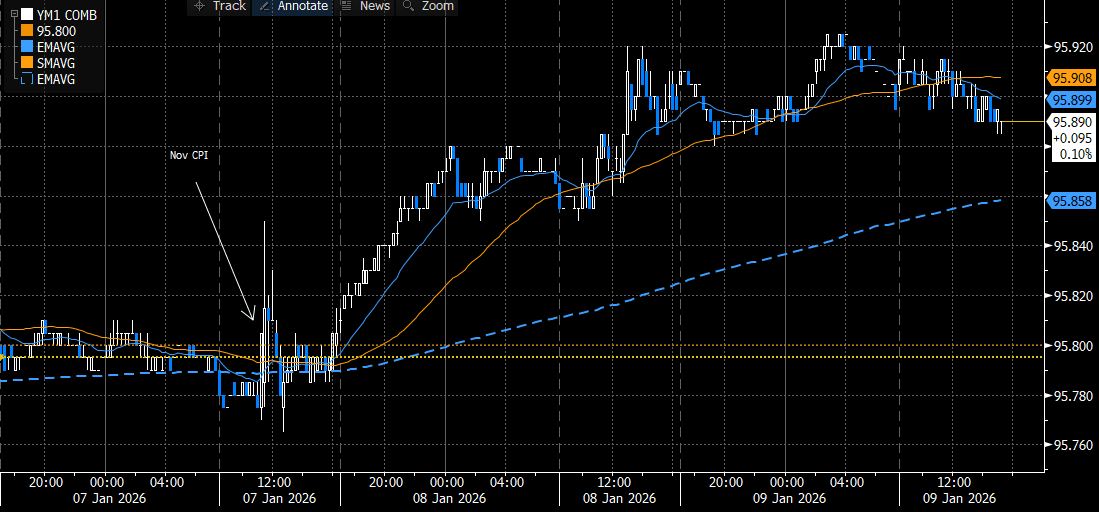
AUSSIE BONDS: Cheapening Ahead Of US Payrolls But Still Richer Than Pre-CPI
ACGBs (YM -1.0 & XM -2.0) are weaker, hovering near session lows, ahead of tonight’s US payrolls data (see chart).
- Cash US tsys are slightly cheaper in today's Asia-Pac session, with consensus looking for nonfarm/private payrolls growth of 69k/75k.
- Cash ACGBs are 1-2bps cheaper with a steeper curve and the AU-US 10-year yield differential at +52bps, its lowest level since early December. In the month leading into this week's CPI release, the spread had traded in a 55-65bps range, marking its widest levels since mid-2022.
- The price action had effectively consolidated the differential's breakout above the 30bps range that had prevailed since November 2022. This widening coincided with a steady lift in market-implied expectations for the RBA cash rate.
- The bills strip is little changed.
- RBA-dated OIS pricing is 3-13bps softer than Wednesday’s pre-CPI levels, with December 2026 leading. Nonetheless, pricing continues to show tightening across all meetings, with the probability of a 25bp hike rising from 28% for February to 91% by June and 138% by December 2026.
- On Monday, the local calendar will see Household Spending and ANZ-Indeed Job Advertisements data.
- Next week, the AOFM plans to sell A$300mn 4.75% 2054 bond on Tuesday, A$1bn 4.25% 2036 bond on Wednesday and A$700mn 3.25% 2029 bond on Friday.
Bloomberg Finance LP
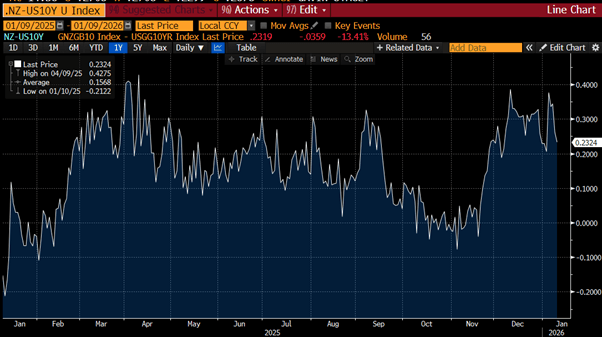
BONDS: NZGBS: Strong Relative Performance Ahead Of US Payrolls
NZGBs closed at session bests, 2bps richer across benchmarks, after a typical pre-US payrolls Friday.
- NZGBs relative performance was even more impressive, with the NZ-US and NZ-AU 10-year yield differentials 6bps and 4bps lower, respectively (see chart).
- Cash US tsys are slightly cheaper in today's Asia-Pac session ahead of the release of the December employment report. Consensus looks for nonfarm/private payrolls growth of 69k/75k with primary dealer analysts a touch higher for nonfarm. It would see similar monthly rates to those in November after nonfarm payrolls fell heavily in October on federal government deferred resignations showing up.
- The local calendar was empty today. The next release will be NZIER Business Opinion Survey data on Tuesday.
- Swap rates closed 1-2bps lower, with the 2s10s curve steeper.
- RBNZ-dated OIS pricing is little changed across meetings. No tightening is priced for February, while October 2026 assigns 20bps.
- Interest-rate expectations across the $-bloc over the past month, looking out to June 2026, have been little changed overall, with the notable exception of NZ, where expectations softened by 16bps. Elsewhere, US pricing edged 3bps higher, while Australia and Canada eased by 5bps and 1bp, respectively.
Bloomberg Finance LP
FOREX: USD Firms, USD/JPY Challenging YTD Highs, CNH Outperforms Post Fix
Broader USD trends remain positive, although aggregate index moves are muted. The BBDXY index unable to sustain earlier highs above 1210, Cross asset moves are fairly modest at this stage, US Tsy yields up a touch (10yr around 4.17%), while US equity futures are close to flat. Regional equity trends are positive, but gains aren't large. Gold and silver aren't moving much, while oil is up but sub Thursday US session highs, Brent last $62.40/bbl. This all comes ahead of the key NFP print in the US later. A Supreme Court ruling on the legality of the Trump tariffs could also come later today US time.
- The main exception to USD upside is USD/CNH, which is holding near 6.9800 in latest dealings (session lows were at 6.9757), after the USD/CNY fixing set a fresh low since 2024 earlier. This is aiding CNH outperformance on key crosses. CNH/JPY is back above 22.53, not far from earlier 2026 highs above 22.54.
- USD/JPY is above Thursday highs, last 157.25/30 and testing 2026 highs to date (157.30). More important resistance will be eyed at 157.89 the Nov 20 high and bull trigger. Earlier data stronger than expected household spending but this didn't benefit the yen.
- There is over $700mn in option expiries for NY cut later at 158.00 strike, which may come into focus if we see an upside NFP later during the US session.
- Japan FinMin Katayama has spoken about risks of China's export controls on global supply chains and called for smooth trade flows (with earlier reports from Japan also pointing to delays on food export to China). The FinMin will also attend a critical mineral in the US.
- AUD and NZD are both down a touch, but remain above Thursday lows. AUD/USD last 0.6690/95, while NZD/USD was near 0.5740/45. Both currencies are slightly higher versus the yen so for in Friday trade, but this came after declines in Thursday trade for these crosses.
- EUR/USD is holding near 1.1650, while GBP/USD is off a touch to 1.3430.
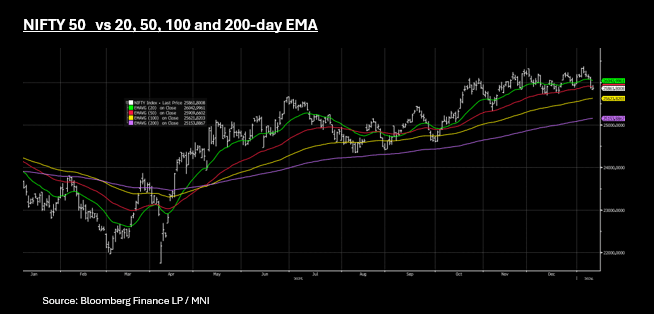
ASIA: AI/Tech Lead Continues, Nifty 50 Below Key Level
With the exception of the Hang Seng and NIFTY 50, Asian markets have had a strong week this week taking leads from Wall Street whilst the AI / tech thematic remains. Key names in Taiwan and Korea continue to deliver weekly gains, with TSMC up over 6% and SK Hynix 9% for the week As we approach the NFP Friday, markets will get its next guide on monetary policy with little expectations priced in for the FED's January meeting. Chinese stocks saw one of their strongest starts in some time with the CSI 300 Index reaching a four-year high.
- The NIKKEI at 51,838 is up +1.3% Friday and +2.9% for the week, having hit a new high of 52,518 Tuesday.
- The KOSPI is up only +0.40% on profit taking on tech names, but +6% for the week.
- China's bourses onshore all up between +2.5% - 4.3% with Shenzhen the outperformer whilst offshore the Hang Seng is down -0.65% for the week.
- The NIFTY 50 hit new highs last week and has fallen gradually each day since to lose -1.7% for the week, and through the 50-day EMA.
- SE Asia's major bourses are up for the week with SE Thai and FTSE Malay's gains modest, whilst the JCI delivered almost +2.5% gains
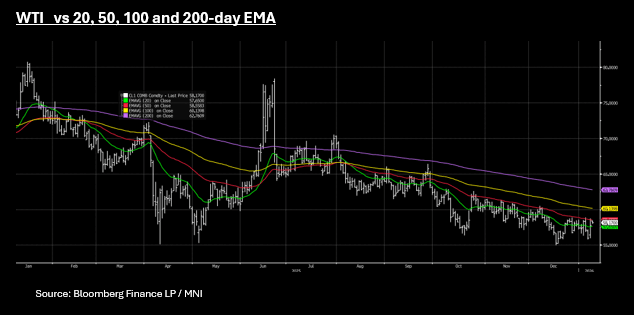
Oil Up Strongly for Week as WTI Nears Key Tech Level
- Following the very strong rally last night, oil has fallen modestly with no new news to drive sentiment.
- Oil prices were strong overnight with both WTI and Brent up on renewed supply concerns stemming from developments in several major oil-producing regions. Geopolitical instability and potential disruptions in Russia, Iraq, and Iran fueled market anxiety with political protests in in protests in Iran are being closely monitored.
- As sources suggest a Russian oil tanker was damaged by a drone attack, President Trump was quoted today as saying he was supportive of a Russian sanctions bill.
- U.S. President Trump's administration intensified pressure on Venezuela's oil sector, seizing two Venezuela-linked tankers and continue discussing plans to control the nation's oil industry whilst news that Chevron is loading Venezuela oil in vast quantities bound for the US and Exxon and ConocoPhillips are looking at their options in the country.
- WTI is down -0.40.% today at US$58.17 bbl yet remains with gains of +1.5% for the week. WTI is near to the 50-day EMA of US$58.55 which has proven a strong resistance point since late September.
- Brent is lower by -0.45% at US$62.42 bbl, whilst remaining up +2.6% for the week and its largest weekly gain in over 10 weeks if sustained.
- Oil markets will continue to monitor geopolitics as the key driver Friday, with one eye on the non farm payrolls release.
Gold Halves O/N Gains, Eyes Strong Week Ahead of NFP
- Gold has given back around half of Thursday's gains during the Asia trading day as investors ready for tonight's non farm payrolls as Initial jobless claims were lower than expected, potentially adding to the move lower today.
- Non farm payrolls will possibly provide some insight as to the future path for the Federal Reserve on monetary policy. Following recent cuts, there is limited priced into markets for the upcoming meeting.
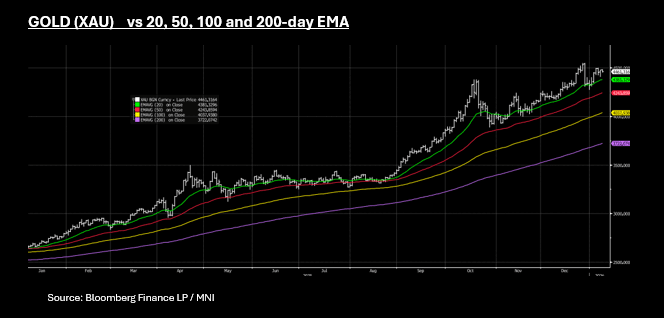
- Gold is down -0.33% today at US$4,462.90 whilst remaining up over 3.00% for the week. Gold currently sits above the 20-day EMA of US$4,381 with all major moving averages sloping upward. The upward slope suggests that the positive trend could remain in place for the near term.
- The current forecast for NFP is a modest increase from the month prior and with only around 3bps of cuts priced in for January, expectations for monetary policy changes remain low. The seemingly outlier risks tonight remain for markets for an unexpected weak number for the December employment read.
CHINA: CPI Highest Since Feb 2023
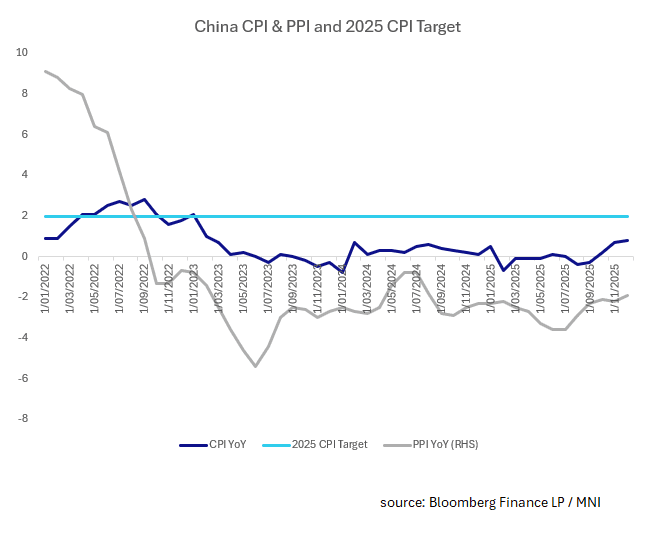
- December CPI in China rose 0.8% in line with estimates. China has not released the 2026 CPI forecasts yet but based on the 2025 forecast of 2.0%, CPI remains below target. The rise to 0.8% represents the highest CPI print since February 2023.
- Core CPI was steady at 1.2% where it has printed for the last 3-months.
- PPI was modestly better, a decline of -1.9% against estimates of -2.0% and prior month of -2.2%. For the PPI it is more of the same as a major structural driver the "involution" —intensive price wars among manufacturers continues. Excessive investment in sectors like electric vehicles, solar panels, and batteries has created a supply-demand imbalance, forcing companies to slash prices to clear inventory and maintain market share. Chinese authorities this week were meeting with battery manufacturers in a bid to further regulate and protect the industry whilst ultimately seeking to stabilize price declines.
ASIA FX: CNY Fix Aids CNH, KRW, TWD Among Worst EM Asia FX Performers YTD
In North East Asia FX, CNH remains a resilient outperformer, aided by a lower USD/CNY fixing. KRW and TWD continue to lose ground, and are among the worst performers in EM Asia FX in 2026 to date. Spill over is evident from weaker yen levels for these two currencies, although losses for both currencies is double if not more compared to what JPY has declined so far this year.
- USD/CNH got to lows of 6.9757 after today's USD/CNY fixing, which hit a fresh low back to 2024. The fixing is aiding CNH outperformance, given it comes in contrast to the drift higher in USD index levels over the past few sessions. USD/CNH has since stabilized to around 6.9800, but is outperforming G10 FX moves as well. CNH/JPY remains in a strong uptrend. We were last 22.5250/60, just off session highs. Earlier 2026 highs above 22.54 are close by.
- Spot USD/KRW has pushed above 1456, continuing to recover from the late 2025 slump (lows of 1424.85). Fresh rhetoric around the currency not reflecting fundamentals has not impacted sentiment so far in recent sessions. Earlier we had Nov goods balance and current account figures, which showed strong rises in surplus positions. Still in the same month we saw very large outflows to offshore equities by local residents ($12.5bn). A move into 1460/80 for USD/KRW may see a stronger policy response from the authorities.
- Spot USD/TWD has risen to fresh highs in the first part of Friday trade, last 31.64, just short of session highs. Broader trends remain supportive for the pair, as we steadily close the gap with the 32.00 level. The Taiex is holding close to recent highs, but offshore investors have been net sellers of local stocks so far in 2026. Next week, delivers quarterly TSMC earnings, with a positive mood around the stock. Renewed optimism in this space could spur fresh offshore inflows. It remains to be seen if this can turn the USD/TWD trend around though. We also get Dec trade figures later, but TWD is out of sync with strong export in recent months.
ASIA FX: Early 2026 Trends Against IDR, THB Continues To Outperform
In South East Asia FX, trends are skewed towards dollar gains, with THB firmer, but IDR, SGD and MYR have lost ground to varying degrees. Aggregate moves are modest at this stage though, as markets await the key US NFP print later. Early YTD trends are skewed against the IDR, which is down around 0.80% so far in 2026, the second worst performer in EM Asia FX (with the won the worst).
- Spot USD/IDR has broken above 16800, last 16825/30. This is fresh highs back to April last year for the pair (came in around 16925 during that period). Given this was during the height the tariff panic in 2025, this points to underlying outflow pressures in Indonesia. Concerns around the fiscal outlook remain in focus, while offshore investors have been modest net sellers of local debt so far this year. Consumer confidence edged down to 123.5 in Dec, but this is above end Q3 lows (115).
- At the other end of the spectrum, USD/THB is lower back to 31.40/45, leaving baht up a modest 0.30% so far in 2026, but the best performer within EM Asia. We remain within recent ranges for this pair, still finding selling interest around 31.50.
- USD/SGD has edged up to 1.2855/60, consistent with some broader USD gains in the G10 space. Recent lows just under 1.2800 remain intact for now. Earlier Jan highs were just short of 1.2900, in terms of an upside focus point. USD/MYR is around 4.0650, slightly higher, but still short of 20-day EMA resistance near 4.0730, which has marked highs in the pair back to late Oct last year. Nov IP was slightly weaker than forecast at +4.3%y/y, versus 5.3% forecast and 6.0% prior. FX markets haven't reacted though.
UP TODAY (TIMES GMT/LOCAL)
| Date | GMT/Local | Impact | Country | Event |
| 09/01/2026 | 0700/0800 | ** |  DE DE | Trade Balance |
| 09/01/2026 | 0700/0800 | ** | DE | Industrial Production |
| 09/01/2026 | 0700/0800 | ** |  SE SE | Private Sector Production m/m |
| 09/01/2026 | 0700/0800 | *** |  NO NO | CPI Norway |
| 09/01/2026 | 0745/0845 | * |  FR FR | Industrial Production |
| 09/01/2026 | 0745/0845 | ** | FR | Consumer Spending |
| 09/01/2026 | 0800/0900 | ** |  ES ES | Industrial Production |
| 09/01/2026 | 0800/0900 | ** |  CH CH | Unemployment |
| 09/01/2026 | 0900/1000 | * |  IT IT | Retail Sales |
| 09/01/2026 | 1000/1100 | ** |  EU EU | EZ Retail Sales |
| 09/01/2026 | 1200/0700 | ** |  BR BR | Brazil Final CPI |
| 09/01/2026 | 1245/1345 | EU | ECB Lane Keynote at Danish Economy Conference | |
| 09/01/2026 | 1330/0830 | *** |  CA CA | Labour Force Survey |
| 09/01/2026 | 1330/0830 | *** | CA | Labour Force Survey |
| 09/01/2026 | 1330/0830 | *** |  US US | Housing Starts |
| 09/01/2026 | 1330/0830 | *** | US | Housing Starts |
| 09/01/2026 | 1330/0830 | *** | US | Employment Report |
| 09/01/2026 | 1330/0830 | *** | US | Employment Report |
| 09/01/2026 | 1330/0830 | *** | US | Employment Report |
| 09/01/2026 | 1330/0830 | *** | US | Employment Report |
| 09/01/2026 | 1330/0830 | *** | US | Employment Report |
| 09/01/2026 | 1330/0830 | *** | US | Employment Report |
| 09/01/2026 | 1500/1000 | *** | US | U. Mich. Survey of Consumers |
| 09/01/2026 | 1500/1000 | ** | US | University of Michigan Surveys of Consumers Inflation Expectation |
| 09/01/2026 | 1500/1000 | US | Minneapolis Fed's Neel Kashkari | |
| 09/01/2026 | 1800/1300 | ** | US | Baker Hughes Rig Count Overview - Weekly |
| 09/01/2026 | 1800/1300 | ** | US | Baker Hughes Rig Count Overview - Weekly |
| 09/01/2026 | 1800/1300 | ** | US | Baker Hughes Rig Count Overview - Weekly |
| 09/01/2026 | 1835/1335 | US | Richmond Fed's Tom Barkin |


