MNI EUROPEAN MARKETS ANALYSIS: Judge Rules Against Cook Firing
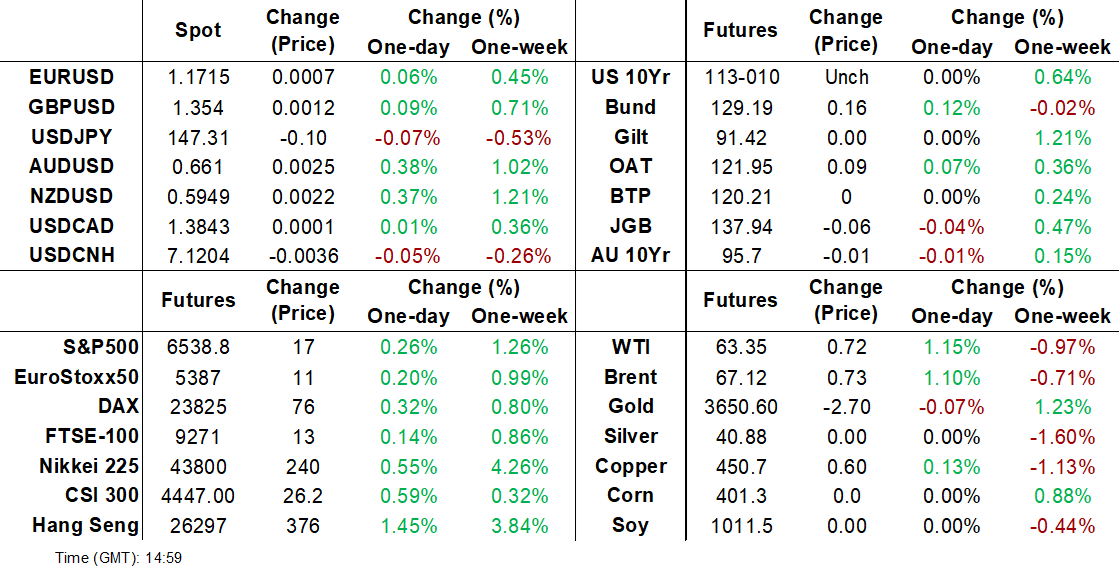
- The USD had another crack at breaking lower but once more found decent demand just below 1197 and bounced, closing back above 1200. The market will be focused on the US inflation data today and tomorrow.
- All major bourses were up today in a strong day across the region. China equities continue to power on as news that domestic insurers allocation to equity has hit their highest in 3-years.
- China's CPI in August declined -0.4%, ahead of estimates of -0.2% and the biggest drop since February. This adds to some key onshore news suggesting that further monetary policy intervention is getting closer.
- Brent has broken above initial resistance at $69.53 opening up key resistance at $71.93.
MARKETS
US TSYS: Asia Wrap - Yields Have Little Reaction To Cook News For Now
The TYZ5 range has been 113-06 to 113-09+ during the Asia-Pacific session. It last changed hands at 113-08+, down 0-02 from the previous close.
- The US 2-year yield has edged higher trading around 3.493%, up 0.01 from its close.
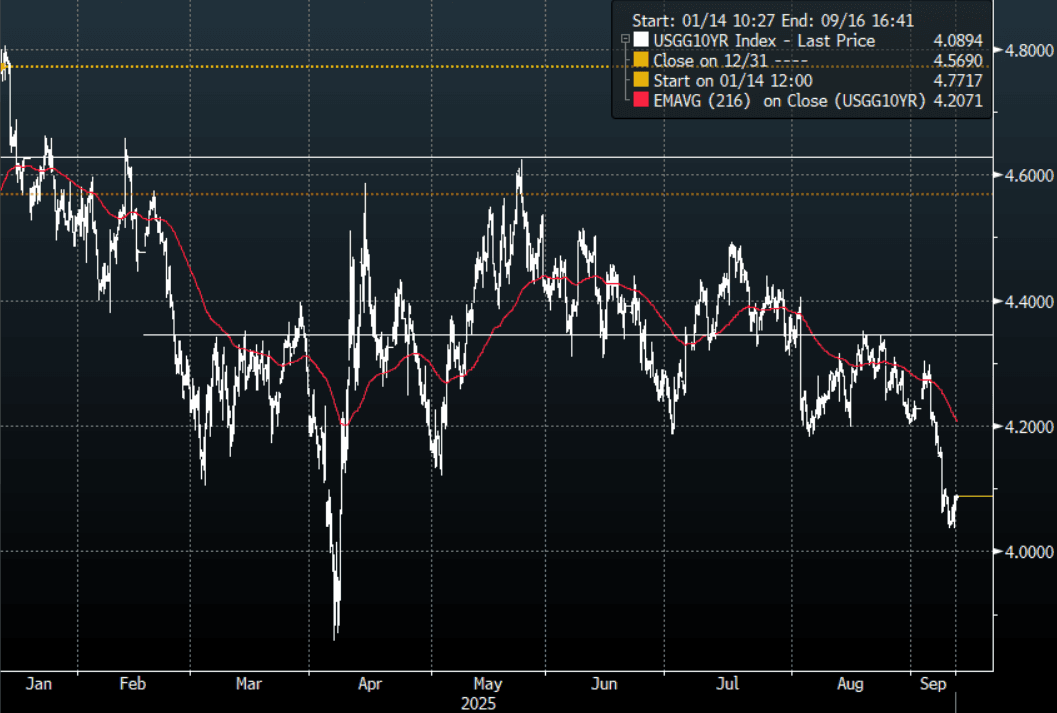
- The US 10-year yield has edged lower trading around 4.045%, up 0.01 from its close.
- 10-Year Yields have broken through its support as the market reacts to a labour market that is rapidly cooling. This move should now see buyers return on bounces with the first buy-zone back towards 4.20%. First target the 4.00% zone then the 3.80% area.
- MNI Policy: A federal judge Tuesday night granted a preliminary injunction blocking President Donald Trump from firing Federal Reserve Governor Lisa Cook while her lawsuit challenging her termination is resolved. The FOMC is set to meet again September 16-17.
- MNI US DATA: For PPI, current Bloomberg consensus is for a cooling after July’s hot print, with M/M final demand PPI at 0.3% (0.9% prior) and “core” (ex-food/energy/trade) also at 0.3% (0.6% prior). Core PCE estimates are for 0.31% M/M vs 0.27% prior, with no analysts seeing core PCE printing above core CPI. That could change based on various PPI components that feed into PCE, but as it stands, the M/M core PCE estimate would be the highest since February.
- Given increasing focus on labor risks it’s hard to imagine a set of inflation readings that stops the Fed from cutting 25bp as expected, but it could help shape the updated rate and economic projections to be released at the meeting (including the 2025 “dot” median), as well as Chair Powell’s tone.
- Data/Events: MBA Mortgage Applications, PPI, Wholesale Inventories/Sales
Fig 1: 10-Year US Yield 2H Chart
Source: MNI - Market News/Bloomberg Finance L.P
FOREX: Asia FX Wrap - The BBDXY Trades Heavy Back Above 1200
The BBDXY has had a range of 1200.35 - 1202.19 in the Asia-Pac session, it is currently trading around 1200, -0.07%. The USD had another crack at breaking lower but once more found decent demand just below 1197 and bounced, closing back above 1200. The market will be focused on the US inflation data tonight and tomorrow looking for the green light to test the lows again. A sustained break below 1197/1195 is needed to regain the momentum lower and retest the year's lows. Should the USD start another leg lower it would have big implications for FX and potentially see a lot of the recent ranges in G10 broken.
- EUR/USD - Asian range 1.1690 - 1.1714, Asia is currently trading 1.1710. The pair’s momentum higher stalled towards the 1.1800 area and then turned back lower. EUR is still within its wider 1.1350-1.1850 range with a bias to the topside.
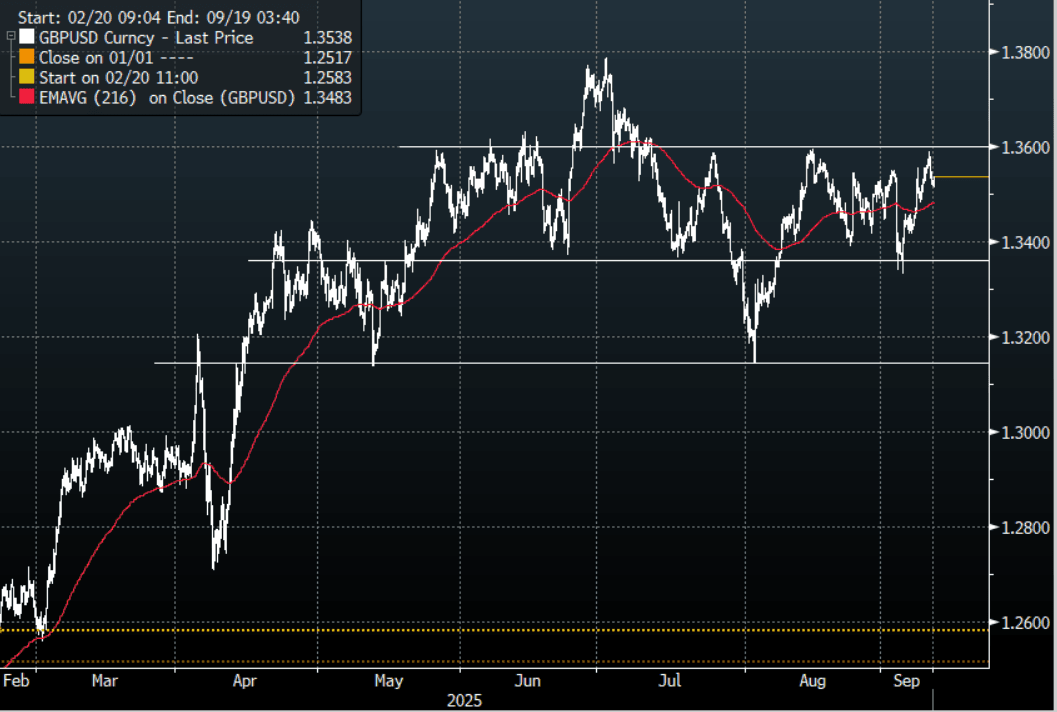
- GBP/USD - Asian range 1.3515 - 1.3536, Asia is currently dealing around 1.3535. The pair failed back towards 1.3600. The pair is back in the middle of its recent 1.3350-1.3650 range.
- USD/CNH - Asian range 7.1216 - 7.1288, the USD/CNY fix printed 7.1062, Asia is currently dealing around 7.1220. Sellers should be around on bounces while price holds below the 7.2200/2500 area and the PBOC manages the fix lower. Above 7.2500 and we could see a test of the USD Shorts.
- Cross asset : SPX +0.25%, Gold $3641, US 10-Year 4.0875%, BBDXY 1200, Crude Oil $63.26
- Data/Events : Spain Industrial Production, Italy Industrial Production
Fig 1: GBP/USD Spot 2H Chart
Source: MNI - Market News/Bloomberg Finance L.P
JPY: Asia Wrap - USD/JPY Support Holds, Consolidates On 147 Into US PPI
The Asia-Pac USD/JPY range has been 147.27-147.57, Asia is currently trading around 147.40, -0.01%. USD/JPY collapsed lower overnight giving the support towards 146.00 a proper test, but it proved to be solid once again as the market looks towards the US inflation data this week. The price then very quickly retraced back to the middle of its 146-149 range once more. CFTC data shows leveraged funds again added a decent clip to their short JPY position last week so they will be hoping the inflation data this week keeps this support intact. A move back below 145/146 is needed to potentially start seeing these positions being flushed out.
- It seems some protection lower down is being added to, in the event the support gives way. “Hedge funds added to bullish options wagers on the Japanese yen Tuesday following news that Bank of Japan officials were open to the idea of raising interest rates again this year, despite the political instability.” - BBG
- (Bloomberg) - USD/JPY will see more downside if Bank of Japan officials hammer home the point that another rate hike is possible this year. But FX traders remain skeptical about the prospect of higher rates.
- "AKAZAWA: WAGE GAINS SHOULD BE PRIORITY OVER TAX CUTS, JBIC WON'T FUND WHAT WON'T BENEFIT JAPAN" - BBG
- Options : Close significant option expiries for NY cut, based on DTCC data: 146.50($902m).Upcoming Close Strikes : 147.40($1.38b Sept 12), 150.00($1.11b Sept 11) - BBG.
- CFTC data shows last week asset managers again added to their JPY longs after a consistent period of reduction +78427( Last +76761), leveraged funds though again used the dip to add a decent clip to their newly built short JPY position -66914(Last -52275). One of them is going to be wrong.
Fig 1 : USD/JPY Spot Daily Chart

Source: MNI - Market News/Bloomberg Finance L.P
AUD: Asia Wrap - AUD Back Above 0.6600 As Risk Trades Higher Into Inflation Data
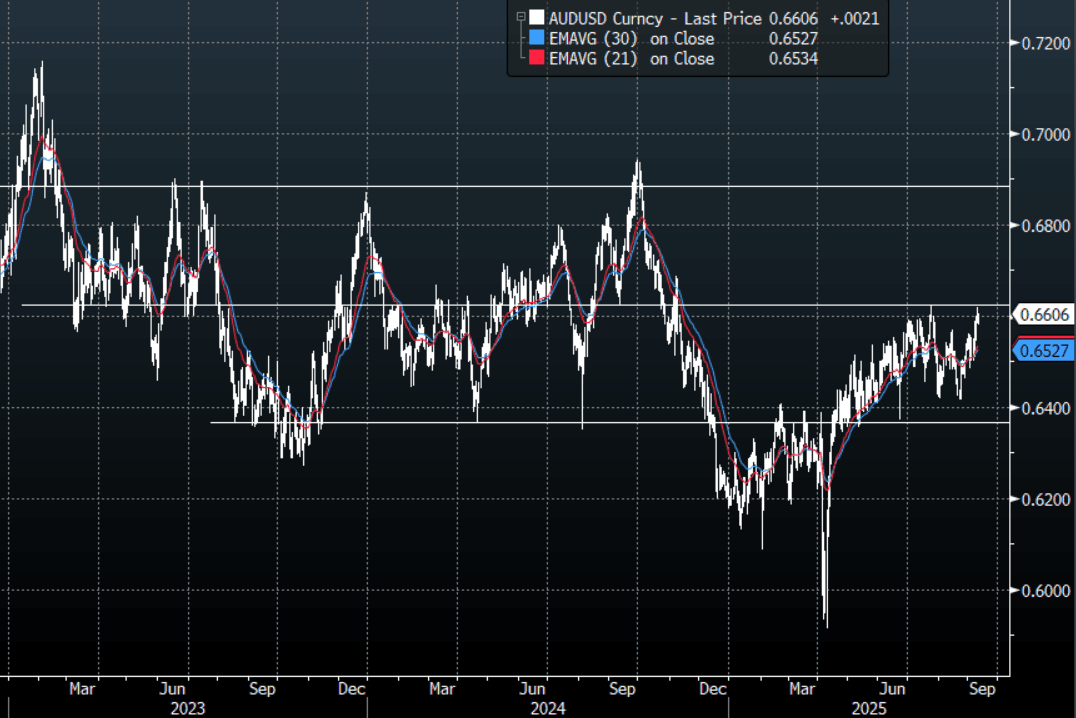
The AUD/USD has had a range of 0.6580 - 0.6606 in the Asia- Pac session, it is currently trading around 0.6605, +0.30%. US stocks are back at their highs even after record revisions to the payrolls data, nothing stops this train. The AUD is probing above 0.6600 again, having stalled overnight as the market awaits the inflation data this week. The AUD remains in its recent multi-month range of 0.6350-0.6650, should the USD break and extend lower we could potentially see the AUD break back above 0.6650. Should this occur it could provide the upward momentum to target levels back towards 0.6900/0.7000. Although still in the range the bias will be for dips back to 0.6500 to be supported for now.
- China Inflationary Pressures Fall Further: With some key onshore news suggesting that further monetary policy intervention is getting closer, today's CPI and PPI did little to dissuade that way of thinking. CPI in August declined -0.4%, ahead of estimates of -0.2% and the biggest drop since February.
- Melbourne Institute consumer inflation expectations for September are released on Thursday. It moderated substantially to 3.9% in August but the 3-month average has been around 4.5% since June.
- Options : Closest significant option expiries for NY cut, based on DTCC data: 0.6550(AUD797m). Upcoming Close Strikes : 0.6650(AUD597m Sept 11) - BBG
- CFTC Data last week shows Asset managers reduced their shorts for the first time in a while -66025(Last -78758), the Leveraged community though look to be rebuilding their own shorts after winding them down -11860(Last -6447).
- AUD/JPY - Asia-Pac range 96.99 - 97.29, Asia is trading around 97.20. The pair topped out towards 97.50 but has consolidated its recent gains. A sustained break above 97.50/98.00 is needed to reignite the upward trend.
Fig 1: AUD/USD spot Daily Chart
Source: MNI - Market News/Bloomberg Finance L.P
NZD: Asia Wrap - NZD/USD Bounces As Risk Moves Higher Into US Inflation Data
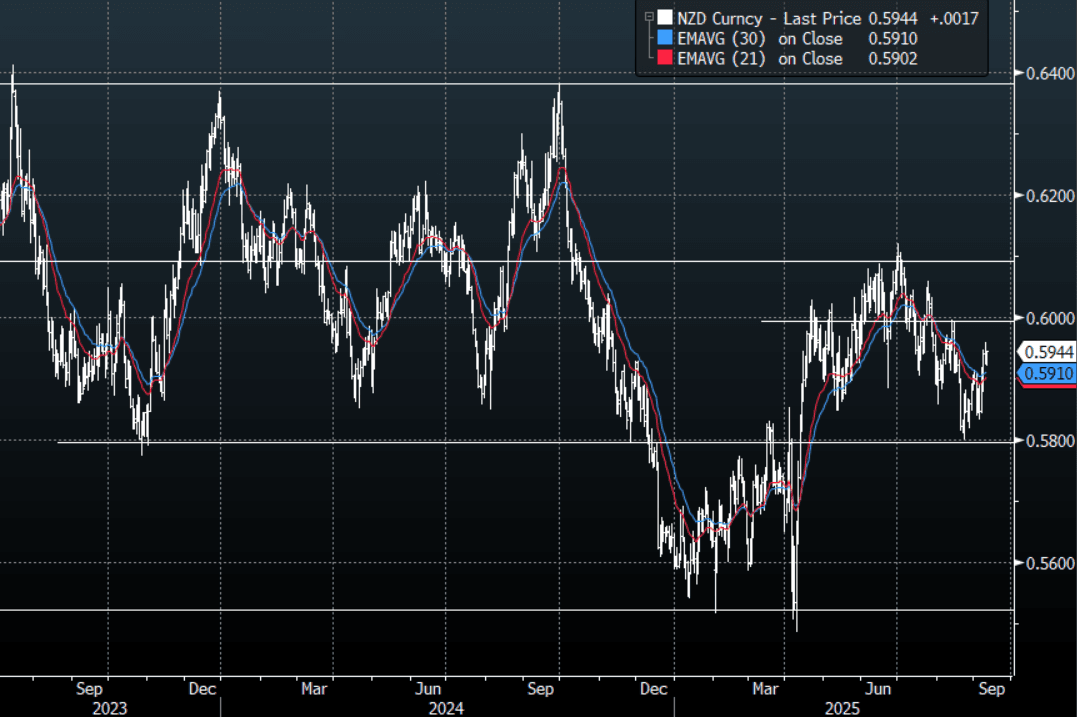
The NZD/USD had a range of 0.5921 - 0.5946 in the Asia-Pac session, going into the London open trading around 0.5945, +0.30%. US stocks are back at their highs even after record revisions to the payrolls data, nothing stops this train. The NZD has bounced into what should be the perfect zone to fade for bears, the price action for the USD though gives me pause. CFTC Data shows light positioning in a market that is struggling for a strong trend as we move back into the middle of the recent 0.5800-0.6100 range.
- MNI: RBNZ Leadership Woes Present Reform Opportunity. Suzanne Snively, a former board member and chair of the independent experts panel that led the 2017–22 RBNZ Act review, said the government may revisit the balance between RBNZ independence and ministerial control, with Finance Minister Nicola Willis likely to reopen debate over governance structures that were examined in the 2017–22 Act review.
- "NZ JULY NET MIGRATION ESTIMATE +2,060(Jun revised up to 1930 from 1670), NEW ZEALAND ANNUAL NET IMMIGRATION PICKED UP TO 13,066 IN JULY" - BBG
- On Thursday, Governor Hawkesby gives “brief remarks” at the Financial Services Council conference and again there will be no new information on the economy or the August MPC decision but there will be Q&A.
- Options : Closest significant option expiries for NY cut, based on DTCC data: 0.5800(NZD515m), 0.5870(NZD320m). Upcoming Close Strikes : none - BBG
- CFTC Data of last week shows Asset Managers added slightly to their new short position in the NZD -5127(Last -4743), the Leveraged community have completely exited their short and have turned a fraction long +285(Last -225)..
- AUD/NZD range for the session has been 1.1108 - 1.1122, currently trading 1.1115. The Cross is consolidating around 1.1100, dips back towards 1.1000/1.1050 should be supported now.
Fig 1: NZD/USD Spot Daily Chart
Source: MNI - Market News/Bloomberg Finance L.P
JGBS: Futures Up From Lows, BoJ Outlook Remains Focus, PPI Tomorrow
JGB futures sit up from earlier lows, showing a modestly positive bias post the lunch time break. We were last 137.93, -.07 versus settlement levels. Earlier lows were at 137.70.
- Focus remains on the BOJ outlook. Out Tokyo based policy team noted earlier - MNI discusses the diminishing chances for a 2025 BOJ hike, see this link for more details.
- This comes after BBG reports yesterday that the central bank could still hike this year, potentially as soon as Oct, even amidst fresh political turmoil.
- The Reuters monthly Tankan survey painted a resilient backdrop for manufacturing. "Manufacturers' sentiment index +13 in September vs +9 in August" (Rtrs). It added, "...showed the manufacturers' mood index improved to 13 in September from 9 in August, marking a third month of increases and the highest reading since August 2022." The official Tankan report for Q3 is due Oct 1.
- The 5yr debt sale came and went without much fanfare, another positive for futures post the lunch time break. The bid to cover was 3.7, versus 2.96 at the August auction. The tail of the auction was also unchanged at 0.03.
- In the cash JGB space, back end yields are holding softer, while the front end is slightly softer. The 30yr and 40yr tenors are down 2bps in yield. The 10yr was last around 1.57%. The JGB 2/30s curve is flatter by around 3bps, last +239.5bps.
- Tomorrow on the data front, we have the BSI industry and manufacturing surveys, along with the August PPI.
JAPAN DATA: Rtrs Monthly Tankan At Multi Yr Highs, Official Q3 Print Due Oct 1
Headlines crossed earlier from Reuters from its monthly survey tracking the BoJ's quarterly Tankan survey - "Manufacturers' sentiment index +13 in September vs +9 in August" (Rtrs). It added, "...showed the manufacturers' mood index improved to 13 in September from 9 in August, marking a third month of increases and the highest reading since August 2022."
- "Multiple managers in the transport machinery sector said they were receiving solid orders, while some referred to stagnant domestic production in recent months given a shrinkage in exports" (via Rtrs). However, the report also noted more caution around the outlook, reflecting concerns on the domestic economic backdrop.
- The official Q3 Tankan report will be out on Oct 1 and will be a key watch point for the BoJ, as it looks to gauge fallout from the US-Japan trade deal.
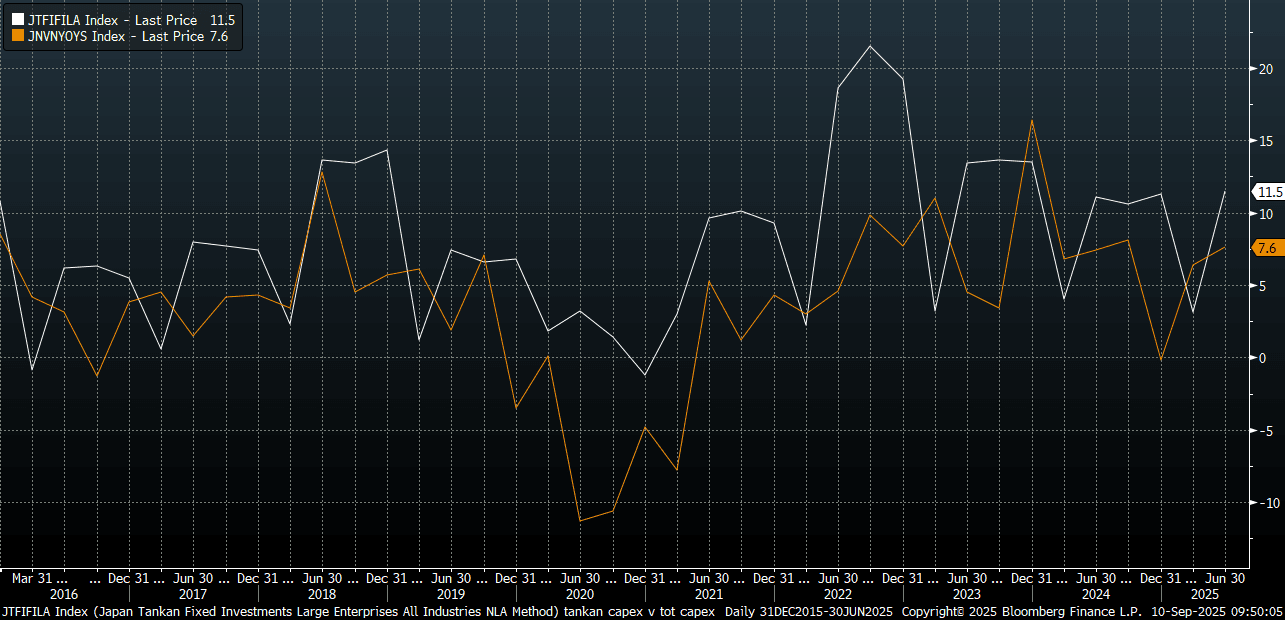
- The last Tankan survey for Q2 painted a resilient backdrop for large manufacturers, while the all industry capex estimate was also nudged higher. The chart below plots this capex estimate against total capex investment y/y.
- A resilient Q3 outcome could give the BoJ renewed confidence in the economic outlook and ring rate hikes back onto the agenda. We saw late yesterday some hawkish headlines via BBG, indicating there is a "chance of" a hike this year despite the political turmoil following PM Ishiba's resignation Sunday, which also weighed on USD/JPY (but follow through to the downside was limited). "Some officials are even of the view that a hike might be appropriate as early as October", the Bloomberg article added.
- Market pricing for a hike in Oct remains fairly modest at this stage though.
Fig 1: Tankan Capex Estimate & Capital Investment Y/Y
Source: Bloomberg Finance L.P/MNI
AUSSIE BONDS: Futures Softer, But Up From Lows, Yields Tracking Recent Ranges
Aussie Bond futures are holding slightly weaker, both the 10yr (XM) and 3yr (YM) off around 2.5bps. 10yr futures were last 95.69, up from earlier lows of 95.675, while 3yr futures are at 96.535, (earlier lows were 96.525). Cash ACGB yields hold around 2bps firmer across the curve, with gains close to uniform. The 3yr yield is around 3.44%, while the 10yr is just under 4.285%.
- For the 3yr yield, downside focus is likely to rest sub 3.40%, which we haven't meaningfully breached in Sep to date, while recent highs rest around 3.55%. For the 10yr, we have spent little time sub 4.20% in recent months, while topside interest has been capped above 4.40%.
- Like NZ, news/data flow has been light in Australia today.
- Tomorrow we get Sep consumer inflation expectations.
- Earlier, via BBG: "Australia sold A$1 billion ($658.8 million) of bonds due Nov. 21, 2031 on Sept. 10."
BONDS: NZGBS: Holding 2-4Bps Firmer, RBNZ To Consult On OMOs
Benchmark NZGB yields how around 2-4bps higher for Wednesday trade. Outside of early yield moves, which followed US gains from Tuesday trade, we have seen quite steady trends through the rest of trade today. The 2yr yield rests at 2.96%, while the 10yr is just above 4.33%, up around 4bps. The 2/10s curve is a touch steeper at +137bps. The 2yr swap rate is down a touch to 2.745%.
- US Tsy futures are a touch weaker so far today, while cash yields are little changed ahead of key inflation data (both this evening and on Thursday).
- The data calendar just had net migration figures for July, not a market mover. We were up +2k and showing some signs of stabilization, with annual migration up to +13k. Still, we are coming from a low base, so further recover is likely needed for this to benefit the economy more broadly.
- The RBNZ announced: "We are consulting on how we conduct Open Market Operations and are seeking input on design considerations for a Committed Liquidity Facility. This consultation builds upon previous work, including speeches and Bulletins given as part of the Liquidity Management Review. Respondents to the consultation may choose to comment on one or both parts of the consultation and whichever questions are relevant to them. This consultation is open until 31 October."
- The data calendar is empty tomorrow, with Friday delivering the Aug PMI, along with card spending figures.
ASIA STOCKS: Sea of Green for Asia's Major Bourses
After two days of significant falls, calm has returned in Jakarta as the new finance minister preaches fiscal discipline whilst setting an aggressive growth target. In Korea, the KOSPI is strong again as the President indicates he is considering removing the proposed tax on capital gains on stocks. The bourses in China continue to power on as news that domestic insurers allocation to equity has hit their highest in 3-years. All major bourses were up today in a strong day across the region.
- The Hang Seng led the way for the China bourses, up +1.19%, the CSI 300 up +0.22%, the Shanghai Comp +0.17% and the Shenzhen Comp +0.15%.
- The NIKKEI bounced back from yesterday's falls and is up +0.71%.
- The TAIEX in Taiwan is up +1.45% for six days of gains as strong portfolio inflows return.
- The KOSPI is the best regional performer today, up +1.60%.
- The Jakarta Composite bounced back and is up +0.95% whilst the FTSE Malay KLCI is up +0.15%.
- The NIFTY 50 is up +0.54% for six consecutive days of gains.
OIL: Geopolitics Drives Brent Above Resistance, US Crude Stocks & PPI Later
Oil prices are higher again during today’s APAC trading after rising around 0.8% on Tuesday finding support from increased Middle East tensions following Israel’s strike on Hamas leaders in Qatar. WTI is up 0.9% to $63.22/bbl, close to the intraday high, and Brent is 0.9% higher at $67.01/bbl. The USD index is down 0.1%.
- Brent has broken above initial resistance at $69.53 opening up key resistance at $71.93. This week’s gains are still seen as corrective but a break of $71.93 may change that.
- The FT reported that President Trump told European representatives that he’s prepared to impose the same tariffs as Europe on China and India for buying Russian energy. However, Trump said he had spoken with his “good friend” Indian PM Modi and that trade negotiations were ongoing between them and that he expects “a successful conclusion for both”.
- Bloomberg reported that there was a US crude inventory build of 1.3mn barrels last week, according to those familiar with the API data. The official EIA data is out Wednesday.
- Later August US PPI data are released and will be watched closely given that a 25bp rate cut is fully priced in for September 17. CPI is out on Thursday. The ECB’s Buch speaks today.
Gold Higher Ahead Of US PPI Data
Gold prices are off their intraday low of $3620.47/oz despite the ruling that temporarily blocks President Trump removing Fed Governor Cook. The judge said that possible mortgage fraud was unlikely to be “cause” for dismissal and that the way she was dismissed was against the constitution. With threats to Fed independence recently driving bullion higher, it has not responded to the news. Gold is currently up 0.4% to $3639.0 supported by increased Middle East tensions as well as a lower US dollar (BBDXY -0.1%). US yields are steady.
- Bullion reached a high of $3640.91 early in today’s APAC trading holding below yesterday’s record of $3674.27.
- The FT reported that President Trump told European representatives that he’s prepared to impose the same tariffs as Europe on China and India for buying Russian energy. However, Trump said he had spoken with his “good friend” Indian PM Modi.
- Gold has found support from increased central bank buying with the PBoC purchasing over successive months but Bloomberg reported that RBI is also accumulating and that Czech holdings are at record.
- After falling 1.2% on Tuesday, silver is 0.4% higher today at $41.03. It fell to $40.721 and then recovered to a high of $41.045.
- Equities are rallying with the S&P e-mini up 0.2%, Hang Seng +1.2% and KOSPI +1.5%. Oil prices are higher again with WTI +0.9% to $63.20/bbl. Copper is up 0.4%.
- Later August US PPI data are released and will be watched closely given that a 25bp rate cut is fully priced in for September 17. CPI is out on Thursday. The ECB’s Buch speaks today.
CHINA: Inflationary Pressures Fall Further
- With some key onshore news suggesting that further monetary policy intervention is getting closer, today's CPI and PPI did little to dissuade that way of thinking.
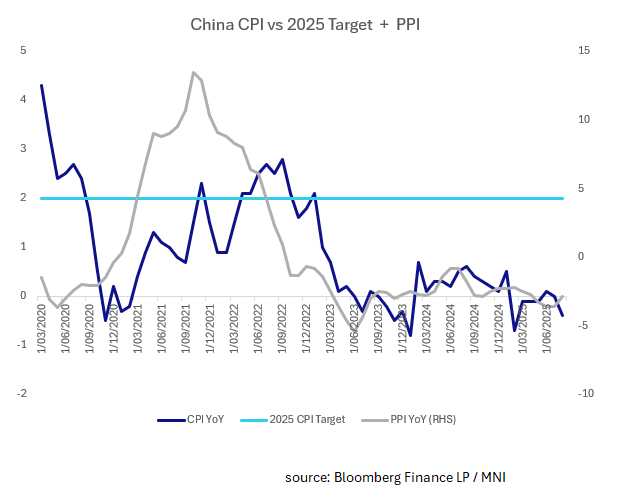
- CPI in August declined -0.4%, ahead of estimates of -0.2% and the biggest drop since February.
- The fall in CPI highlights the risks to a slowing economy, despite story in Yicai yesterday claiming that their chief economist survey showing a growing confidence in the economic outlook.
- In 2025 there has been just two months of barely positive prints for CPI, one zero and the remainder all modestly negative to underscore the reality of a third successive year of deflationary pressures.
- Whilst retail sales, industrial production and exports remain positive, it is clear that the pace of expansion has decreased.
- Domestic demand has been weighed down for several years by the malaise in real estate which has seen a multi year decline in house prices.
- China's August PPI declined by -2.9%, from -3.6% in July.
- For PPI the story remains the same with the last positive print in September 2022.
INDIA: US Trade Deficit With India Has Widened Over Last 5 Years
The FT reported that President Trump told European representatives that he’s prepared to impose the same tariffs as Europe on China and India for buying Russian energy. However, Trump also said he had spoken with his “good friend” Indian PM Modi and that trade negotiations were ongoing between them and that he expects “a successful conclusion for both”.
- On August 27 US import duties of 50% came into effect on Indian products. 25% was the reciprocal tariff, down only 1pp from the initial rate proposed, and another 25% was punitive for India’s significant imports of Russian oil which it has refused to stop purchasing. The US’s main export to India is oil and gas.
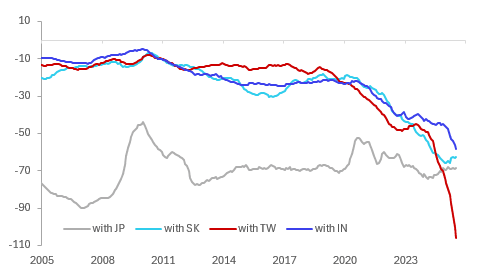
- India’s 2024 trade deficit with the US had almost doubled since 2020 but 2025 is on track to see it grow sharply but India has frontloaded shipments since March to beat duties and they could ease off over H2.
US trade deficit $bn 12mth sum
Source: MNI - Market News/LSEG
- India has one of the higher export shares to US in the region at 20% in 2024 but as a share of its economy it is low at only 2.6% of GDP.
- The main sectors impacted by higher US import duties are pharmaceuticals followed by miscellaneous manufacturing commodities, communications equipment, apparel and textile furnishings.
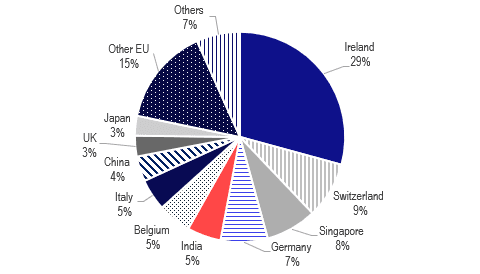
- India is only the 10th largest source of US merchandise imports worth 2.7% of the total and in terms of Asian countries it is behind Taiwan and South Korea who are facing US tariffs of 20% and 15% respectively. 5.2% of US pharmaceutical imports come from India, the 5th largest.
US imports of pharmaceuticals & medicines % total 2024
PHILIPPINES: Unemployment Jumps in July
- Philippines Unemployment jumped in July to the highest level since August 2022.
- For the early part of 2025, there had been a steady, modest decline in the unemployment rate.
- Despite five rate cuts since August 2024, the argument that monetary policy has more work to do appears to be growing
- The BSP next meets October 9

UP TODAY (TIMES GMT/LOCAL)
| Date | GMT/Local | Impact | Country | Event |
| 10/09/2025 | 0600/0800 | *** |  NO | CPI Norway |
| 10/09/2025 | 0600/0800 | ** |  SE | Private Sector Production m/m |
| 10/09/2025 | 0700/0900 | ** |  ES | Industrial Production |
| 10/09/2025 | 0800/1000 | * |  IT | Industrial Production |
| 10/09/2025 | 0900/1000 | ** |  GB | Gilt Outright Auction Result |
| 10/09/2025 | 1100/0700 | ** |  US | MBA Weekly Applications Index |
| 10/09/2025 | 1145/1345 |  CH | SNB's Schlegel on Central Bank Communication in Vezia | |
| 10/09/2025 | - | *** |  CN | Money Supply |
| 10/09/2025 | - | *** | CN | New Loans |
| 10/09/2025 | - | *** | CN | Social Financing |
| 10/09/2025 | 1230/0830 | *** | US | PPI |
| 10/09/2025 | 1230/0830 | *** | US | PPI |
| 10/09/2025 | 1400/1000 | ** | US | Wholesale Trade |
| 10/09/2025 | 1400/1000 | ** | US | Wholesale Trade |
| 10/09/2025 | 1430/1030 | ** | US | DOE Weekly Crude Oil Stocks |
| 10/09/2025 | 1430/1030 | ** | US | US DOE Petroleum Supply |
| 10/09/2025 | 1700/1300 | ** | US | US Note 10 Year Treasury Auction Result |
| 11/09/2025 | - |  EU | European Central Bank Meeting | |
| 11/09/2025 | 0600/0800 | *** | SE | Final Inflation Report |
| 11/09/2025 | 0600/0800 | *** | SE | Final Inflation Report |
| 11/09/2025 | 1100/0700 | *** |  TR | Turkey Benchmark Rate |
| 11/09/2025 | 1215/1415 | *** | EU | ECB Deposit Rate |
| 11/09/2025 | 1215/1415 | *** | EU | ECB Main Refi Rate |
| 11/09/2025 | 1215/1415 | *** | EU | ECB Marginal Lending Rate |
| 11/09/2025 | 1230/0830 | *** | US | Jobless Claims |
| 11/09/2025 | 1230/0830 | ** | US | WASDE Weekly Import/Export |
| 11/09/2025 | 1230/0830 | * |  CA | Household debt-to-income |
| 11/09/2025 | 1230/0830 | *** | US | CPI |
| 11/09/2025 | 1230/0830 | *** | US | CPI |
| 11/09/2025 | 1230/0830 | *** | US | CPI |
| 11/09/2025 | 1245/1445 | EU | ECB Press Conference |


