MNI EUROPEAN MARKETS ANALYSIS: Fed Speak In Focus Later
- US equity futures have tracked lower today in response to the Moody's US government credit downgrade from late on Friday. US Tsy yields are higher, led by the backend. Trump's tax bill also passed a key Republican committee.
- The USD was down, but mostly against the safe havens, aggregate moves aren't large though.
- China April activity data was mixed, with retail softer, but IP firmer, housing headwinds persisted though. House price falls were larger in April compared to March.
- Later the FOMC’s Bostic, Jefferson, Williams, Logan and Kashkari appear. The Atlanta Fed’s financial market conference takes place until May 21. The April US leading index and euro area April CPI are released.
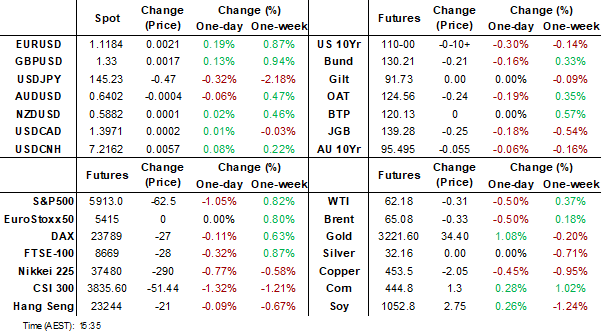
MARKETS
US TSYS: Asia Wrap - Yield Curves Steepen
TYM5 has traded higher within a range of 109-29 to 110-08 during the Asia-Pacific session. It last changed hands at 109-30, down 0-12 from the previous close.
- The US 2-year yield has edged lower, dealing around 3.988%, down 0.01 from its close.
- The US 10-year yield has moved higher, dealing around 4.510%, up 0.03 from its close.
- This has seen the yield curve steepen in Asia - 2s10s +4.42 at 51.753.
- (Bloomberg) -- “Goldman Sachs interest-rate strategists raise their year-end Treasury yield forecasts following a larger-than-expected reduction in US-China tariffs.”
- “A later and slower baseline for Fed cuts, a still challenging (if less severely so) growth versus inflation trade-off, and the broader fiscal trend all underpin our upward revision to US yields,” wrote a Goldman team including George Cole and William Marshall in a Friday note”
- “Goldman Sachs now sees: End-2025 2-year Treasury yield at 3.90% (3.30% previously), End-2025 10-year Treasury yield at 4.50% (4.00% previously).”
- US HOUSE PANEL APPROVES TRUMP TAX CUT BILL, SETTING UP A POSSIBLE VOTE ON PASSAGE THIS WEEK - [RTRS]"
- The 10-year Yield looks likely to test the 4.5% resistance area again on the downgrade. A sustained break above this level could see another round of selling targeting the 4.75% area. Support towards 4.35% held Friday night, dips back towards here should see supply emerge once more.
- Data/Events : Atlanta Fed President Raphael Bostic , Dallas Fed President Lorie Logan and Fed Vice Chair Philip Jefferson speak at Amelia Island conference. New York Fed President John Williams speaks at an event organized by the Mortgage Bankers Association.
JGBS: Belly Leads Curve Cheaper, Tariff Discussions In Focus
JGB futures are weaker and near Tokyo session lows, -27 compared to settlement levels.
- March Tertiary Industry Index fell 0.3% m/m versus -0.2% estimate.
- “Japan's Prime Minister Shigeru Ishiba says the country won't compromise its national interests in trade talks with the US by fixating on time limits. Japan will continue to seek exemptions for all additional tariffs imposed by the US and won't accept a deal that doesn't address the 25% tariff on cars.” (per BBG)
- Cash US tsys have twist-steepened in today's Asia-Pac session, with yields 1bp lower to 4bps higher, as the market continued to digest late Friday news that Moody's Ratings downgraded the US credit score.
- "US House panel approves Trump tax cut bill, setting up a possible vote on passage this week" - [RTRS]
- Cash JGBs are flat to 2bps cheaper across benchmarks, with the belly leading. The benchmark 10-year yield is 1.5bps higher at 1.478% versus the cycle high of 1.596%.
- Swap rates are flat to 1bp lower, with swap spreads tighter.
- Tomorrow, the local calendar will see Tokyo Condominiums for Sale data alongside 20-year supply.
- The G7 will hold a meeting from the 20th to the 22nd, with attention focused on whether foreign exchange rates will be discussed in relation to tariffs.
AUSSIE BONDS: Cheaper Ahead Of RBA Policy Decision Tomorrow
ACGBs (YM -4.0 & XM -6.0) are cheaper on a data-light Sydney session.
- Cash US tsys have twist-steepened in today's Asia-Pac session, with yields 1bp lower to 4bps higher, as the market continued to digest late Friday news that Moody's Ratings downgraded the US credit score.
- (Bloomberg) -- “Goldman Sachs interest-rate strategists raise their year-end Treasury yield forecasts following a larger-than-expected reduction in US-China tariffs.”
- “US House panel approves Trump tax cut bill, setting up a possible vote on passage this week” - [RTRS]
- Cash ACGBs are 4-6bps cheaper with the AU-US 10-year yield differential at flat.
- The bills strip has bear-steepened, with pricing -2 to -6.
- Tomorrow, the local calendar will see the RBA Policy Decision, with the market expecting a 25bp cut to 3.85%.
- RBA-dated OIS pricing is flat to 4bps firmer across meetings today. A 25bp rate cut in May is given a 95% probability, with a cumulative 75bps of easing priced by year-end. Notably, today’s moves leave meetings pricing 4-44bps firmer than levels before the release of Q1 CPI data on April 30.
- The AOFM plans to sell A$1200mn of the 4.25% 21 December 2035 bond on Wednesday and A$800mn of the 2.75% 21 November 2028 bond on Friday.
BONDS: NZGBS: Closed At Cheaps With A Bear-Steepener, US Downgrade In Focus
NZGBs closed at session cheaps, showing a bear-steepener, with yields 5-8bps higher.
- Producer output prices rose 2.1% q/q in Q1, the largest quarterly increase since mid-2022.
- “New Zealand will change its thin capitalisation rules to remove a roadblock to foreign investment”, Finance Minister Nicola Willis says.
- “New Zealand's monthly prices suggest inflation is gaining momentum, pointing to upside risks to the Reserve Bank of New Zealand's 2Q25 outlook.” (per BBG)
- Swap rates closed 4-6bps higher, with implied swap spreads tighter.
- Nevertheless, the market’s attention was focused abroad with cash US tsys twist-steepening in today's Asia-Pac session. US yields are 1bp lower to 5bps higher with the market continuing to digest late Friday news that Moody's Ratings downgraded the US credit score.
- RBNZ dated OIS pricing closed flat to 3bps firmer across meetings, late 2025 / early 2026 leading. 25bps of easing is priced for May, with a cumulative 63bps by November 2025.
- Tomorrow, the local calendar will be empty ahead of trade balance data on Wednesday and the Budget on Thursday.
- On Friday, the NZ Treasury plans to sell NZ$250mn of the 3.00% Apr-29 bond, NZ$150mn of the 3.50% Apr-33 bond and NZ$50mn of the 1.75% May-41 bond.
FOREX: FX Wrap - USD Stuggles On Downgrade
The BBDXY has had a range of 1228.00 - 1230.27 in the Asia-Pac session, it is currently trading around 1230. “The ECB’s Christine Lagarde told La Tribune Dimanche the euro’s strength against the dollar is “counterintuitive, but justified” amid Trump’s erratic policies and presents an opportunity for Europe. She said she’s “not at all pessimistic” about the bloc’s economy.”(BBG)
- EUR/USD - Asian range 1.1173 - 1.1199, Asia is currently trading 1.1185. EUR/USD has had a quiet session considering the backdrop. The market is still expected to use dips as a buying opportunity and dips back towards 1.09/1.10 should see buyers remerge.
- GBP/USD - Asian range 1.3267 - 1.3314, Asia is currently dealing around 1.3300. Decent demand for GBP sub 1.3200 has seen it bounce back to the middle of its recent range 1.3150 - 1.3450. Like the EUR the market prefers to buy on dips, building for the next leg higher.
- USD/CNH - Asian range 7.2042 - 7.2180, the USD/CNY fix printed 7.1916. Asia is currently dealing around 7.2160. Sellers should be found on a bounce back towards 7.24/25 again.
- Cross asset : SPX -1.01%, Gold $3215, US 10-Year 4.51%, BBDXY 1229, Crude oil $62.23
Data/Events : ECB Muller & SNB Schlegel to speak, Spain Trade Balance, EZ CPI
Fig 1: GBP/USD Spot Daily Chart

Source: MNI - Market News/Bloomberg
JPY: Asia Wrap - USD/JPY Demand Seen Sub 145.00
The Asia-Pac range has been 144.81 - 145.47, Asia is currently trading around 145.30. USD/JPY opened lower and traded heavily for most of our session on the back of a knee-jerk reaction lower in stocks to the downgrade news.
- MNI - China Data: “The April activity outcomes were mixed, with retail weaker than forecast, while IP posted a modest upside surprise. Both measures slowed versus March outcomes. Headwinds still persist in the property sector, while house price growth slipped further into negative territory.”
- "*ISHIBA: CAN'T ACCEPT US TARIFFS INCLUDING FOR CARS" - BBG
- JAPAN FINMIN KATO: JAPAN NOT FACING PROBLEM PROCURING FUNDS FROM MARKET VIA DEBT ISSUANCE, IF JAPAN LOSES MARKET TRUST IN ITS FINANCES, IT MAY FACE RISE IN INTEREST RATES THAT COULD AFFECT DEBT REDEMPTION" RTRS
- USD/JPY tested below 145.00 this morning as stocks turned down, some demand seen below 145.00 after the Japanese fix.
- The support around 144/145 looks important now and a break would once again bring the focus back to the pivotal 140.00 area. The price action though does not look great and the market is still more comfortable selling rallies..
Options : Closest significant option expiries for NY cut, based on DTCC data: Y141.90($1.07bln), Y147.00($969.6m), Y146.50($780.7m), Upcoming Strikes : 145.50($1.03b May 20), 145.00($789.7m May 20), 142.00($878m May21)
Fig 1 : USD/JPY Spot Daily Chart

Source: MNI - Market News/Bloomberg
NZD: Asia Wrap - NZD Drifts Higher
The NZD/USD had a range of 0.5875 - 0.5899 in the Asia-Pac session, going into the London open around 0.5890.
- MNI - China Data : “The April activity outcomes were mixed, with retail weaker than forecast, while IP posted a modest upside surprise. Both measures slowed versus March outcomes. Headwinds still persist in the property sector, while house price growth slipped further into negative territory.”
- The NZD/USD has held up pretty well considering the knee-jerk reaction lower in stocks to the downgrade news.
- The NZD now seems to be comfortable in a 0.5800/0.6050 range and awaits a catalyst to provide the impetus to break-out.
- The support back towards 0.5800 has held very well, and while this continues to hold expect buyers to be around on dips. The first target is the highs just above 0.6000, a break above here is needed to regain momentum.
- CFTC Data showed Asset managers continuing to build back their shorts, while the leveraged community continued to reduce their own short.
- Options : Closest significant option expiries for NY cut, based on DTCC data: 0.5915(NZD1.06Bln)
AUD/NZD range for the session has been 1.0872 - 1.0899, currently trading 1.0885. The Cross has found some supply just above 1.0900, support is seen back towards 1.0800. A sustained break above 1.0920 would turn the focus higher.
Fig 1: NZD/USD Spot Daily Chart

- Source: MNI - Market News/Bloomberg
The AUD/USD had a range of 0.6400 - 0.6422 in the Asia- Pac session, it is trading around 0.6410. AUD/USD continues to find demand sub 0.6400, while underperforming in the crosses.
- “Australia is “up for a deal” with the EU but not at any price, PM Anthony Albanese said, offering cautious optimism after years of talks.”(BBG)
- MNI - The RBA decision is announced tomorrow and is widely expected to cut rates 25bp to 3.85% after Q1 trimmed mean CPI fell within the 2-3% target band. After stronger-than-expected Q1 wages and April employment data, it is likely to retain its cautious tone regarding future easing and reiterate that uncertainty is currently very high. Updated staff forecasts will be published with the meeting statement.
- Bloomberg - “The Australian dollar is positioned for upside should the RBA deliver a hawkish cut. The trimmed mean CPI remains substantially above the middle of the 2 to 3% target range, while labor market data is holding firm and fiscal spending is strong. The central bank is overwhelmingly expected to ease policy, but those factors argue for policymakers to express caution about further reductions if they do so. Investors are betting the RBA will lower rates twice in the second half of the year, so those positions look vulnerable to a rapid unwind.”
- (Bloomberg) -- “A few larger exporters were seen buying the Australian dollar in the Tokyo morning session to hedge out their US dollar receipts, according to Asia-based FX traders.”
- The AUD/USD has found demand around again 0.6400 today, expect buyers to be around on dips while the support in the AUD holds, a close back below 0.6300/50 would start to challenge the newly formed uptrend.
- MNI FX OPTIONS: Expiries for May19NY cut 1000ET (Source DTCC) : AUD/USD: $0.6525(AUD393.9m), Upcoming Strikes : 0.6350(AUD367m May 20)
AUD/JPY - Today's range 92.88 - 93.23, it is trading currently around 93.10. Support is again being challenged back towards the 93.00 area. There should be some demand around 92.00/93.00 first up but a sustained close back below 91.50/92.00 would turn the focus back towards the lows again.
Fig 1: AUD/USD spot Daily Chart

Source: MNI - Market News/Bloomberg
FOREX: Asset Managers Added To Commodity FX Shorts Last Week - Per CFTC
The table below updates the CFTC FX positioning data for leveraged and asset manager contracts shifts and outright positions, as at the end of last week. Trends were mixed across the leveraged and asset manager space. Asset managers added to commodity FX shorts.
- Leverage contracts saw yen longs added too, increasing the aggregate net long in this space. EUR saw net buying, but outright leveraged contracts are close to flat. GBP longs were trimmed.
- AUD shorts were cut, a trend that has been evident since the early parts of May. CAD shorts were added to by leveraged players.
- In the asset management space, JPY longs were cut, while AUD shorts were added too. These were the two main trends, with EUR and GBP asset manager positioning not shifting a great deal.
- NZD and CAD short shorts were added too for asset managers.
Table 1: CFTC FX Positioning Update - By Investor Type & Currency
| Leveraged Contracts | Asset manager Contracts | |||
| Weekly Change | Outright Position | Weekly Change | Outright Position | |
| JPY | 4039 | 24741 | -14374 | 110919 |
| EUR | 2154 | -5314 | 8992 | 335868 |
| GBP | -4711 | 36971 | 106 | -5910 |
| AUD | 7334 | -5553 | -14638 | -27899 |
| NZD | 1916 | -3532 | -3151 | -20157 |
| CAD | -9867 | -36196 | -9991 | -68087 |
| CHF | 3 | -898 | 253 | -25010 |
| MXN | -5259 | -1683 | 6028 | 27109 |
Source: CFTC/MNI - Market News/Bloomberg
ASIA STOCKS: Major Bourses Down on US Downgrade
Major bourses across the region despite China's industrial production in April beating expectations. Across the region the key focus was not earnings or regional economic data but the Moody's downgrade of the US and news that the US consumer continues to be very pessimistic.
Alibaba shares drop as much as 4.8% in Hong Kong following a New York Times report that the Trump administration has raised concerns over Apple’s potential deal with the Chinese tech giant as Hong Kong prepares for teh trading of CATL trading debut, following its price at what was considered the top end of its range.
- Major bourses are lower in China with the Hang Seng down -0.50%, CSI 300 -0.38% Shanghai Comp -0.10% and Shenzhen down -0.10%.
- The TAIEX in Taiwan is down -1.25%
- The KOSPI has had its worst fall since the middle of April, down -1.20%.
- The FTSE Bursa Malaysia KLCI had its biggest drop since early April, down -1.03%
- The Jakarta Composite is one of the few risers today, up +0.25% to continue its recent good run.
- Singapore's FTSE Straits Times is down -0.17% and the PSEi in the Philippines is down -0.15%.
- India's NIFTY 50 is holding onto very modest gains in the morning session, up just +0.08% following last weeks gains in excess of 4%
ASIA STOCKS: A US$5bn Week of Inflows for Asia
Asia continues to enjoy strong inflows with most countries’ net positive for last week, and the total for the surveyed markets exceeding US$5bn.
- South Korea: Recorded outflows of -$6m on Friday, bringing the 5-day total to +$684m. 2025 to date flows are -$11,360m. The 5-day average is +$137m, the 20-day average is +$22m and the 100-day average of -$128m.
- Taiwan: Had inflows of +$543m as of Friday, with total inflows of +$3,381m over the past 5 days. YTD flows are negative at -$11,090. The 5-day average is +$676m, the 20-day average of +$418m and the 100-day average of -$124m.
- India: Had inflows of +$671m as of the 15th, with total inflows of +$807m over the past 5 days. YTD flows are negative -$10,088m. The 5-day average is +$161m, the 20-day average of +$333m and the 100-day average of -$120m.
- Indonesia: Had inflows of +$32m as of Friday, with total inflows of +$221 over the prior five days. YTD flows are negative -$2,947m. The 5-day average is +$44m, the 20-day average -$31m and the 100-day average -$33m
- Thailand: Recorded outflows of -$34m as of Friday, outflows totaling -$175m over the past 5 days. YTD flows are negative at -$1,747m. The 5-day average is -$35m, the 20-day average of -$18m the 100-day average of -$18m.
- Malaysia: Recorded inflows of +$43m as of Friday, totaling +$421m over the past 5 days. YTD flows are negative at -$2,090m. The 5-day average is +$84m, the 20-day average of +$38m and the 100-day average of -$24m.
- Philippines: Saw outflows of -$7m as of Friday, with net inflows of +$5m over the past 5 days. YTD flows are negative at -$224m. The 5-day average is +$1m, the 20-day average of +$3m the 100-day average of -$3m.

OIL: Crude Monitoring Developments On Many Fronts
After rising over a percent on Friday, crude is moderately lower in APAC trading today following April data showing weaker retail sales and property sector in China. Brent is down 0.4% to $65.16 after falling to $64.69 early in the session, while WTI is -0.3% to $62.28 after a low of $61.77. The early sell off was driven by concern regarding the strength of US growth in the wake of Moodys’ downgrade. The USD index is down 0.2%.
- The progress of negotiations on Iran’s nuclear programme, US trade deals and peace in Ukraine remain highly uncertain. Iranian President Pezeshkian has said it won’t give up its non-military nuclear programme. Estimates suggest that an easing of sanctions on Russia and Iran would only have a moderate impact on global oil supplies as both have been able to find ways around restrictions.
- US President Trump has said that he will speak by phone to Russian President Putin about an end to the war in Ukraine at 10:00 EDT (14:00 GMT) today. This will be followed by a call with Ukrainian President Zelensky and some NATO leaders.
- China’s April IP data showed a 1.5% y/y rise in crude production but 8.1% y/y in natural gas.
- Later the FOMC’s Bostic, Jefferson, Williams, Logan and Kashkari appear. The Atlanta Fed’s financial market conference takes place until May 21. The April US leading index and euro area April CPI are released.
Gold Bounces on Market Weakness
- Gold has had a better day today in the Asia trading day, rising +0.36% to US$3,215.30.
- Despite solid Chinese data (I/P beat expectations, retail sales in line) equity markets fell giving gold a boost.
- Gold is also likely being supported by the Moody's downgrade of the US rating given concerns for the economic outlook and budget deficit.
- Gold prices fell 1.1% on Friday to $3203.65/oz pressured by higher US yields after a low of $3154.60 to be down 3.6% on the week and 2.6% in May. Bullion has been trending lower since its peak on May 6 at $3435.62. The USD index rose 0.2%.
CHINA: House Prices Down Shanghai a Brightspot (updated)
- April's house price data continued to highlight the challenges for authorities in achieving a recovery in the multi-year downturn in house prices.
- April's new house prices decline increased from March to -0.12%, representing 23 consecutive months of contracting.
- April's used house prices decline increased from March to -0.41%, representing a contraction in every month since the last expansion in April 2023.
- New home prices did rise in 22 cities MoM compared to March and 3 cities saw growth YoY.
- Used home prices in 5 cities rose MoM.
- Beijing saw a rise in new home prices of +0.01% MoM yet declined -5% YoY.
- Shanghai saw a rise in new home prices of +0.5% MoM whilst delivering a +5.9% YoY increase.

CHINA: Hard to See Significant Tariff Impacts in April Data
- April data releases showed limited impact from the trade war.
- April retail sales did decline to +5.1% (from +5.9% in March) yet remains above the 1 year average of +3.6% and the 5 year average of +4.5%.
- In what could be front running tariffs, industrial production beat expectations rising +6.1%, ahead of forecasts of +5.7%
- Investments in Fixed Assets (excluding rural households) rose +4.0%, moderately lower than March's result of +4.2%
- The ongoing malaise in the property sector shows limited signs of improving (as witnessed by the release of home prices earlier today) with the April Property Investment YTD YoY printing at -10.3% where it has remained since 2023.
- Residential property sales YTD YoY declined -1.9%, higher than March's result of -0.4%
- China's surveyed jobless rate was steady at +5.1%

SOUTH KOREA: Country Wrap: PM Lead in No Rush for US Deal.
- South Korea’s leading presidential candidate Lee Jae-myung said there’s no need to rush into an early agreement in trade negotiations with the US, criticizing the interim government for what he called its hasty engagement with the Trump administration. During the first head-to-head television debate with his rivals on Sunday, Lee, the nominee of the opposition Democratic Party, said the US doesn’t necessarily have an “overwhelming upper hand” in tariff negotiations. (source BBG)
- South Korea and the United States are scheduled to hold a second round of technical discussions in Washington this week regarding the latter's sweeping tariff scheme, as the two sides are working toward forging a "package" deal by early July, officials said on Monday. A South Korean government delegation is expected to depart for Washington around Tuesday to engage in the talks, which could begin as early as Tuesday (US time), according to officials from the Ministry of Trade, Industry and Energy. The two sides were to discuss six key areas of trade imbalances, non-tariff measures, economic security, digital trade, country of origin of products and commercial considerations, they added, reports Yonhap news agency. Last month, the U.S. began imposing reciprocal tariffs on partner nations, including 25 percent duties on South Korea, only to pause them shortly afterward to allow for one-on-one negotiations. (source BBG)
- The KOSPI has had its worst fall since the middle of April, down -1.20%.
- The Won has had a modest start to the trading week, rising +0.09% to 1,398.55
- Bonds are higher in yield across the curve with the 10YR the worst performer rising +6.5bps to 2.74%
ASIA FX: Mixed In NEA, USD/CNH Up Following Mixed April Activity Data
In North East Asia FX markets, trends have been mixed, but recent ranges have been respected. USD/CNH is a little higher, while USD/KRW is lower. Regional equity sentiment is softer, with weaker US equity futures, withthe Moody's credit downgrade not helping sentiment.
- USD/CNH is back close to 7.2170, so still off recent highs around the 7.2500 region. The pair started the session closer to 7.2100. Today's data showed renewed weakness in house prices, while April activity figures were mixed. Retail sales softer than forecast but IP better, both measures slowed from March levels though. Property activity measures stayed weaker.
- Spot USD/KRW has dipped under 1400 but remains above recent lows. The pair was last near 1398, around 0.25% stronger in won terms versus end Friday levels. Downside focus in the pair is likely to be on a fresh test back under 1390 (lows today have been at 1394.25). Onshore equities have retreated, the Kospi down over 1%. Focus remains on US-South Korea trade talks, which are expected to continue this week.
- Spot USD/TWD has drifted a little higher, last near 30.20. Like South Korea, the local equity market is seeing some weakness following recent strong gains. Tomorrow in Taiwan we get April export orders.
UP TODAY (TIMES GMT/LOCAL)
| Date | GMT/Local | Impact | Country | Event |
| 19/05/2025 | 0900/1100 | *** |  EU EU | HICP (f) |
| 19/05/2025 | 1245/0845 |  US US | New York Fed's John Williams | |
| 19/05/2025 | 1245/0845 | US | Fed Vice Chair Philip Jefferson | |
| 19/05/2025 | 1530/1130 | * | US | US Treasury Auction Result for 13 Week Bill |
| 19/05/2025 | 1530/1130 | * | US | US Treasury Auction Result for 26 Week Bill |
| 19/05/2025 | 1715/1315 | US | Dallas Fed's Lorie Logan | |
| 19/05/2025 | 1730/1330 | US | Minneapolis Fed's Neel Kashkari | |
| 20/05/2025 | 0430/1430 | *** |  AU AU | RBA Rate Decision |
| 20/05/2025 | 0600/0800 | ** |  DE DE | PPI |
| 20/05/2025 | 0800/1000 | ** | EU | EZ Current Account |
| 20/05/2025 | 0800/0900 |  GB GB | BOE's Pill At Barclays Briefing | |
| 20/05/2025 | 0900/1100 | ** | EU | Construction Production |
| 20/05/2025 | 1000/1200 | EU | ECB's Cipollone pre-rec video at Sustainability Festival | |
| 20/05/2025 | - | EU | ECB's Lagarde and Cipollone at G7 Meeting | |
| 20/05/2025 | 1230/0830 | *** |  CA CA | CPI |
| 20/05/2025 | 1230/0830 | ** | US | Philadelphia Fed Nonmanufacturing Index |
| 20/05/2025 | 1255/0855 | ** | US | Redbook Retail Sales Index |
| 20/05/2025 | 1300/0900 | US | Richmond Fed's Tom Barkin |


