MNI BOK WATCH: Board Likely To Hold, Nov Rate Cut Eyed

The Bank of Korea board is likely to leave its base rate unchanged at 2.50% on Thursday, though a rate cut is expected in November as some board members adopt a more positive stance toward policy easing to support the economy, observers told MNI.
“Governor Rhee referred to elevated real-estate prices on Monday, indicating the bank will likely keep policy unchanged this week,” said an expert familiar with South Korean monetary policy discussions.
The probability of a rate cut at the Nov 27 meeting is high, with a further reduction to 2.0% in early 2026 expected, he added. The board last delivered a 25-basis-point cut at the May 29 meeting, bringing cumulative easing since October 2024 to 100bp, and held steady at its most recent meeting in September. (See MNI BOK WATCH: On Hold, Governor Keeps Rate Cut Stance)
According to minutes from the Aug 28 meeting, several board members expressed concern about weak labour-market conditions and sluggish domestic demand. The unemployment rate has since risen to 2.1% in September from 2.0% in August and 1.9% in July.
ECONOMIC CONCERNS
A separate South Korea observer noted that overheating in the property market remains a key constraint on near-term easing, even though the Bank is inclined to lower rates to support activity. Domestic demand is recovering gradually and exports remain solid, allowing the Bank to tolerate holding policy steady this week, the person said.
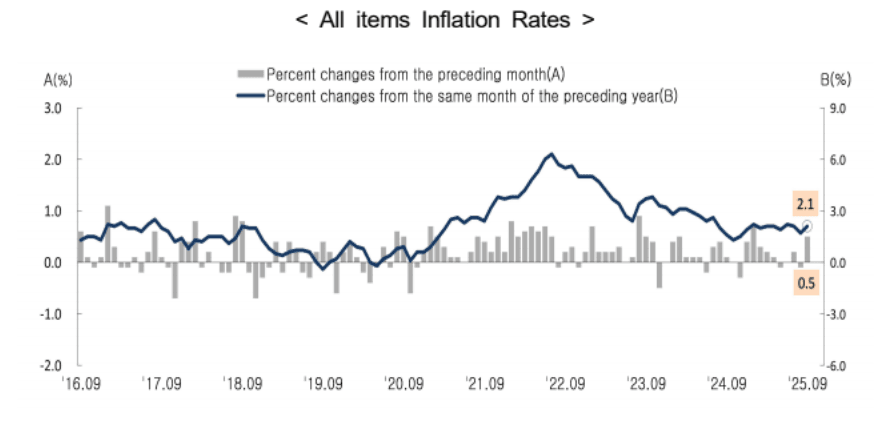
Consumer prices rose 2.1% in September from 1.7% in August, near the Bank’s 2% target, leaving little pressure for an immediate rate hike. (See chart) However, the relatively weak won against the dollar continues to limit the scope for monetary easing, the first expert argued.
The economy continues to benefit from exports, which climbed 12.7% in September, marking the fourth consecutive monthly rise and reaching their highest level since March 2022. Growth was led by semiconductors (+22%) and automobiles (+16.8%), although shipments to the U.S. fell 1.4%, reflecting ongoing trade tensions.
Bank officials are closely monitoring global economic developments and potential reactions to front-loaded demand, as well as household debt trends and financial stability risks.
The government tightened real-estate measures again on Oct 15, following similar curbs in late June, with the new rules aimed at cooling housing demand through stricter lending limits.
EASING BIAS
Governor Rhee said in September that five of the six board members, excluding the chair, remain supportive of a rate cut within months, suggesting the Bank’s easing bias is unchanged.
The International Monetary Fund recently raised its 2025 growth forecast for South Korea to 0.9% from 0.8% projected in July, while maintaining its 2026 outlook at 1.8%. The OECD kept its growth forecasts unchanged at 1% for 2025 and 2.2% for 2026.


