FED: Miran On Watching Data During Government Shutdown
Fed Governor Miran (voter) on data challenges broadly, including how private sector data can offer good visibility on housing but could be misleading more broadly for inflation.
- Moderator: This administration has expressed a lot of skepticism in the validity of government data, and I just wanted to know where you stand on that. Do you believe in the accuracy of the data that the US government is putting out right now?
Miran: To be clear, I think that there's always the need for nuance and interpretation when it comes to economic data in general. I do think that the US government data have been and remain and will continue to remain the gold standard and the best in the world. In my mind, there has been some deterioration in quality in recent years, due in part to declining response rates. For instance, the current population survey or the establishment survey response rates have come down by, I think, about 30 to 35% over the last, you know, I think ten, fifteen years or so. This is something that I would hope, ultimately gets addressed and resolved and improved. But it's not up to the Federal Reserve to to do that.
- Q: Do you think it's important that the data be perceived as being politically independent?
Miran: That the data are not manipulated for political purposes is what's important. I think that the government data are are the best quality we have, and they are the benchmark by which we we do and should continue to set policy. During this period of a government shutdown, you know, we are you know, we are deprived of most of the data that we would need to be to be making monetary policy effectively. Fortunately, we only have to make a policy decision every six weeks. And so I would remain optimistic that we will have the data by the time that we have to actually make our decision at the end of the month. In the meantime, there are some private sources of data. They're good to look at while you have nothing else. But I don't think that any of them are really sufficient replacements for the government data.
- Q: And what do you do in the event that the shutdown continues and you don't have access to the information you need?
- Miran: Well, as I said before, my view is that monetary policy should be forward looking and should be forecast dependent. And so given the forecasts I have in mind, I would be looking for evidence that there was a reason why they might not come to pass. And so I'm always looking for what might falsify my view for the future. Like where would I be wrong? And as I said before, I think where would I be wrong is primarily, well, two things. One, if there's a lot more tariff inflation than I'm expecting, that's hard to do without the inflation data from the government. There are some private sources for prices, but I don't know that they're really reflective of of the consumption bundles that that people actually consume, that get reflected in government data. And the other thing is, of course, the housing market. And this is an area where there actually is a reasonable amount of non-government data that can that can help. And so to the extent that a lot of my optimism on inflation is driven by the shelter disinflation, I expect this is something that I can sort of look for in non-government data. And thus far, at any rate, I haven't seen anything that would make me think that my view has to be materially adjusted.
Want to read more?
Find more articles and bullets on these widgets:
Historical bullets
LOOK AHEAD: US Macro: PPI (Wed) and CPI (Thu) Inflation
US PPI inflation is released on Wednesday before CPI inflation on Thursday, an unusual ordering that should see core PCE implications dialled in after the CPI release rather than the usual wide range waiting for specific PPI details. PPI will be watched more closely than usual this month after a far stronger than expected jump in last month’s July report fired a warning short over tariff-based cost pressures starting to feed through. That included a 0.6% M/M increase in our preferred core series of PPI ex food, energy & trade services, which strips out items such as the then booming portfolio management & investment advice category following the strength in equity markets. It's too early to gauge an accurate sense of analyst expectations for August.
CPI inflation on Thursday will then be the last major release ahead of the Sep 17 FOMC decision. Consensus looks for core CPI at 0.3% M/M after the 0.32% M/M in July, another monthly increase comfortably above a pace consistent with 2% inflation. August should in theory start to see the largest tariff impacts along with September and possibly October. Returning to July’s report, core goods inflation was softer than expected, at a still solid (by core goods standards) 0.2% M/M for a second month running but about half that of 0.4% expected by analysts. Instead, non-housing core services surprised higher. The latter was a “dangerous” development in the words of a usually dovish Chicago Fed’s Goolsbee (’25 voter), who speaking after Friday’s payrolls report is still undecided on a September cut whilst looking for August inflation data “to get more information”.
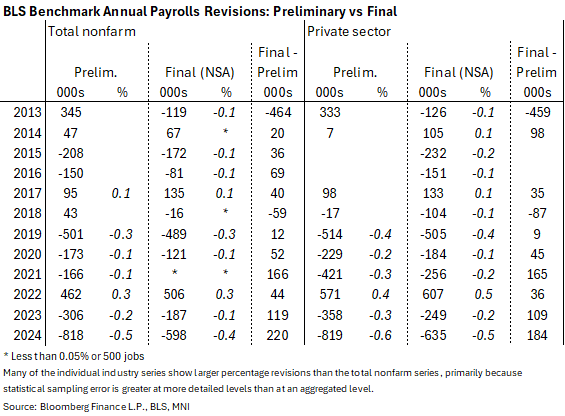
LOOK AHEAD: US Macro: Payrolls Preliminary Benchmark Revisions (Tue)
- The BLS on Tuesday will publish preliminary estimates of benchmark revisions, based off QCEW data for Q1.
- These will give an indication of the actual benchmark revisions on the Mar 2025 level of payrolls due with the Jan 2026 payrolls report released in early February.
- Bear in mind that the final benchmark estimate tends to nearly always be more negative than the preliminary figure – see historical values to the right.
- That doesn’t mean they can’t be large again after last year’s historically negative revision that lowered the level of payrolls by ~600k. Initial estimates we’ve seen look for another large downward revision, with the smallest being worth -550k but with wide ranges higher.
FED: Barclays Adds A Cut To 2025 Fed View
Barclays analysts now expect three Fed cuts in the remainder of the year, adding October to their pre-existing call for 25bp reductions in September and December. "Given the disappointing August employment report, we expect the FOMC to see more elevated downside risks to the employment side of the mandate."
- As for a 50bp September cut, "we think that the FOMC will view [that] as sending too strong a signal that labor market conditions are deteriorating. Indeed, we think that participants such as Powell understand that the slower pace of payroll employment reflects at least, in part, slower labor supply, which does not translate into increased labor market slack."
- For 2026 they continue to expect 25bp cuts in March and June to 3.00-3.25%, but "we do not think the FOMC will be able to cut rates more than twice next year, as we think that activity will show some slight acceleration, with the economy adapting to the new tariff environment and fiscal policy providing some support, and the unemployment rate will revert down amid limited increase in labor supply."


