FED: Miran Doesn't See 'Third Mandate' Having Influence On His View
Q: So I want to continue on the topic of long term rates. What can the fed do to influence long term rates to the extent that you believe that that's a goal?
Miran: I have a personal preference for completeness. And so when I'm trying to sort of analyze a problem, I tend to sort of list everything that I think could possibly be relevant. And this gets me into trouble sometimes, as it did last year in that trade paper that I wrote in which I listed every policy in the world that I could think of as possibly affecting the external accounts. Earlier this year at my testimony in front of Congress for the confirmation hearing, I literally just read out the Federal Reserve acts tasking of the Fed's mandate, which is stable prices, maximum employment and moderate long term interest rates. I wasn't trying to reinterpret the Fed's monetary policy framework in doing so. I was just being complete and caring about democracy and the rule of law and what Congress is actually tasked the fed with. Now, most people tend to think that moderate long term interest rates will just naturally fall out of achieving stable prices and maximum employment. And I agree with that. I think that makes a lot of sense. So I think that moderate long term interest rates is something that Congress tasked the fed with.
Q: Is the third mandate at all influencing how you're thinking about policy right now?
Miran: No it's not. I think most people think that achieving moderate long term interest rates will naturally come out of achieving maximum employment and stable prices. I agree with that. I could imagine there being sort of tail scenarios of the world in which that's not the case, but I don't think that any of those tail scenarios are remotely describing a reality that I see now or that I would expect to see.
Want to read more?
Find more articles and bullets on these widgets:
Historical bullets
LOOK AHEAD: US Macro: PPI (Wed) and CPI (Thu) Inflation
US PPI inflation is released on Wednesday before CPI inflation on Thursday, an unusual ordering that should see core PCE implications dialled in after the CPI release rather than the usual wide range waiting for specific PPI details. PPI will be watched more closely than usual this month after a far stronger than expected jump in last month’s July report fired a warning short over tariff-based cost pressures starting to feed through. That included a 0.6% M/M increase in our preferred core series of PPI ex food, energy & trade services, which strips out items such as the then booming portfolio management & investment advice category following the strength in equity markets. It's too early to gauge an accurate sense of analyst expectations for August.
CPI inflation on Thursday will then be the last major release ahead of the Sep 17 FOMC decision. Consensus looks for core CPI at 0.3% M/M after the 0.32% M/M in July, another monthly increase comfortably above a pace consistent with 2% inflation. August should in theory start to see the largest tariff impacts along with September and possibly October. Returning to July’s report, core goods inflation was softer than expected, at a still solid (by core goods standards) 0.2% M/M for a second month running but about half that of 0.4% expected by analysts. Instead, non-housing core services surprised higher. The latter was a “dangerous” development in the words of a usually dovish Chicago Fed’s Goolsbee (’25 voter), who speaking after Friday’s payrolls report is still undecided on a September cut whilst looking for August inflation data “to get more information”.
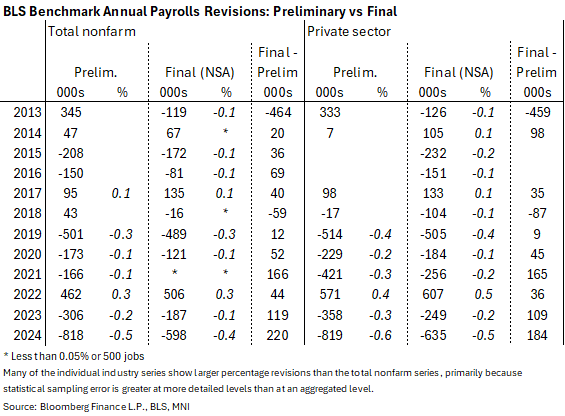
LOOK AHEAD: US Macro: Payrolls Preliminary Benchmark Revisions (Tue)
- The BLS on Tuesday will publish preliminary estimates of benchmark revisions, based off QCEW data for Q1.
- These will give an indication of the actual benchmark revisions on the Mar 2025 level of payrolls due with the Jan 2026 payrolls report released in early February.
- Bear in mind that the final benchmark estimate tends to nearly always be more negative than the preliminary figure – see historical values to the right.
- That doesn’t mean they can’t be large again after last year’s historically negative revision that lowered the level of payrolls by ~600k. Initial estimates we’ve seen look for another large downward revision, with the smallest being worth -550k but with wide ranges higher.
FED: Barclays Adds A Cut To 2025 Fed View
Barclays analysts now expect three Fed cuts in the remainder of the year, adding October to their pre-existing call for 25bp reductions in September and December. "Given the disappointing August employment report, we expect the FOMC to see more elevated downside risks to the employment side of the mandate."
- As for a 50bp September cut, "we think that the FOMC will view [that] as sending too strong a signal that labor market conditions are deteriorating. Indeed, we think that participants such as Powell understand that the slower pace of payroll employment reflects at least, in part, slower labor supply, which does not translate into increased labor market slack."
- For 2026 they continue to expect 25bp cuts in March and June to 3.00-3.25%, but "we do not think the FOMC will be able to cut rates more than twice next year, as we think that activity will show some slight acceleration, with the economy adapting to the new tariff environment and fiscal policy providing some support, and the unemployment rate will revert down amid limited increase in labor supply."


