US STOCKS: Late Equities Roundup: Miners Outperform as Gold Hits Record High
Dec-26 19:58
- Stocks hold near steady (SPX Eminis & Nasdaq) to weaker for the DJIA late Friday. Currently, the DJIA trades down 81.36 points (-0.17%) at 48652.31, S&P E-Mini Futures down 4.5 points (-0.06%) at 6978.5, Nasdaq up 16.4 points (0.1%) at 23629.91.
- Materials, Information Technology and Health Care sector shares led advances in late trade. Miners continued to buoy the Materials sector after Gold climbing to new record highs early Friday (4,549.92), trading desks citing an uptick in geopolitical tensions after Pres Trump launched attacks on Isis elements in Nigeria.
- Freeport-McMoRan +1.77%, Smurfit WestRock +1.14%, Newmont +0.78% and LyondellBasell Industries +0.72%.
- NVIDIA +1.88%, Crowdstrike Holdings +0.97%, Lam Research +0.94% and Dell Technologies +0.85%.
- Elevance Health +1.21%, Viatris +0.78%, UnitedHealth Group +0.71% and Baxter International +0.65%.
- Conversely, Energy sector and Utilities/Industrials shares led declines in the second half:
- Devon Energy -2.04%, APA Corp -1.64%, Diamondback Energy -1.23% and Occidental Petroleum -1.20%.
- Edison International -1.31%, Constellation Energy -1.29%, American Water Works -0.69% and Alliant Energy -0.61%.
- Huntington Ingalls Industries -1.18%, General Dynamics -1.08%, Axon Enterprise -1.07% and Northrop Grumman -1.06%.
Want to read more?
Find more articles and bullets on these widgets:
Historical bullets
FED: Beige Book: Employment Responses Continue Trend Deterioration
Nov-26 19:49
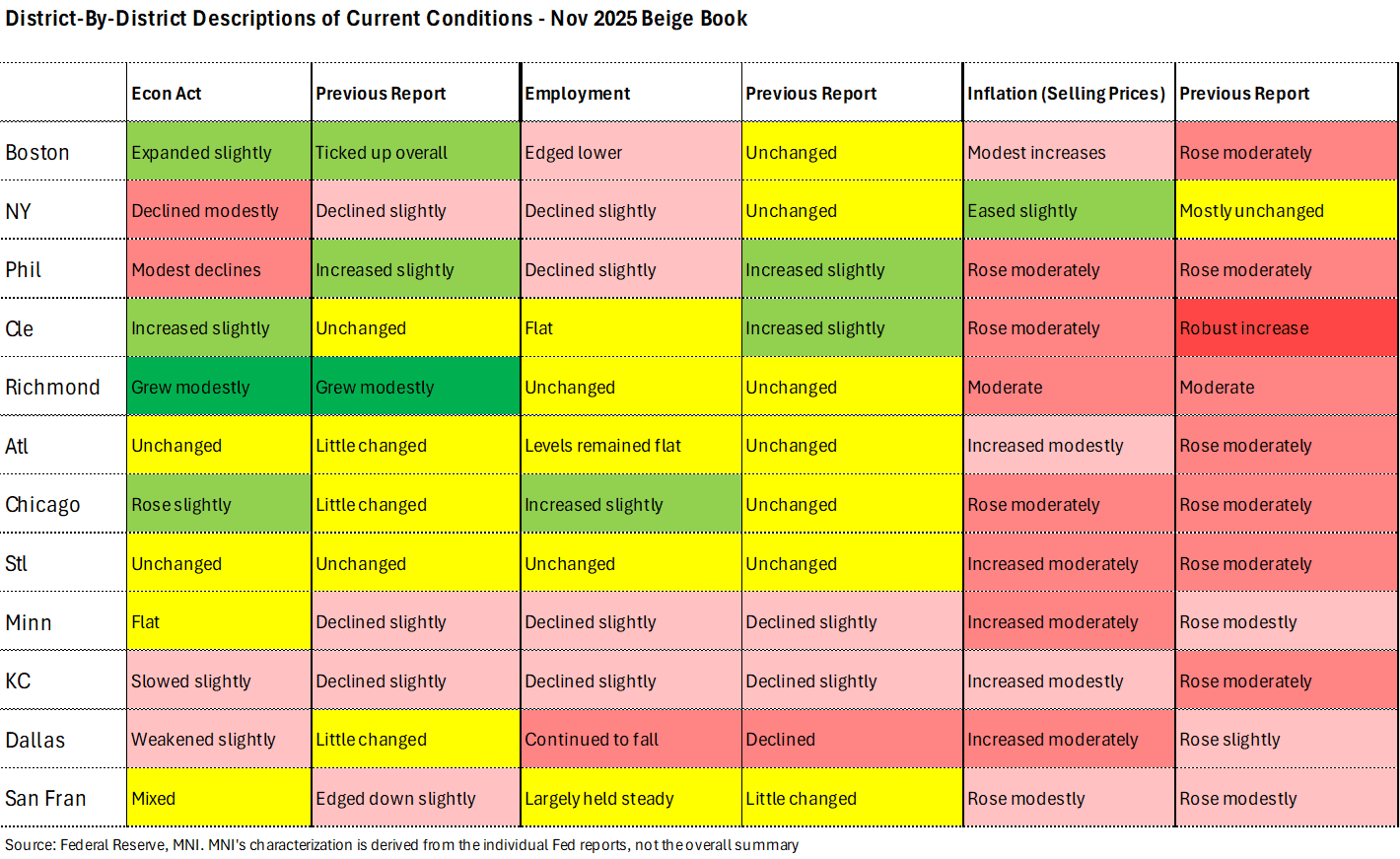
- You can clearly see the deterioration over time in the breadth of employment level responses in the table below.
- Whilst one district seeing a small increase isn’t unusual, there is starting to be a clearer shift to those seeing declines albeit still mostly only slight declines at this stage.

COMMODITIES: Precious Metals Rally Amid Fed Rate Cut Hopes, Crude Rebounds
Nov-26 19:45
- Precious metals have rallied today as expectations for a December Fed rate cut continued to weigh on the US dollar.
- Spot gold has risen by 0.8% to $4,164/oz, while silver has jumped by 3.5% to $53.3/oz.
- The trend condition in gold remains bullish and the bear phase between Oct 20 and 28 appears to have been a correction. The first short-term bull trigger has been defined at $4,245.23, the Nov 13 high.
- Meanwhile, trend signals in silver also remain bullish, with sights on $54.480, the Oct 17 high. Clearance of this level would confirm a resumption of the primary uptrend and open $55.444, a Fibonacci projection.
- Elsewhere, copper has rallied by a further 2.1% to $520/lb, taking total gains from last week’s lows to 4%. The move has been given added momentum by concerns of supply shortages outside of the US amid the tariff threat.
- Price has broken initial resistance at the 50-day EMA and further gains above next resistance at $550.00, the Jul 9 and 28 lows, would undermine the bearish threat.
- WTI crude is also higher today after recovering from a low of $57.66/bbl yesterday amid Ukraine-Russia peace hopes.
- WTI Jan 26 is up by 1.1% at $58.6/bbl.
- Resistance to watch is $61.84, the Oct 24 high, a clear break of which would signal scope for a stronger correction.
FED: Beige Book: District Details See Better Activity But Softer Labor & Prices
Nov-26 19:40
- The Beige Book showed a net improvement for economic activity on the below district-by-district comparison.
- It’s a small improvement though, with the overall summary still classifying economic activity as “little changed” according to most of the twelve districts. Two noted a modest decline whilst one reported modest growth.
- However, there were net dovish developments across employment and inflation on a breadth basis, as shown below, including around half of districts noting weaker labor demand.
Trending Top
Mar-27 20:13


