GERMAN DATA: Labour Market Deterioration Accelerated In Q3
Nov-21 09:42
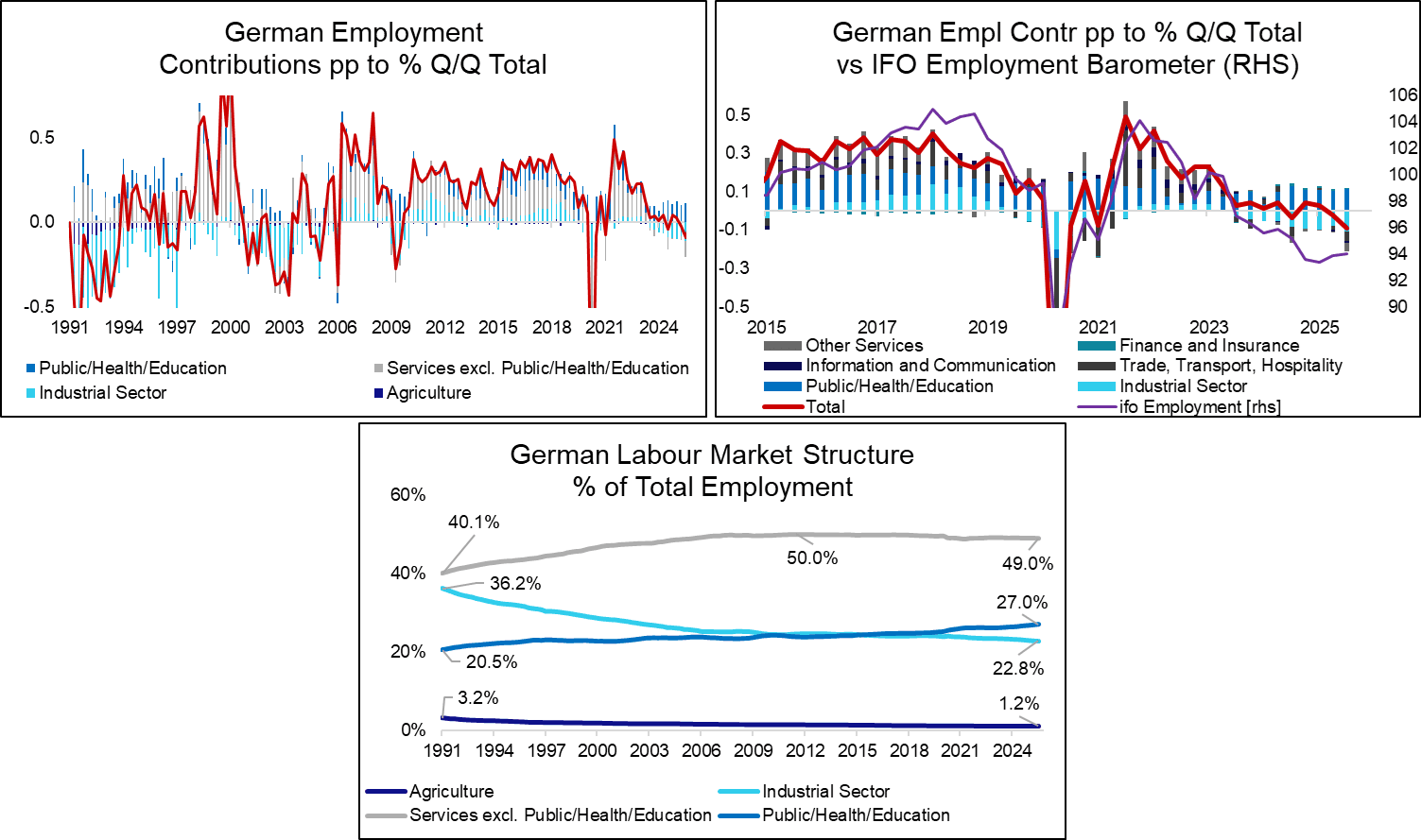
The German labour market deterioration accelerated in Q3, as employment declined by 41k on the quarter (-0.09% Q/Q), vs -11k (-0.02%) in Q2. Industrial, information & communication and corporate service provider sectors all declined at their sharpest rates since the pandemic.
- The industrial sector saw its saw its ninth consecutive quarter of declining employment, at -0.47% Q/Q after -0.34% in Q2 for the weakest rate since the pandemic.
- Employment in the services sector continued to increase but at the slowest pace since Q1 2021 (0.03% Q/Q vs 0.11% Q2). As in previous quarters, the main upside driver was the "public service providers, education, health" cluster rising by 0.43% (an acceleration from Q2's 0.39% and the quickest pace since Q3 2024).
- Other services subsectors were mixed, with declines in information and communication at -0.19% and for corporate service providers at -0.32% (both these sectors seeing their lowest rates since the pandemic). Employment in finance and insurance meanwhile ticked up, at 0.18%, while real estate and housing services employment was broadly unchanged.
- The data adds some context to the 0.0% Q/Q Q3 GDP print after -0.3% in Q2, implying higher productivity last quarter on a per person basis. However, average hours worked per person in employment outweighed that, coming in at 333.7 (vs 333.1 Q2, +0.18%), implying declining productivity on an hourly comparison.
- The number of self-employed persons declined in Q3, continuing its long-term downtrend, at -0.14% Q/Q.
- From a long-term structural perspective, the composition of the German labour market continues to shift, with the public/health/education cluster gaining greater prevalence in employment (see bottom chart).
- Note that this builds on the headline Q3 figures being released on Tuesday, with the details noted here only updated overnight.
Want to read more?
Find more articles and bullets on these widgets:
Historical bullets
GERMAN AUCTION RESULTS: Weak 7-year Bund Auction
Oct-22 09:37
Weak demand again on that 2.50% Nov-32 Bund auction despite it being the only re-opening of the line in Q4.
- Bid-to-offer at 0.93x, below last month’s 1.13x.
- Lowest accepted price of 101.05 below the 101.062 pre-auction mid.
- The secondary price has fallen 3 points since the auction results were published, now at 101.034.
- Very little spillover to Bund futures however (5 ticks of downside)
GERMAN AUCTION RESULTS: 2.50% Nov-32 Bund
Oct-22 09:32
| 2.50% Nov-32 Bund | Previous | |
| ISIN | DE000BU27014 | |
| Total sold | E3bln | E4bln |
| Allotted | E2.284bln | E3.045bln |
| Avg yield | 2.33% | 2.52% |
| Bid-to-offer | 0.93x | 1.13x |
| Bid-to-cover | 1.22x | 1.48x |
| Avg Price | 101.07 | 99.86 |
| Low Price | 101.05 | 99.86 |
| Pre-auction mid | 101.062 | 99.838 |
| Previous date | 24-Sep-25 |
EQUITY OPTIONS: Estoxx Rolling Put
Oct-22 09:31
SX5E (21st Nov vs 19th Dec) 4400p, bought the Dec for 4.9 in 4k.


