ASIA STOCKS: Japan Softens Further, Other Markets Higher
Outside of further Japan equity market weakness, most Asia Pac equity indices are firmer in the first part of Thursday trade. US equity futures are a touch higher, as are EU futures. In Wednesday cash trade, US markets lost further ground, but both the SPX and the Nasdaq finished well above intra-session lows from the session.
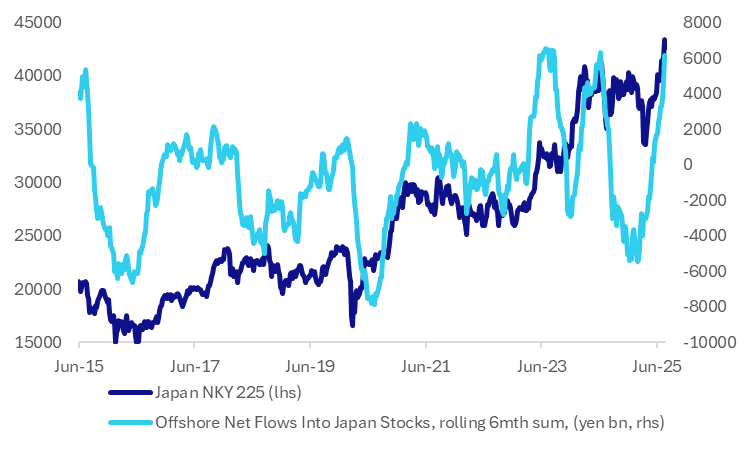
- In Japan, the Topix is off around 0.50%, while the NKY is down slightly more (off 0.60%). Both markets are only marginally off recent record highs. Earlier data showed, up until the end of last week, continued inflows into local stocks from offshore investors. Indeed, since the start of April there has only one week of net selling of local equities out of the past 20 weeks.
- The chart below plots the rolling 6 mth sum of offshore inflows into Japan stocks and the NKY 225 index. We are back close to cycle highs on this flow metric. Loss of momentum in this space could impact Japan equity trends if history is a guide.
- Elsewhere, Taiwan's Taiex has recouped some of yesterday's losses, the index up a little over 1% (after dipping nearly 3% yesterday, amidst nearly $2.4bn in offshore selling). South Korea's Kospi is also tracking up, last up around 0.90%.
- Hong Kong's HSI is down a little, but the CSI 300 in China continues to rally, up a further 0.70% putting the index around the 4300 level. The index continues to close in on intra-session highs from Oct last year.
- Australia's ASX 200 is up firmly, +0.85% to fresh record highs, amidst a broad based rally. NZ markets also continued to rise, up a further 1.1%, after yesterday's strong gains post the dovish RBNZ cut.
- In South East Asia, outside of modest losses for Thailand and Indonesia, markets are modestly higher. The Philippines is out today.
Fig 1: Offshore Inflows Have Surged Into Japan Stocks
Source: Bloomberg Finance L.P./MNI
Want to read more?
Find more articles and bullets on these widgets:
Historical bullets
GLOBAL MACRO: Vessel Departures To US Normalising In July
Bloomberg container ship tracking data show that there was an increase in the number of vessels sailing to the US from most major trading partners through June. Exporters likely frontloaded shipments ahead of the July 9 planned imposition of delayed reciprocal tariffs. While they have been postponed again to August 1, this frontloading has resulted in the start of normalisation in sailings in July and looks likely to distort H2 trade data for the US, China, Europe and other Asian countries.
Container ship departures to the US
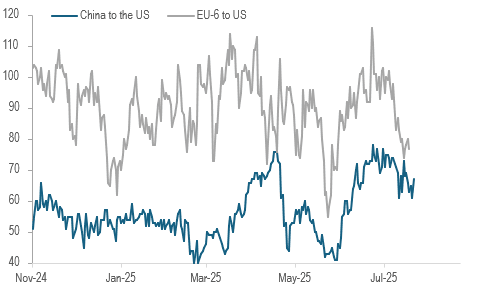
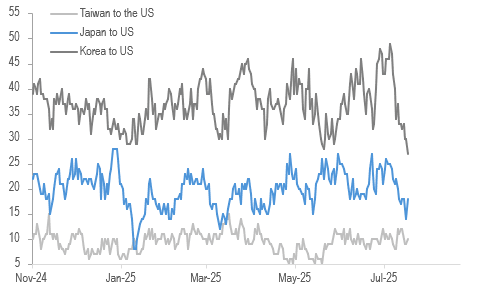
- Departures to the US from China remain above the average number from 2023 to end January 2025. The 30-day average to July 21 was around 20 vessels more than this average. While from the EU-6 (Belgium, France, Germany, Italy, Netherlands & Spain) it was just below, but from Japan and Taiwan slightly higher and significantly higher from Korea.
- Q1 saw a sharp rise in annual growth in merchandise export values to the US from most countries in order to beat tariff deadlines. Many have seen a contraction in Q2, including China, Korea and Japan as well as Canada & Mexico, while Taiwan remained strong up 76.4% y/y in June. ASEAN countries also continue to see robust shipments to the US.
Container ship departures to the US
Source: MNI - Market News/Bloomberg Finance L.P.
STIR: RBNZ-Dated OIS Holding Post-CPI Softening
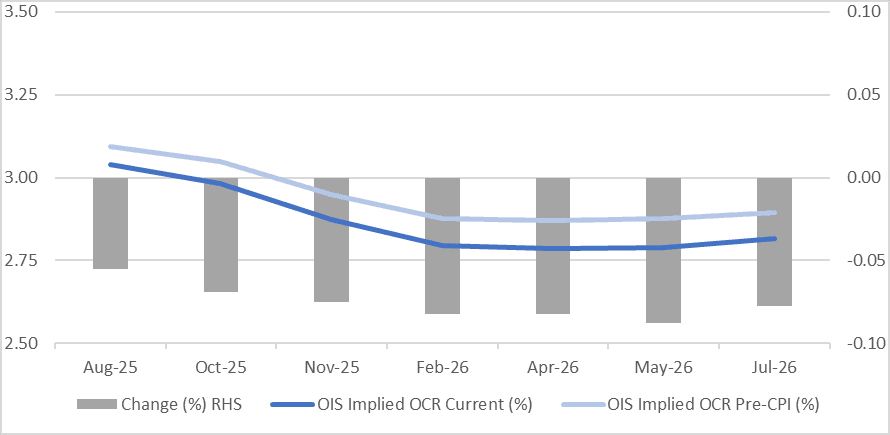
RBNZ-dated OIS pricing is 5-9bps softer across meetings versus Monday’s pre-CPI levels.
- NZ CPI rose less than economists expected in Q2. Headline CPI rose 0.5% q/q 2.7% y/y (estimate +0.6% and 2.8%). Tradeables rose 0.3% q/q, less than forecast, while non-tradeables were in line at 0.7% q/q.
- 21bps of easing is priced for August, with a cumulative 38bps by November 2025 versus 16bps and 30bps prior to the data.
Figure 1: RBNZ Dated OIS Current vs. Pre-CPI (%)
Source: Bloomberg Finance LP / MNI
CHINA PRESS: China Should Reduce Holdings Of U.S. Government Debt
China should decrease holdings of U.S. treasury bills and import more high-tech capital goods and strategic materials, according to Yu Yongding, an academic member at the Chinese Academy of Social Sciences. Economists and policy advisers interviewed by China Daily said authorities should reduce U.S. government debt to safeguard national financial stability, amid waning confidence in the dollar-based system and persistent geopolitical tensions. Guan Tao, a former senior official at the State Administration for Foreign Exchange, said the long-term sustainability of U.S. debt was a concern.


