SECURITY: Iran Vows To Continue Nuclear Program, Snapback Appear Unavoidable
Sep-25 15:29
Iranian Vice President and head of the Atomic Energy Organisation of Iran, Mohammad Eslami, told reporters in Moscow Iran “will continue with its nuclear program,” ahead of the Sept. 27 deadline for the reimposition of UN sanctions via the snapback mechanism triggered by the UK, Germany, and France on Aug. 28.
- Eslami added Iran's nuclear program is “completely transparent,” despite a decision yesterday by Iran’s Supreme National Security Council to suspend cooperation with the International Atomic Energy Agency.
- In an interview with Sky News in Vienna yesterday, Eslami said nuclear facilities damaged by Israel/US strikes in June would be rebuilt, adding, "What is important is that science, know-how, technology, and industry are long-standing and deeply-rooted in the history of Iran."
- While the comments, and similar from President Pezeshkian earlier in the week, indicate the reimposition of sanctions is now unavoidable, IAEA Director Rafael Grossi and Russian President Vladimir Putin are also in attendance at the Atomexpo in Moscow, leaving open a final chance for diplomacy.
- Grossi warned yesterday it would take “not much time” to enrich Iran’s stockpile of uranium from its current 60% purity to 90% weapons-grade. “It’s a matter of weeks -- not months or years,” per IranIntl.
- That assessment is likely to torpedo the prospect of a new nuclear deal and increase the likelihood of further Israeli military action on Iran’s nuclear facilities. Prime Minister Benjamin Netanyahu is likely to raise the issue in his address to the UN General Assembly tomorrow. Netanyahu will then meet President Donald Trump on Monday for their first meeting since Israel unilaterally bombed Hamas officials in Qatar.
Want to read more?
Find more articles and bullets on these widgets:
Historical bullets
US TSY FUTURES: Midday September'25-December'25 Roll Update: 70%-80% Complete
Aug-26 15:27
Latest Tsy quarterly futures roll volumes from September'25 to December'25 below. Percentage complete currently 70%-80% ahead "First Notice" date this Friday, August 29. Current roll details:
- TUU5/TUZ5 appr 1,266,500 from -9.12 to -8.75, -9.0 last; 80% complete
- FVU5/FVZ5 appr 1,528,800 from -5.5 to -5.0, -5.25 last; 70% complete
- TYU5/TYZ5 appr 926,800 from -1.25 to -0.5, -0.75 last; 71% complete
- UXYU5/UXYZ5 app 550,300 from -0.25 to +0.5, 0.00 last; 72% complete
- USU5/USZ5 appr 312,600 from 12.0 to 12.75, 12.25 last; 79% complete
- WNU5/WNZ5 appr 435,700 from 7.0 to 8.25, 7.75 last; 74% complete
- Reminder, Sep futures don't expire until next month: 10s, 30s and Ultras on September 22, 2s and 5s on September 30.
OPTIONS: Larger FX Option Pipeline
Aug-26 15:16
- EUR/USD: Aug29 $1.1600(E1.3bln), $1.1625(E4.0bln), $1.1700(E1.1bln), $1.1725(E1.1bln)
- USD/JPY: Aug29 Y146.50($1.1bln)
- EUR/GBP: Aug29 Gbp0.8563-80(E2.0bln)
US DATA: Philly Non-Mfg Firms See Faster Price Increases Despite Sensitivity
Aug-26 15:08
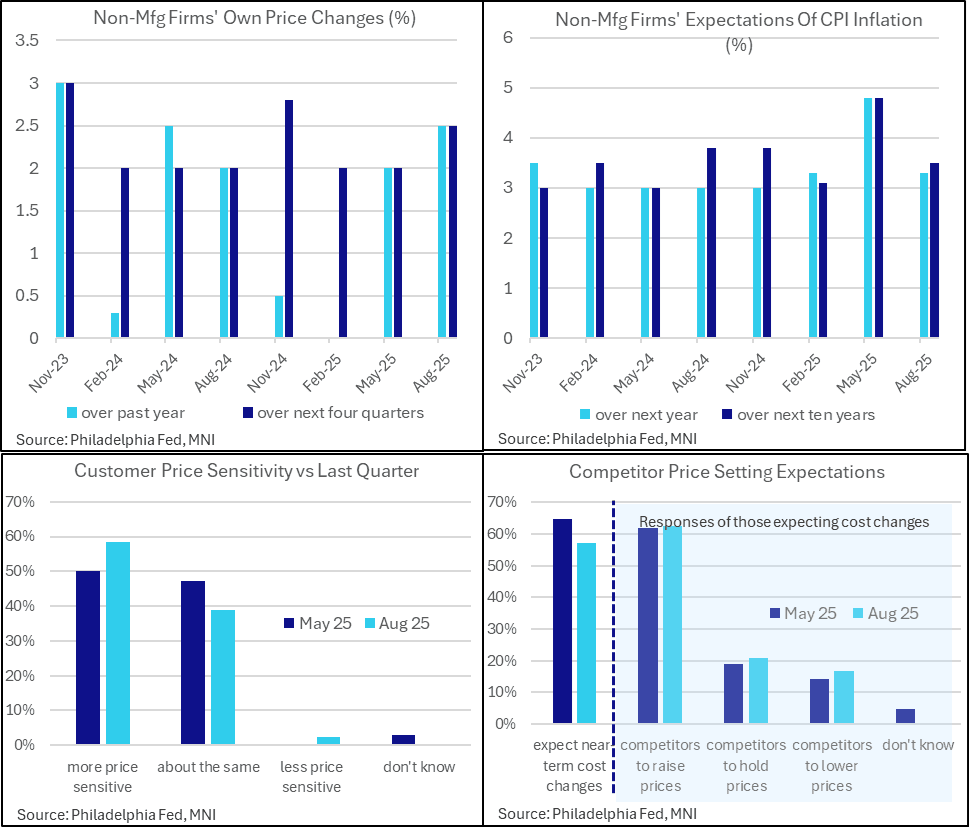
- The Philly Fed non-manufacturing survey special questions on inflation expectations show a somewhat similar split in the activity indexes touched upon earlier with their historically large discrepancy between strong firms’ own activity and weak regional activity in August.
- The median firm reported increasing its own prices by 2.5% over the past year, up from 2.0% in the May question and having essentially paused annual price increases through end 2024/early 2025. It’s the strongest actual increase since the May 2024 survey.
- Own price expectations also firmed from 2.0% to 2.5%, above a typical median of 2% in surveys over the past almost two years but not an unprecedented level.
- Firms’ expectations of consumer inflation meanwhile cooled from a particularly strong May release, with those for the next year reverting to 3.3% from 4.8%. Ten-year ahead expectations also cooled to 3.5% after 4.8%, still above the 3.1% in February prior to reciprocal tariff announcements but within ranges.
- Elsewhere, these non-manufacturing firms reported greater price sensitivity over the quarter (59% reported higher sensitivity vs 50% in May) and fewer expect cost changes over the near-term (57% vs 65%). Of those that do expect cost increases, a similar almost two thirds expect those to be higher, with price changes over a median 3 months vs 2.5 months in the May survey.