US DATA: Import Prices Show Most Exporters Didn’t Take Tariff “Hit” In Apr/May
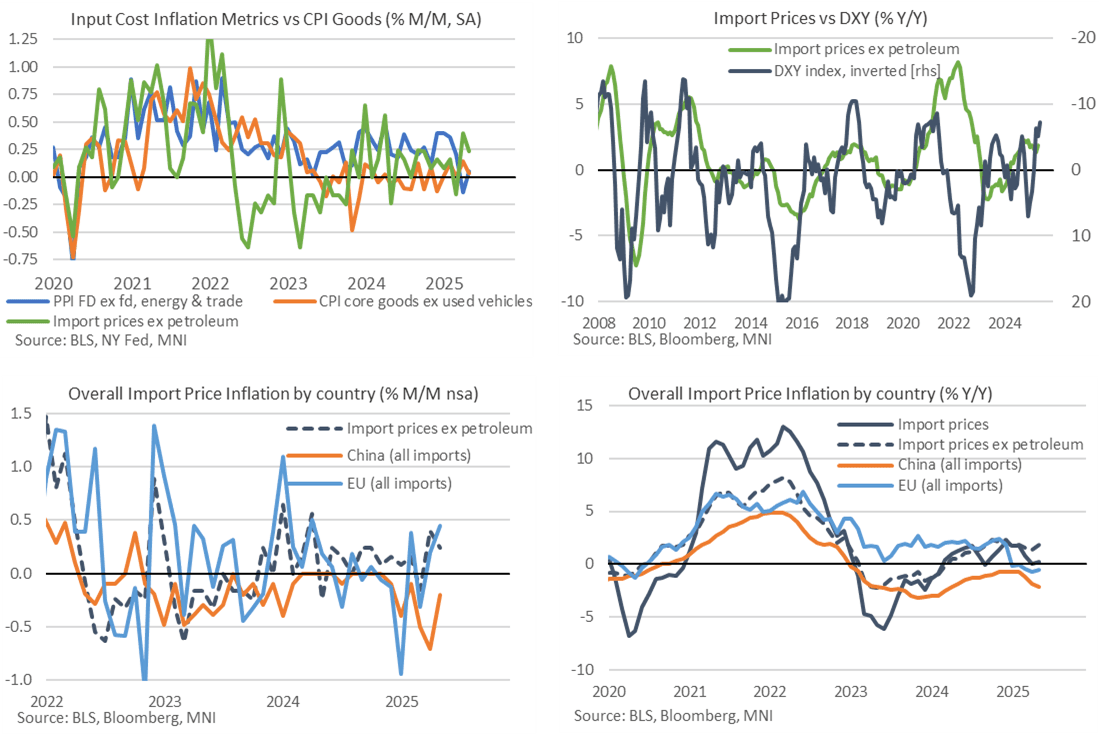
- Import prices were a little stronger than expected in May at 0.0% M/M (cons -0.2) after 0.1% in April whilst ex petroleum prices increased 0.2% M/M (cons 0.1) after 0.4% in April.
- For ex-petroleum prices, it’s a solid increase after the 0.4% in April was its strongest in twelve months. It saw the Y/Y accelerate from 1.36% to 1.8% Y/Y for its highest since February and with some further increases possible judging by USD weakness - see charts below.
- Whilst these data do not take account of tariffs (which are considered taxes in the national accounts), they importantly point to little sign of exporters taking part of the “hit” of US tariffs in the form of lowering their prices to remain more competitive against countries with lower tariff rates.
- That’s on a widespread basis, and likely a factor of the baseline ‘reciprocal’ 10% tariff rates seen for many countries during the current 90-day pause. There are however signs of some discounting from those that have been targeted more heavily, with China a clear standout.
- For example, overall import prices from China fell -0.2% M/M in May after a heavy -0.7% M/M in April whereas prices from the EU increased 0.4% M/M after 0.2% M/M.
- Overall declines in Canada (-1.0%) and Mexico (-0.3%) have to be taken with caution, as this was driven by fuel prices, with non-manufacturing import prices +0.7% M/M from Canada and 0.0% M/M from Mexico.
- China import price inflation stands at -2.1% Y/Y (weakest since Apr 2024) whilst EU import price inflation lifted from -0.8% to -0.5% Y/Y after what had been its weakest since May 2020.
Want to read more?
Find more articles and bullets on these widgets:
Historical bullets
EURUSD TECHS: Support Remains Intact
- RES 4: 1.1625 1.500 proj of the Feb 28 - Mar 18 - 27 price swing
- RES 3: 1.1608 High Nov 9 2021
- RES 2: 1.1440/1573 High Apr 23 / 21 and the bull trigger
- RES 1: 1.1266/1381 High May 14 / High May 2 - 6
- PRICE: 1.1144 @ 19:09 BST May 16
- SUP 1: 1.1094/65 50-day EMA and a pivot level / Low May 12
- SUP 2: 1.1026 38.2% retracement of the Feb 3 - Apr 21 bull cycle
- SUP 3: 1.0943 Low Apr 10
- SUP 4: 1.0857 50.0% retracement of the Feb 3 - Apr 21 bull cycle
EURUSD continues to trade above last week’s low. Recent weakness appears corrective and key trend signals highlight an uptrend. Note that a key support at the 50-day EMA, at 1.1094, remains intact. A clean break of this average would undermine the uptrend. A key resistance to watch is 1.1381, the May 2 - 6 high. Clearance of this level would signal the end of the correction and highlight a bullish break.
RATINGS: Moody's Downgrades US's AAA Rating As Deficits Seen Ballooning
Moody's has downgraded the US's long-term credit rating to Aa1 trom Aaa. The move may not have been fully expected today. But it was the last holdout among they S&P and Fitch to demote the USA from the top rating, and they placed negative outlook on the US last year (now stable). Fiscal deterioration, both past and anticipated as Congress wrangles with the Republican fiscal bill, is cited as the key factor. From the release (link):
- “While we recognize the US’ significant economic and financial strengths, we believe these no longer fully counterbalance the decline in fiscal metrics."
- "This one-notch downgrade on our 21-notch rating scale reflects the increase over more than a decade in government debt and interest payment ratios to levels that are significantly higher than similarly rated sovereigns...We do not believe that material multi-year reductions in mandatory spending and deficits will result from current fiscal proposals under consideration."
- "If the 2017 Tax Cuts and Jobs Act is extended, which is our base case, it will add around $4 trillion to the federal fiscal primary (excluding interest payments) deficit over the next decade. As a result, we expect federal deficits to widen, reaching nearly 9% of GDP by 2035, up from 6.4% in 2024, driven mainly by increased interest payments on debt, rising entitlement spending, and relatively low revenue generation."
- "We anticipate that the federal debt burden will rise to about 134% of GDP by 2035, compared to 98% in 2024."
- "Federal interest payments are likely to absorb around 30% of revenue by 2035, up from about 18% in 2024 and 9% in 2021. The US general government interest burden, which takes into account federal, state and local debt, absorbed 12% of revenue in 2024, compared to 1.6% for Aaa-rated sovereigns."
US FISCAL: "Extraordinary Measures" Continue To Dwindle Amid Debt Impasse
The "extraordinary measures" available to Treasury to stave off a debt default were down to $82B as of May 14, per a Treasury Department release today.
- That compares unfavorably with a high of $335B in January when the debt limit impasse began. Combined with $562B in Treasury cash on hand, though, after April's large tax intakes, that makes for around $644B in available resources before the "x-date" is reached.
- Resources are gradually being eroded since reaching nearly $800B in mid-April.
- Per Tsy Sec Bessent's letter to Congress last week, "after reviewing receipts from the recent April tax filing season, there is a reasonable probability that the federal government's cash and extraordinary measures will be exhausted in August while Congress is scheduled to be in recess. Therefore, I respectfully urge Congress to increase or suspend the debt limit by mid-July, before its scheduled break, to protect the full faith and credit of the United States."


