INDIA: Headline CPI Expected to Fall Below 1% in October
Yesterday’s September CPI inflation release was broadly in line with expectations, falling to 1.5% Y/Y from 2.1% Y/Y in August. That marks the headline reading’s lowest level in more than eight years as well as the eighth consecutive print below the RBI’s 4% midpoint target. Moving forward, strong base effects, soft food price inflation and GST related effects are expected to drive disinflation even further in October, with most analysts predicting a sub-1% print next month. Annual inflation is then expected to pick up once base effects wane.
- Goldman Sachs’ preliminary estimate for October headline inflation is sub 1% Y/Y, led by food prices sequentially contracting by 0.9% in seasonally adjusted terms till October 11, which implies an inflation of -3.3% Y/Y, due to favourable base effects and some pass-through of GST-related cuts to consumer prices. Given the continued food price deflation in October, GS lower their headline inflation forecast by 0.7ppts to 1.9% Y/Y in Q4 CY25 but subsequently bake in a sequential increase in Q1 CY26.
- JP Morgan note that due to a favourable base effect, even without incorporating the impact of GST cuts, October inflation is expected to fall to just 0.5% Y/Y. The impact of GST cuts will depend on the degree of pass-through. Assuming a 50% pass-through, JPM say October inflation could be as low as 0%. More broadly, headline inflation is projected to remain very low until December. Only after the base effect wanes in 4Q25 is CPI inflation expected to firm up.
- SocGen say it is not surprising that the RBI may choose to remain cautious. They expect the high statistical base effect to persist until October before it begins to reverse significantly, which would push inflation higher. Given this potential inflation headwind – where the reversing base effect could eventually drive inflation closer to 4% – the RBI is unlikely to base its monetary policy decisions solely on past inflation data. SocGen anticipate a 25bp cut at the December RBI meeting.
Want to read more?
Find more articles and bullets on these widgets:
Historical bullets
AUSSIE 3-YEAR TECHS: (U5) Bounces Further Off Support
- RES 3: 97.190 - High May 5 2023
- RES 2: 96.932 - 76.4% of Mar-Nov ‘23 bear leg
- RES 1: 96.860 - High Apr 07
- PRICE: 96.550 @ 15:36 BST Sep 12
- SUP 1: 96.430/95.900 - Low Sep 3 / Low Jan 14
- SUP 2: 95.760 - Low 14 Nov ‘24
- SUP 3: 95.480 - Low Jan 11 2023 and a major support
Aussie 3-yr futures are trading off recent lows. A resumption of gains from here would further narrow the gap with resistance at 96.730, the Sep 17 ‘24 high, leaving 96.860 as the next key level. Any continuation lower would instead strengthen a bearish threat. This would refocus attention on 95.760, the 14 Nov ‘24 low. Conversely, a reversal higher would open 96.860, the Apr 7 high.
FED: MNI Fed Preview-September 2025: A Reluctant Return To Easing
We've published our preview of the upcoming FOMC meeting - Download Full Report Here
- The Federal Reserve is set to resume its easing cycle at the September 16-17 meeting with a 25bp cut to the funds rate range to 4.00-4.25%.
- The decision to cut after a 5-meeting pause was well-telegraphed by Chair Powell, whose Jackson Hole speech described a “shifting balance of risks” toward a weaker labor market that “may warrant adjusting our policy stance”.
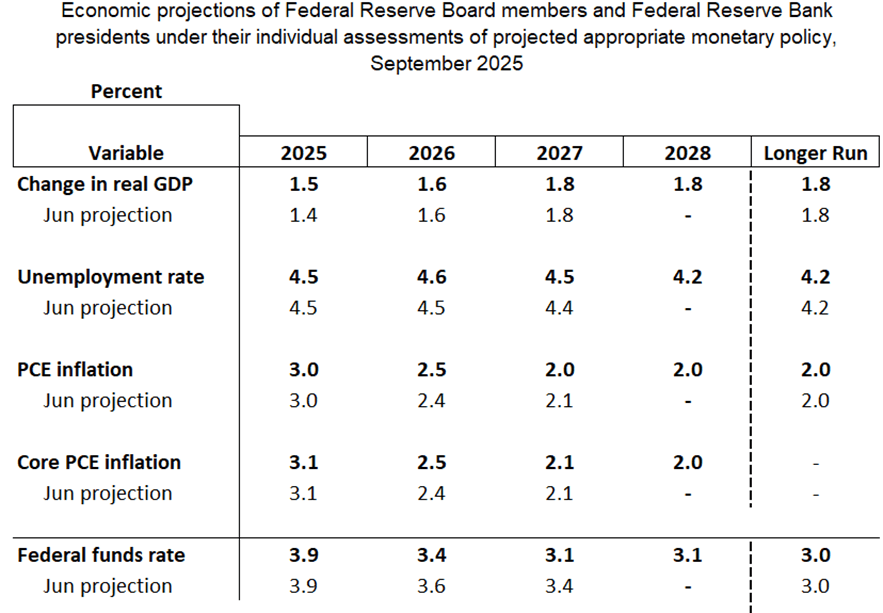
- The updated quarterly projections aren’t likely to bring many changes to the macroeconomic variables, but as usual the signal sent from the Fed rate “Dot Plot” will garner attention. A Committee split between expecting one or two further cuts this year is likely, keeping each of the remaining meetings of 2025 “live”.
- The Statement will downgrade the description of the labor market to reflect a rise in the unemployment rate and poor payrolls growth, and is likely to include at least one dissent to the rate decision.
- But with a Committee that is fairly divided on the way forward, Powell will be noncommittal on future action, reiterating that policy is not on a preset course, and upcoming decisions will be data-dependent.
- A key undercurrent is an increasingly activist approach to Fed personnel management from the White House, which leaves the composition of the FOMC uncertain not just over the medium-term but also at this meeting.
MNI’s separate preview of sell-side analyst summaries to follow on Monday Sep 15
RATINGS: Fitch: France Cut To A+ From AA, Portugal Up To A From A-
Fitch has downgraded France's sovereign rating to A+ (with stable outlook) from AA-. Release here.
- Among other factors in the decision, Fitch cites "High and Rising Debt Ratio", "Political Fragmentation Hinders Consolidation", "Weak Fiscal Record", "High 2025 Deficit", "Uncertain Fiscal Consolidation Path", and "Fiscal Rigidities".
- In "Factors that Could, Individually or Collectively, Lead to Negative Rating Action/Downgrade", Fitch cites "Public Finances: A sustained increase in government debt/GDP over the medium term, due to failure to implement fiscal consolidation measures and/or a persistent increase in financing costs" and "Macro: Materially lower economic growth prospects and weakened competitiveness." Conversely, potentially leading to positive ratings action would be "Public Finances: Confidence that government debt/GDP will be put on a downward trajectory over the medium term, for example, due to fiscal consolidation and/or stronger economic growth".
- Fitch also raised Portugal to A (stable outlook) from A-, while elsewhere, S&P raised Spain to A+ (stable outlook) from A.
- As MNI wrote earlier, we expected France to be downgraded to A+ and Portugal to be upgraded to A.


