AUSTRALIA: Gradual Progress On Housing Affordability Helped By Numerous Factors
There has been a moderate improvement in housing affordability with prices soft in Q4 and Q1, a strong rise in Q1 disposable income and mortgage rates lower, which should fall further with more RBA easing expected. However, affordability remains 40% below trend, only slight progress from the worst at 42.8% in Q3 2024. Housing also remains overvalued but the degree has declined. Structural issues in the sector persist with working age population growth picking up again while building approvals have weakened.
- Housing affordability was up 4.5% y/y in Q1 and is currently on track to rise by around 7.5% y/y in Q2, which would see the index rise to around 38% below trend. The Q2 average of Cotality home values is up 1.0% q/q but the annual rate has moderated to 2.8% from 3.8% and the 11.1% peak in Q1 2024.
Australia housing affordability vs valuation % deviation from trend
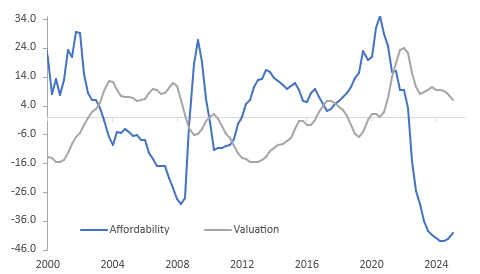
- Rental growth has also moderated with Q1 at 5.5% y/y down from 6.4% y/y and the 7.8% y/y peak in Q1 2024. As home price inflation has slowed more than rents, valuation is down 1.6% y/y but still 6.1% above trend down from 24.1% in Q1 2022.
- Demand remains solid with working-age population rising around 50k/month in 2025 and growth rising 2.6% y/y in April up from 2.4% and the July/August 2024 trough of 1.7% y/y.
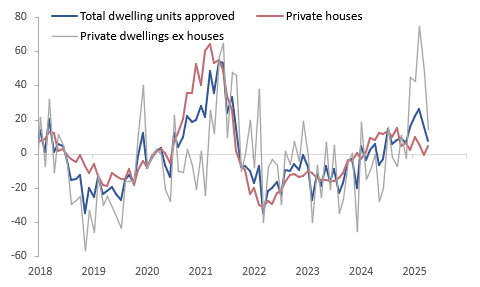
- Q1 real residential investment rose 2.6% q/q, the strongest quarterly rate since Q1 2021, to be up 5.6% y/y. But the number of dwelling building approvals fell for the third straight month in April driven by the volatile multi-unit component but growth in private houses has also slowed.
- This is consistent with the sales of new homes falling 10.6% y/y in April with only NSW seeing an increase.
Australia building approvals y/y%
Want to read more?
Find more articles and bullets on these widgets:
Historical bullets
CHINA PRESS: China Car Sales And Production Exceed 10 Million
Auto production and sales in China hit 10.1 and 10.0 million units in the first four months of the year, up 12.9% and 10.8% y/y, marking the first time both exceeded 10 million simultaneously, according to the China Association of Automobile Manufacturers. New energy vehicle (NEV) production and sales reached 4.4 million and 4.3 million, up 48% and 46%, with NEVs accounting for 42% of total sales. Vehicle exports rose 6% to 1.9 million units, including 642,000 NEVs, up 52.6% y/y.
CHINA PRESS: China To Step Up Strategic Mineral Exports Control
Beijing will strengthen its supply chain control of strategic mineral exports, China Securities Journal reported, following a Ministry of Commerce meeting with several departments. Central and provincial officials managing concentrations of strategic mineral resources must closely track flows, strengthen information sharing and enhance early warnings to strictly prevent illegal outflows, the meeting outlined.
CHINA PRESS: China, U.S. To Focus On Non-tariff Barriers
China and the U.S. will continue negotiating tariff and non-tariff barriers such as investment, market access and key mineral supplies, Global Times reported, citing Huang Zhengliang, a researcher associated with the Ministry of Industry and Information Technology. Yang Shuiqing, a scholar at the Chinese Academy of Social Sciences, noted ongoing U.S. investigations into semiconductors, pharmaceuticals, automobiles and key minerals risked increased tariffs on these sectors.


