FED: Gov Miran: Market-Based Core Ex-Shelter CPI Argues For Quicker Cuts
Fed Gov Miran follows up his third consecutive dissent in favor of a 50bp cut (vs the 25bp decided) at the December meeting with a speech detailing his views on inflation (link). There are no surprises from the current-biggest dove on the FOMC on his rate outlook: he advocates "a quicker pace of easing policy". He argues that underlying inflation pressures are moderating, and a preferred measure of core inflation that cuts out various components that he considers distorted - market-based core ex-shelter PCE - is running close to the 2% target already. No word in the speech on whether he was the participant who submitted the lowest Fed funds rate dot for end-2026 (2.1%, 150bp of cuts from current levels) in the December projections but it is likely.
- The main thrust of his argument is that shelter inflation is both a badly-lagging indicator of price pressures from the pandemic period, and measures of it are due to come down substantially in the coming quarters. And since wages "are the primary driver of service inflation" recent labor market looseness have "tilt[ed] nominal wage growth risks toward the downside".
- He acknowledges "The lack of a clear downward forecast for core goods prices might suggest keeping interest rates elevated." But "the shelter outlook appears relatively clear—because market rents lead measured inflation—and powerful enough to overwhelm even the possibility of sustained higher goods inflation. Underlying inflation is near, and further approaching, our target...Shelter inflation is indicative of a supply–demand imbalance that occurred as much as two to four years ago, not today. Given monetary policy lags, we need to make policy for 2027, not 2022...Keeping policy unnecessarily tight because of an imbalance from 2022, or because of artifacts of the statistical measurement process, will lead to job losses".
- But he says "a better measure of underlying inflation would account for distortions from shelter and imputed prices. Removing imputed phantom inflation like portfolio management, market-based core inflation is running below 2.6 percent. If we further remove housing and look at market-based core ex shelter, underlying inflation is running below 2.3 percent, within noise of our target. Once shelter inflation has normalized from the anomalous post-pandemic experience, ordinary market-based core may be more appropriate."
- The above provides impetus to cut, in addition to potential labor market risks (and, he notes warily, "Recessions are an inevitable part of the business cycle, and at some point, we will suffer one. We should strive to ensure that point is as far in the future and as shallow as possible by appropriately calibrating monetary policy.")
Want to read more?
Find more articles and bullets on these widgets:
Historical bullets
CANADA DATA: October CPI Preview: Analysts Eye Lower Gasoline Prices (2/2)
Canadian analysts' expectations for October inflation:
- CIBC: "Inflation should have eased slightly in October, mainly due to a drop in gasoline prices following an increase in the prior month that was atypical of usual seasonal patterns....Measures of core inflation may not decelerate as much, with rent inflation still stubbornly higher relative to market asking prices.... Inflationary pressures should have eased again relative to the prior month but, with various year-over-year core measures still averaging closer to 3% than 2%, the inflation data are likely to reaffirm that the Bank of Canada is on hold for the foreseeable future."
- Desjardins: "The removal of retaliatory tariffs last month continues to filter through to consumer prices, which should help temper headline inflation in the coming months. With goods inflation excluding food and energy already trending lower, the elimination of countertariffs is expected to further support this normalization. Services inflation, which remained sticky due to strong readings in late 2024, is likely to continue its downward trajectory, with additional progress anticipated through Q4. A similar trend is evident in the Bank of Canada’s core measures, which likely moderated slightly in October but remain near 3%."
- National: "Despite a drop in energy prices, headline prices may still have increased 0.2% in the month (not seasonally adjusted). If we’re right, the annual inflation rate could decline by three-tenths of a percentage point to 2.1% as a result of a highly negative base effect. Looking at the Bank of Canada's core measures, we expect the CPI-med to move from 3.2% to 3.1% on an annual basis, while the CPI-trim should ease from 3.1% to 3.0%.
- RBC: "moderation is expected to be primarily driven by lower gasoline prices, which fell 5% from September. We expect food price growth to hold close to September’s 3.8% annual rate in October. The October data will include the annual update on property tax prices in the CPI data. Significant property tax increases again took effect in some major population centers, but nationally we expect a smaller increase (4%) than the 6% increase in October a year ago. Headline CPI growth continues to be distorted on the downside by the removal of the carbon tax from energy products in most provinces in April. Broader measures of ‘core’ inflation are expected to remain above the Bank of Canada’s 2% target rate in October."
- TD: "A larger drag from energy and further disinflation in shelter should drive the headline print, while core measures edge lower to 2.95% y/y in a sign of thawing underlying price pressures. However, we don't expect material implications for the near-term rate outlook given hawkish BoC guidance last month."
CANADA DATA: October CPI Preview: Moderation Won't Sway BOC From Holding (1/2)
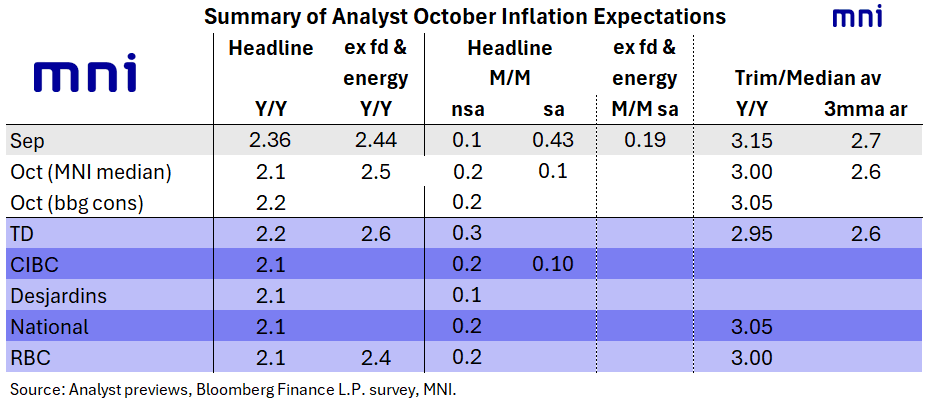
Canadian CPI is expected to have pulled back in October from September's 7-month high 2.4% Y/Y. Consensus (Bloomberg median) sees October CPI at 2.2% Y/Y (2.4% prior), with M/M at 0.2% (0.1% prior), while the average Median/Trim measure is seen at 3.05% (3.15% prior).
- MNI's analyst median skews a little softer than that. In the next note we include some sell-side expectations for Monday's release - several haven't yet published their forecasts but we will provide our usual roundup on Monday ahead of the print.
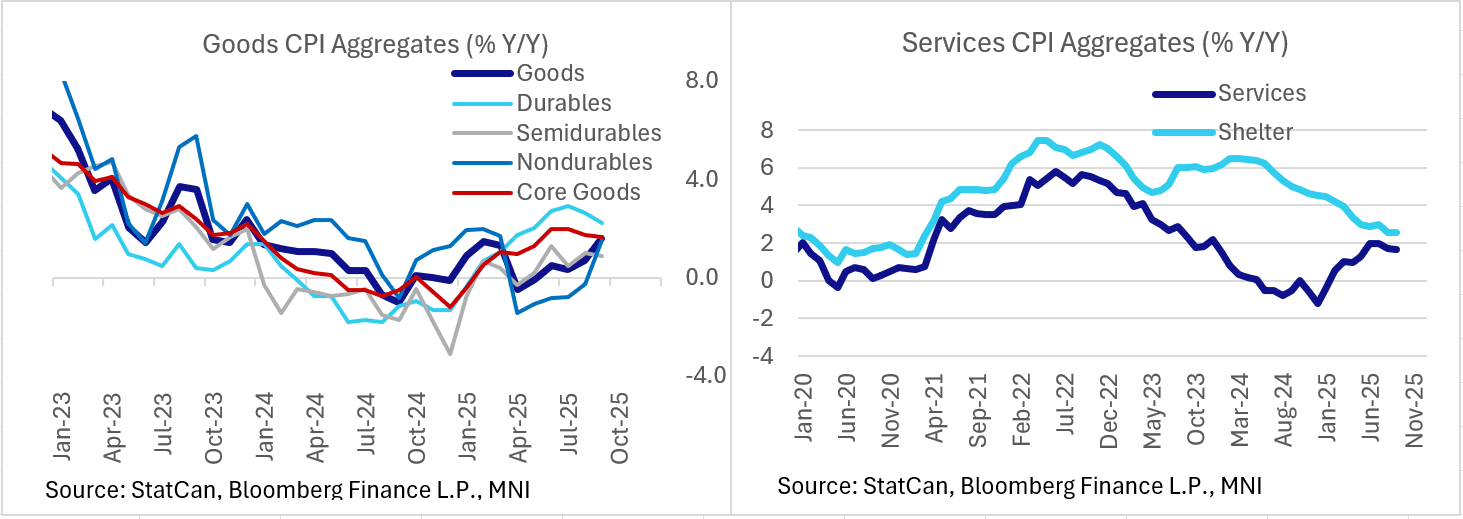
- A variety of factors are seen behind the moderation, including Ottawa's removal of retaliatory tariffs on the US in September, as well as softer gasoline prices. Overall, core goods inflation is moderating with core services merely a little stickier, and it was largely food/energy inflation and downstream effects thereof that spurred the latest tickup in overall CPI.
- The standout takeaway from the September CPI report was in the stubborn trim/median average failing to decelerate in the month as expected. Though that particular measure has been increasingly discounted by Bank of Canada policymakers, core metrics were also largely sequentially steady/higher. None appeared to be game-changers however in terms of the overall consensus narrative of gradual disinflation from the summer's highs but nonetheless ensured the report carried a slightly hawkish tone overall with continued evidence that prices may be a little sticker than hoped.
- October's data are unlikely to change the Bank of Canada's assessment at the October meeting that "Looking at the full range of inflation indicators, Governing Council concluded that underlying inflation was still around 2½%."
- In any case they "acknowledged that year-over-year inflation would be choppy in the coming months" so would be likely to maintain the bias to hold rates for the foreseeable future even in the event of a downside surprise.
US STOCKS CLOSE: Equities Recover From Intraday Pullback
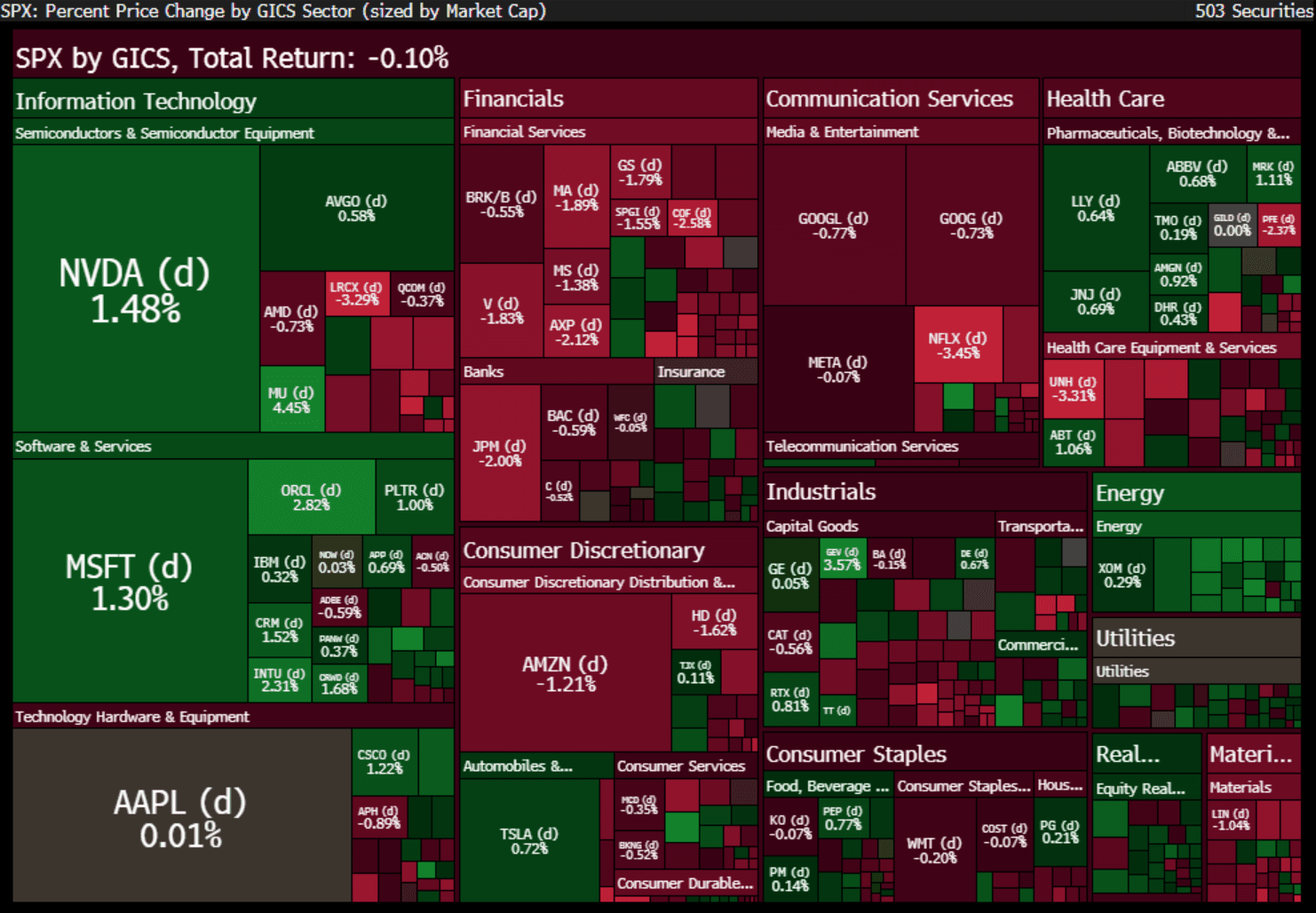
Equities recovered from a sharp intraday sell-off to close roughly flat Friday, with the Nasdaq and S&P 500 almost unchanged but the the Dow Jones retracing 0.7% after Thursday's outperformance.
- Reeling from concerns over AI-related valuations and waning prospects for a December Fed cut, the S&P fell as much as 1.3% (6,646.87) which would have marked the lowest close in a month, but bounced to trade roughly flat on the session.
- Energy (+1.4%) and tech (0.7%) outperformed on the S&P 500, with losses led by financials (-1.0%) and materials (-1.2%).
- Megacaps NVidia (+1.6%) and Microsoft (+1.3%) were the biggest upside contributors, offsetting downside for Google (-0.7%), Netflix (-3.4%) and Amazon (-1.1%) in the tech/communications space, while JPM (-1.8%), Visa (-1.7%) and Mastercard (-1.8%) pulled down financials.
- Latest futures levels: Dow Jones mini down 325 pts or -0.68% at 47253, S&P 500 mini down 6.25 pts or -0.09% at 6762.5, NASDAQ mini down 13.75 pts or -0.05% at 25125.25.