EUROPEAN INFLATION: German Services ex-Airfares CPI Contribution Shrinks [1/2]
Nov-12 10:03
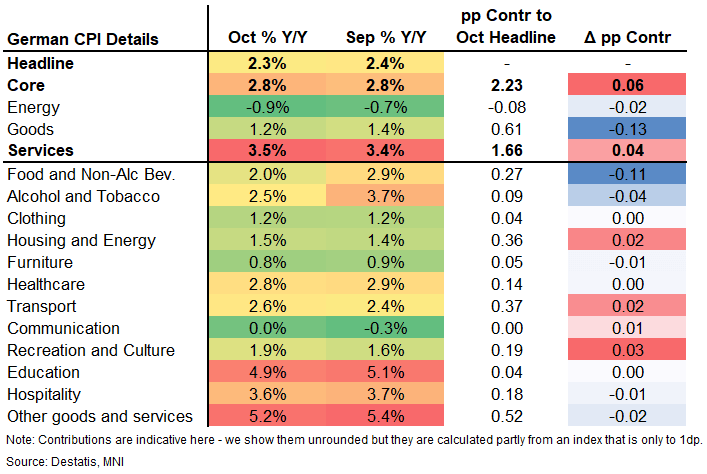
German final October HICP was unrevised from the flash readings at 2.3 Y/Y (2.4% in Sep) and 0.3% M/M. The final reading to CPI was also unrevised at 2.3% Y/Y (2.4% in Aug) and 0.3% M/M whilst core CPI remained at 2.8% Y/Y. Details point towards the services upside surprise in the country being airfares-driven, taking away from its relevance for the ECB.
- Services accelerated to 3.5% Y/Y (confirming the flash reading) for its highest rate since April, adding 0.04pp to headline inflation in October. Goods inflation meanwhile more than negated that, with a 0.13pp lower contribution to headline, mostly on the back of both lower food and energy Y/Y.
- As we projected after the state level data ahead of the national-level flash release, airfares were a strongly positive driver, and indeed excluding their contribution the services category would have slowed vs September (airfares added 0.05pp alone, printing 3.1% Y/Y after -4.9% Sep while analysts saw a deceleration in the category).
- This is relevant because the October final inflation figures are likely the final input for the ECB's December projections and President Lagarde in her October meeting press conference again hinted that the persistence of services inflation drivers are important. Today's data confirms the ECB may likely look through the German (and as a function of that, also at least parts of the Eurozone) services upside surprise in October.
- The remainder of the services categories were mostly lower, meanwhile: Healthcare was 2.8% Y/Y vs 2.9% Sep (2.8% MNI tracking), communication 0.0% vs 0.3% Sep (0.0% MNI tracking), hospitality 3.6% vs 3.7% Sep (3.4-3.5% MNI tracking), and education was 4.9% (5.1% Sep, 4.8% MNI tracking). However, recreation and culture accelerated to 1.9% (1.6% Sep; volatile package holidays had a limited effect here; 1.9% MNI tracking).
- Non-core categories were lower across the board, meanwhile: Food (incl. non-alc beverages) was 2.0% Y/Y (2.9% Sep; 2.0-2.1% MNI tracking), while energy moved further into deflationary territory (-0.9% vs -0.7% Sep; no MNI tracking but we did project a fall in the Y/Y rate).
[See the disclaimer below the table on using the changes in contributions with caution]
Want to read more?
Find more articles and bullets on these widgets:
Historical bullets
EQUITY OPTIONS: Estoxx Put Spread
Oct-13 10:02
SX5E (11th Nov) 5200/5000ps, bought for 14.4 in 6k.
TARIFFS: Goldman On Tariff Passthrough Estimates (2/2)
Oct-13 09:57
- Goldman Sachs write that the customs duties implied US effective tariff rate “had risen by 9pp through August, or by nearly 11pp net of frontloading effects.”
- “Following recent tariff increases on some products and countries and hints of exemptions for others, we now expect it to rise by 12pp in total in 2025 and by another 3.5pp or 15.5pp in total through 2026, a bit less than we previously assumed.”
- They estimate that foreign exporters are “absorbing some of the tariff cost, unlike in 2019, though some of the decline likely reflects underreporting of import value to evade tariffs”. Meanwhile, passthrough to consumer prices has reached “55% after six months, meaningfully lower than at the same point in 2019.”
- They estimate that “US consumers would eventually absorb 55% of tariff costs, US businesses would absorb 22%, foreign exporters would absorb 18%, and 5% would be evaded.” US businesses are likely bearing a larger share currently though.
- GS estimate that “tariff effects have raised core PCE prices by 0.44% so far this year”. Their forecast, which assumed peak passthrough will rise from 55% to 70% “implies a further 0.6% boost from tariffs through next year”. That leaves core PCE inflation at 3.0% Y/Y in Dec 2025 and 2.4% in Dec 2026.
- To give an idea of sensitivity, core PCE inflation would be 3.1% and 2.7% respectively if passthrough peaks at 100%, or 2.9% and 2.2% if passthrough holds at 55%.
TARIFFS: Taking Stock Of Realized Tariff Rates After US-China Tensions (1/2)
Oct-13 09:55
- President Trump on Friday threatened new 100% tariffs on China and the imposition of its own export controls on “any and all critical software” on Nov 1 following China’s earlier export curbs on its rare earth metals.
- Trump has since appeared to downplay these threats, posting on Truth Social on Sunday “Don’t worry about China, it will all be fine! Highly respected President Xi just had a bad moment.”
- The speed with which apparent watering down of rhetoric has come after high tariff threats suggests low likelihood of effective tariff rates pushing north of 25% as was the case in April after Chinese retaliation to reciprocal tariffs sparked a surge in the China tariff rate to 145%. This of course is in a static sense as such levels of tariff rates are broadly seen as halting trade between the two countries.
- Nevertheless, it’s worth taking stock of latest tariff rates from both proposed rates and actual collection of customs duties.
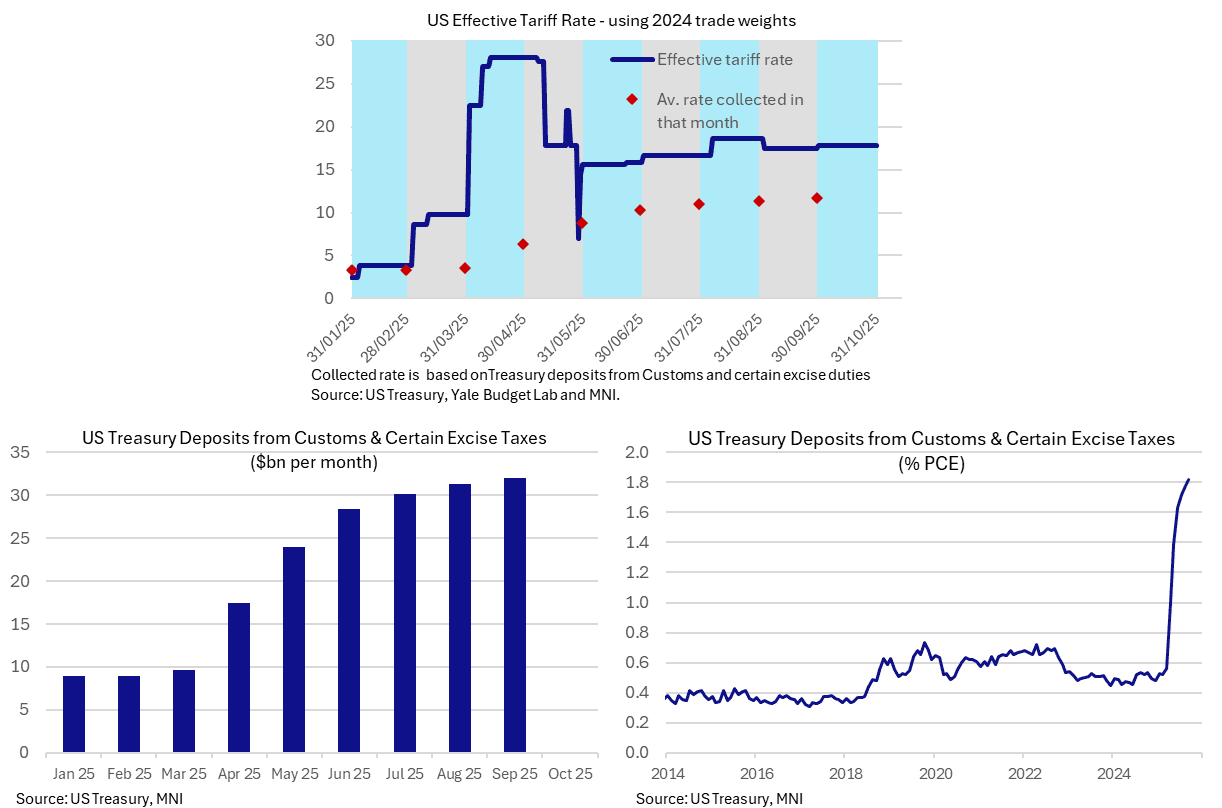
- The latest Yale Budget Lab report from Sep 26 had an effective tariff rate of 17.4% at end-Sept, expected to have increased to 17.9% into October.
- Customs duties meanwhile have seen a stalling in progress in recent months, up to $32bn in September ($384bn annualized) after $31.3bn in Aug and $30.0bn in Jul. For context, this was in the $8-9bn region prior to the second Trump administration.
- It leaves an implied tariff rate either side of 11.5% depending on which period of trade you use for the denominator vs closer to 11.25% in Aug or 3.0% back in Dec.
- Alternatively, customs duties have increased by 1.3pps to ~1.8% of personal consumption expenditure, with most of this cumulative increase having come by June when it was worth an additional 1.1pp. These figures give an idea of the system-wide impact, whilst Goldman Sachs analysis in the second part of this post goes into detail as to how much might actually show up in consumer prices.