US CREDIT UPDATE: General Mills (GIS): 2Q26 Results
General Mills: 2Q25 Results
(GIS; Baa2/BBB/NR)
Beat BBG consensus and reaffirmed weaker guidance. Continues implementation of its new strategic framework. Ex-divestitures, growth and margins remain challenged given weakened consumer demand for branded products and costs related to tariffs. Credit metrics intact. Slight credit negative. GIS trades at the tighter end of the range of BBB Food comps, so given guidance for FY26, we see little upside from current levels.
• Total revenues were $4.98b, better than BBG consensus of $4.79b but still down 7% YOY mostly due to divestitures (yogurt).
• Organic net sales were -1%, higher than consensus of -2.5%.
• North American Retail was down 13% YOY and NA Foodservice was down 8% with both impacted by divestments. NA Pet was up 11% (10% due to acquisitions) and Intl was up 6%.
• Adj Gross mgn was down 150bps to 34.8%
• Adj Operating profit was $848m, down 20% YOY. Margin was down 289bps to 17.4%. Weaker demand and investment in brand improvements hurt. Restructuring costs alone were $122m.
• Adj EPS of $1.10/sh was ahead of consensus of $1.03/sh but down 21% YOY.
• Total debt dropped to $13.7b, down from $14.3b last year. Capex of $253m was down from $301m last year. Share repurchases were $500m, down from $600m last year.
• Reaffirmed guidance. Its investment program in brands continues and dollar growth is expected after its implementation, likely next fiscal year. GIS still sees weaker operating profit and EPS persisting for the remainder of FY26.
• FY26 revenues should be (1)-1% and adj operating profit will be down 10-15% YOY.
Want to read more?
Find more articles and bullets on these widgets:
Historical bullets
OPTIONS: Expiries for Nov17 NY cut 1000ET (Source DTCC)
- EUR/USD: $1.2100(E1.4bln)
- GBP/USD: $1.3100(Gbp541mln)
- EUR/GBP: Gbp0.8830(E513mln)
- USD/JPY: Y155.00($1.1bln)
- USD/CAD: C$1.4000($510mln)
MACRO OUTLOOK: EC May Be Overoptimistic On German Fiscal Ramp-up
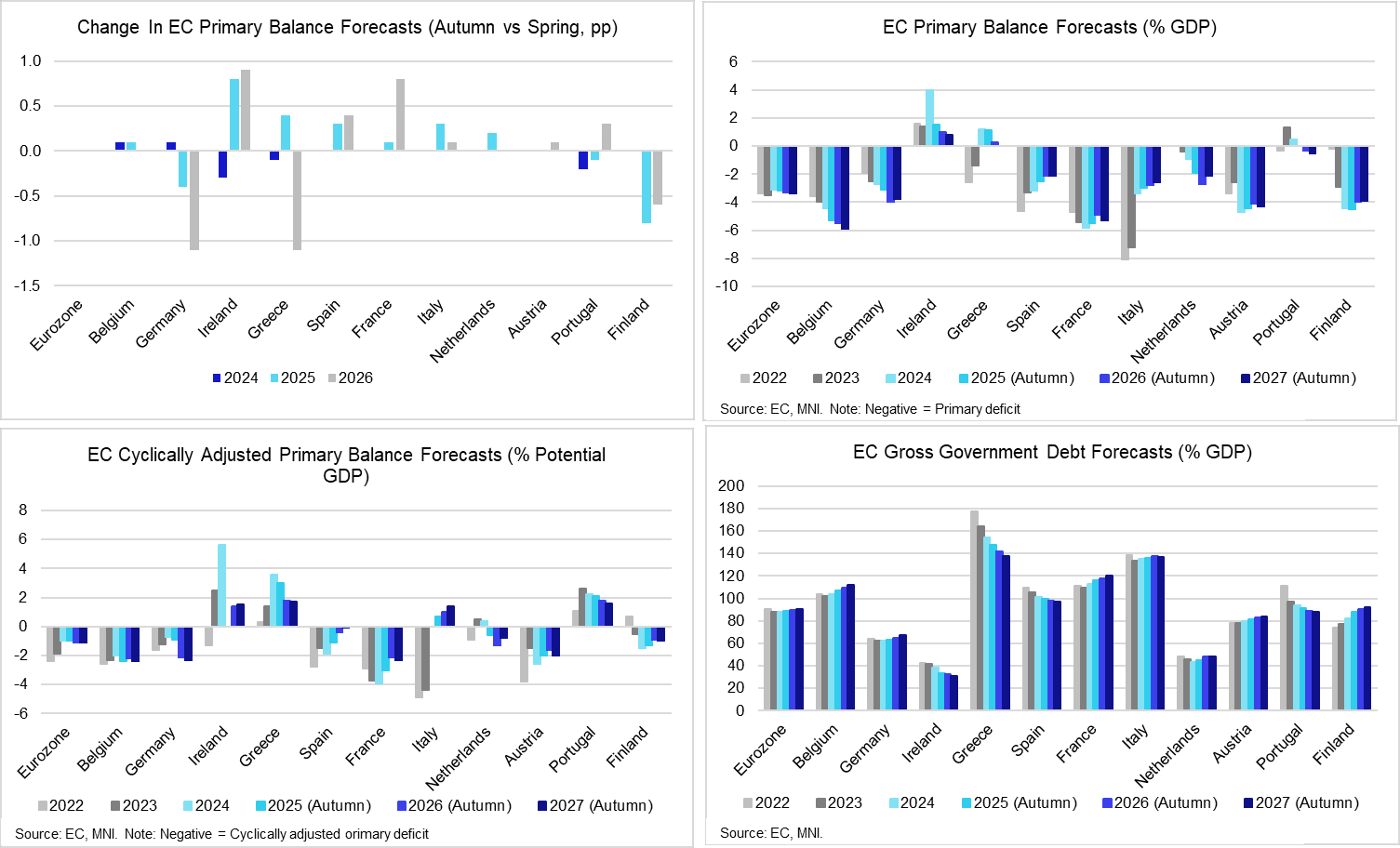
The EC’s Autumn projections are the first to account for the anticipated expansion of German fiscal spending. The EC projects the German budget deficit at 3.1% GDP in 2025, 4.0% in 2026 and 3.8% in 2027. In the Spring, the EC projected the 2025 German deficit at 2.7% and 2026 at 2.9%. On a cyclically adjusted primary basis (to better account for actual fiscal impulses), the EC projects a 1.2pp impulse (versus potential GDP) in 2026 and a 0.2pp impulse in 2027. The 2026 impulse is the joint largest across the largest 11 Eurozone countries.
- The 2025 deficit projection of 3.1% seems quite large, particularly with the 4Q rolling deficit at just 2.2% as of Q2 2025. Monthly federal fiscal data also hasn’t pointed to a substantial ramp up of fiscal easing yet. This data will be updated on Thursday, allowing us to better gauge current trends.
- Looking at the fiscal projections more broadly, cross-country trends highlight diverging outlooks between countries formerly classed as the “periphery” and other Eurozone peers. These trends have been reflected in market pricing across the last few years, through narrower XXX/Bund spreads.
- Between 2025-2027, debt/GDP is expected to fall in Ireland (-1.8pp), Greece (-9.6pp), Spain (-2.9pp) and Portugal (-3.1pp). Italian debt/GDP is expected to rise 0.8pp in the next two years, but this represents a 1.5pp rise in 2026 partially offset by a 0.7pp fall in 2027.
- For the Eurozone as a whole, primary balance projections are unchanged relative to the Spring. Bloc-wide debt/GDP is expected to hover around 90% through 2027.
- Full EC forecasts can be found here: https://economy-finance.ec.europa.eu/document/download/34538512-fff6-451a-8bbc-4c8d60e4d132_en?filename=ip327_en.pdf
OUTLOOK: Price Signal Summary - Corrective Cycle In Gilts
- In the FI space, a strong sell-off in Bund futures last week reinforces the current bearish condition and the contract is trading closer to its cycle lows. Price has pierced 128.52, the 76.4% retracement of the Sep 25 - Oct 17 bull leg. A clear break of this handle would signal scope for an extension towards 128.25, the Oct 7 low. Key short-term resistance is seen at 129.40, last Thursday’s high. Clearance of this hurdle would signal a reversal. First resistance is 128.80, the Nov 10 low.
- Gilt futures gapped sharply lower on Friday. For now, a move down is considered corrective and the next key support to watch lies at 91.82, the Sep 11 high and a former key breakout level. Moving average studies remain in a bull-mode position, highlighting a dominant uptrend. First resistance to watch is 92.85, the Nov 14 high. On the downside, a break of 91.82, the Sep 11 high, would strengthen a bear theme.


