NATGAS: Gas Summary At European Close: TTF Falls
TTF front month has fallen amid a warmer revision to temperatures for next week. Import supplies to ...
Want to read more?
Find more articles and bullets on these widgets:
Historical bullets
US DATA: … But Other JOLTS Indicators Read Clearly Softer
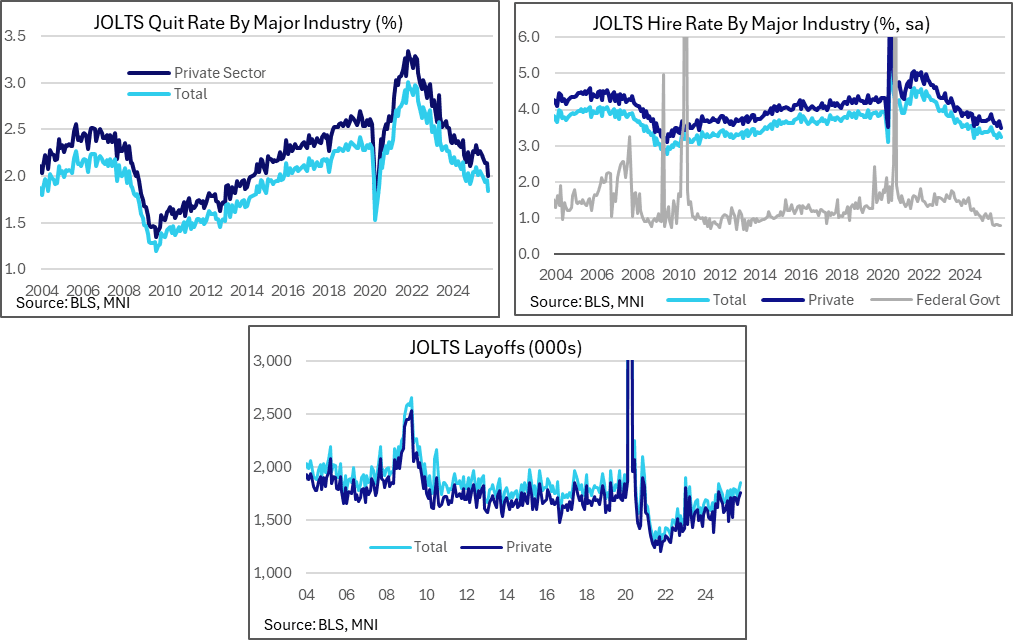
The quits rate fell further in October to its lowest since 2014 when excluding two pandemic months of 2020 and the hires rate broadly confirmed August’s decline to lows since 2021.
- The quits rate was reported at 1.8%, down from 1.96 in September and 1.94 in August.
- We have taken this October quits rate from the 1.d.p value reported by the BLS rather than our usual unrounded calculations which use the usually already known level of payrolled employment in the month.
- Of course, we will only officially know the October level of payrolls with the delayed November report on Dec 16. It’s unclear whether the BLS has used what it currently estimates to have been payrolls employment in October or whether it just references September instead (the latter would yield a 1.84 quit rate so it would just hold).
- Those details aside, this 1.8% quit rate is its lowest since 2014 outside of Apr and May 2020 pandemic months, clearly pointing to greater caution in the labor market. It steps below a range of 1.9-2.1% seen since mid-2024.
- The hires rate meanwhile broadly confirmed a shift to new recent lows, reported at 3.2% in October (it would be 3.23 assuming zero payrolls growth since September) for close to the 3.21 in August that had been its lowest since Sep 2021 when excluding the pandemic-hit Apr 2020. This briefly increased to 3.36% in September.
- Finally, layoffs increased further to 1854k in October and 1781k in September after the 1725k in August to hit the highest since early 2023. It paints a weaker picture than that painted by higher frequency weekly jobless claims data although is a less severe increase than the surge in layoff announcements from back in the October Challenger report.
- Historical context gives a mixed read for these JOLTS layoffs. The 1854k in October has only just pushed back above the 1818k averaged in 2019, a period when the labor market was historically tight, yet layoffs were reported a similar levels for many years before that when the labor market wasn't as robust.
US DATA: Much Higher Than Expected JOLTS Job Openings…
Job openings in the delayed BLS JOLTS report were far higher than expected in October. There was rare relative outperformance to alternative sources such as Indeed or Revelio that had helped form expectations of a modest steady decline compared to August data last released just prior to the government shutdown.
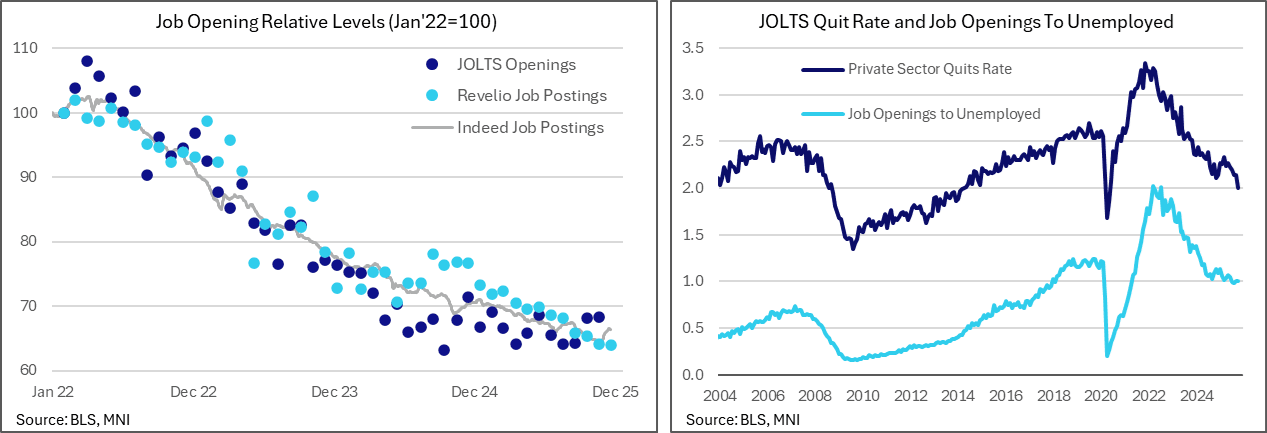
- Job openings were far higher than expected in October at 7670k (sa, cons 7117k) and were also higher than presumably expected at 7658k in September data also released today.
- It’s a marked increase compared to the 7227k seen in August shortly before the government shutdown. As the chart below shows, the size of this deviation from alternate indicators such as Indeed or Revelio isn’t new but JOLTS being relatively higher than them certainly is.
- It saw the ratio of openings to unemployed rise to 1.01 in September, more than reversing its dip from 1.00 to 0.98 in August (a fresh low and technically its first sub-1.0 since Apr 2021). This increase was limited by September’s already known large increase in unemployment.
- It remained at 1.01 in October assuming the same level of unemployment (there won’t ever be household survey details for October), leaving four months averaging 1.00 for a further steady moderation from the 1.04 averaged in Feb-Jun. Powell in September noted the ratio remained near 1 as a part of a number of other labor market indicators that remain broadly stable, but we assume greater sensitivity if this starts falling materially lower. For context, it averaged 1.2 in 2019 and 1.0 in 2017-18.
FRANCE: Gov't MP Claims PLFSS Will Pass w/8 Vote Majority, But Risks Abound
With the National Assembly set to vote in around three hours on the Social Security Finance Bill (PLFSS), there is no clear signal as to whether the crucial legislation will pass or be defeated. If the legislation is passed, it will return to the Senate. To save time, the Senate is likely to simply vote to reject the National Assembly's version as a whole on Friday, 12 Dec, rather than revise it. This would see the bill return to the National Assembly for final ratification in the following days (any changes the Senate makes can be removed by deputies, and then the legislation enacted without Senate approval via Art. 46 of the Constitution.
- Renaissance deputy Sylvain Maillard claims, "It will come down to 8 votes, that's the final count. Around 8, it passes, yes it passes."
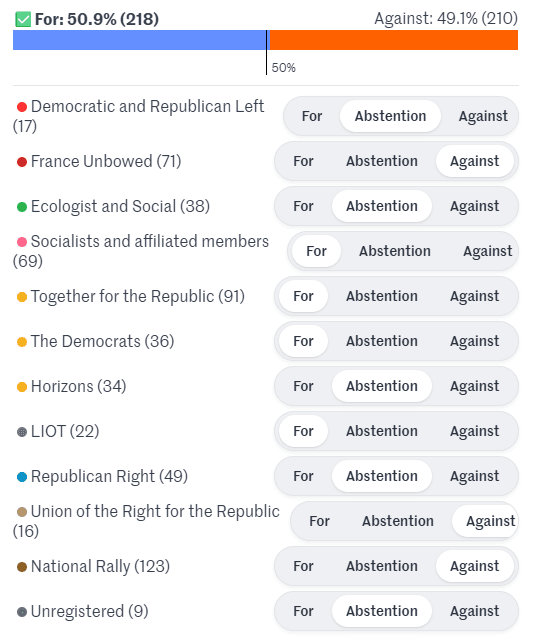
- As shown in the graphic below, the abstention of the Ecologists (see FRANCE: Today's Crucial National Assembly Vote Remains On A Knife Edge), the conservative Les Républicains, centre-right Horizons, and left-wing Democratic and Republican Left groups would be enough to pass the budget.
- It is also likely that groups will not vote as a whole, making it even more difficult to calculate the final result. Ecologist Deputy Sandrine Rousseau has already stated her intention to vote against the bill.
- The Health Minister and Minister of Public Accounts have been speaking on the floor of the chamber to tout concessions on healthcare in a final effort to convince deputies from the Ecologist group to abstain rather than vote against the bill.
- Lawmakers in the small centrist Liberties, Independents, Overseas and Territories (LIOT) group have "total freedom to vote" any way they wish, according to deputy for the Vosges, Christophe Naegelen, who added the group will vote "in the majority" for the PLFSS.
Chart 1. Hypothetical Voting Blocs in National Assembly for PLFSS
Source: Le Monde, MNI


