LNG: Further Decline in TTF Forward Curve Necessary to Cancel US Cargoes
Dec-04 13:42
The TTF forward curve is trending towards long-term US LNG export costs, but may need to fall towards the parity with Henry Hub to lead to US cargo cancellations, according to ICIS analyst Alex Froley.
- The current TTF forward curve for European gas during 2025 to 2030 is in a range of around $10/MMBtu down to $8/MMBtu at the end of the period, declining in line with expectations of greater supply, mainly from the US and Qatar.
- The forward curve is now reasonably close to long-term US export plant costs (estimated at 115% of Henry Hub plus $3.50 for plant cost and shipping).
- However, during the pandemic, US output wasn’t cut back until TTF dropped through long-term cost levels to hit parity with Henry Hub.
- This may mean that, if a global supply wave of LNG reaches the market in 2027/28 faster than demand can absorb it, the forward curve could drop to equalize with Henry Hub in order to cancel US cargoes.
- That scenario would represent a ~50% decline in TTF over the next two years, “albeit likely only for a short period of time until new demand infrastructure is completed,” according to Froley.
- Froley notes however that there could be a lot of demand waiting at levels only slightly lower than today’s prices.
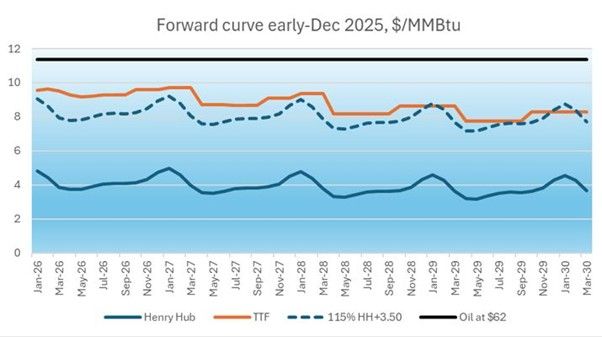
Source: Alex Froley
Want to read more?
Find more articles and bullets on these widgets:
Historical bullets
US TSY OPTIONS: Dec'25 2Y Broken Put Condor
Nov-04 13:40
- 10,000 TUZ5 103.87/104.37/104.5/104.87 broken put condors ref 104-05.5 to -05.62, 7.5 net
FOREX: Key AUDNZD Resistance in Focus Ahead of NZ Employment Data
Nov-04 13:37
- AUDNZD had two separate bouts of strength early Tuesday, with both rallies stalling just ahead of key medium-term resistance at 1.1491. We have highlighted that a break of this level would place the cross at its highest point since 2013, with plenty of attention on the level/1.1500 ahead of NZ employment data, which highlights the APAC calendar on Wednesday.
- Filled jobs for the quarter signal a stabilisation, but employment is likely to have remained weak, with consensus forecasting it to rise only 0.1% q/q to be still down 0.2% y/y. The unemployment rate is expected to rise 0.1pp to 5.3%, in line with the RBNZ's August projections. Soft labour demand is likely to weigh on private wage growth, which is forecast to rise around 0.4% q/q after 0.6%.
- JP Morgan have emphasised that NZD positioning, for systematics in particular, still screens very short Kiwi, and that a tactical long into the data makes a lot of sense to them. This view is highlighted by the fact JPM’s economics team think the NZ economy is primed for a recovery as business surveys begin to show signs of stabilisation.
- With the RBA out of the way, and given the cross has been closely following 2y rate spreads over the past couple of weeks, AUDNZD shorts would be their pick.
- The initial target for a correction lower is seen at the 20-day EMA, at 1.1373, before more meaningful support just below the 1.13 mark.
CANADA: Carney Seen Running CAD75B Deficits, Record Outside Covid
Nov-04 13:36
- Economists surveyed by MNI say deficit in Canada budget due Tues after 4pm EST will be CAD75b in fiscal year that began April 1, and in the next fiscal year. La Presse newspaper reported it could top CAD100 billion.
- While small relative to GDP at around 2% it would be higher in cash terms than anything outside pandemic. Deficit was CAD328B in 2020-21, declined to CAD35B two years later, and moved up to CAD62B in 2023-24.
- First budget in almost 2Y after delays linked to Liberal leadership race, April's election taking Mark Carney to power, and US trade war uncertainty.
- Economists see little chance budget keeps pledge to lower debt- and deficit-to-GDP over next few years. Canada is doubling defense spending to 5% of GDP for NATO target.
- Carney needs some opposition votes to pass budget, avoid early election. Carney also plans to balance newly broken out operating budget in 3Y and use some of that cash to boost investment. Economists doubt his goal of cutting departmental spending more than 7% will be met.
- Investors not focused on Canada fiscal deterioration in world of rising government debt: 10Y bond yielding 3.15% Monday, below similar Treasury at 4.11%. Moody's affirmed Canada's triple-A rating Friday.
- CIBC: "Canada has to be careful not to let a cyclical bump in deficits turn into a large structural gap. What we’ll be eyeing on budget night is the projection for the future trend in interest costs as a share of GDP."
- National Bank Financial: "Even the most optimistic scenario shows Federal debt as a percentage of GDP rising from less than 50% to almost 60% over the next five years."
- And: "No matter the scenario, federal debt will rise, topping $2 trillion in a few years and could be flirting with $3 trillion in a decade’s time. It sounds like a lot—and it is—but scaled to GDP, the GoC debt stock could gradually level out assuming a structural deficit is addressed. Other jurisdictions (e.g., the U.S.) can’t say the same."


