US OUTLOOK/OPINION: Financial Conditions Remain Loose By Most Measures
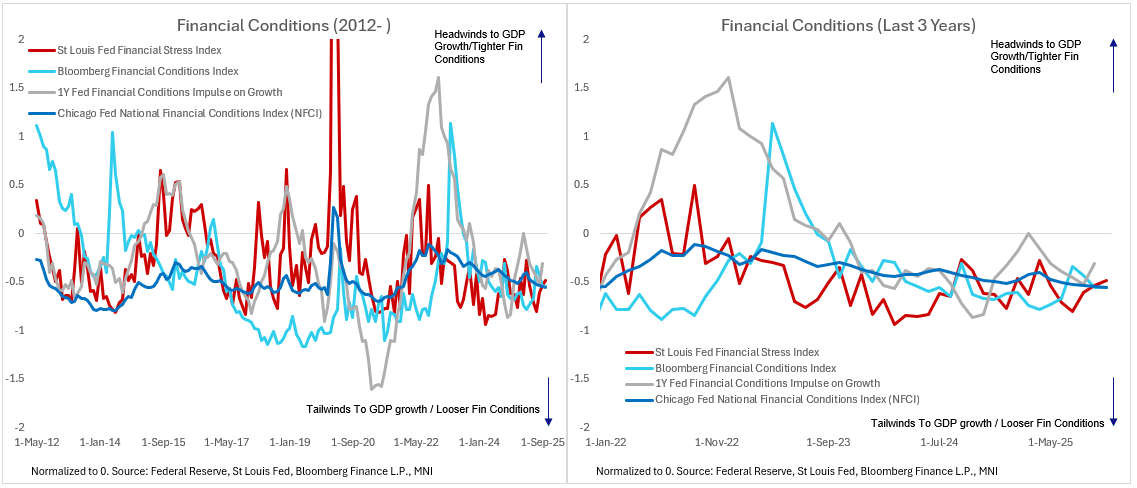
Wednesday's release of the Chicago Fed's National Financial Conditions Index (NFCI) for the week ending Oct 17 was another reminder that overall financial conditions remain loose and should generally be thought of as a tailwind to US economic growth.
- Per the Chicago Fed, "The NFCI was unchanged at –0.55 in the week ending October 17. Risk indicators contributed –0.27, credit indicators contributed –0.17, and leverage indicators contributed –0.10 to the index in the latest week."
- That's the most negative the index has printed since the beginning of 2021 and has progressively moved lower since mid-April.
- Negative values in the index have been historically associated with looser-than-average financial conditions, while negative values in the adjusted NFCI (also -0.55) are associated with financial conditions that are looser than what would be typically suggested by prevailing macroeconomic conditions. Only 1 of the 105 series used to construct the NFCI was tighter than average.
- The NFCI as well as multiple other indicators of financial stress and overall conditions reflect multiple factors: equities near all-time highs, long-end yields (real and nominal) at the lowest levels in a year, the dollar down 3% Y/Y and credit spreads near all-time tights.
- The Fed's recent re-prioritization of labor market conditions over price stability in terms of the balance of risks suggests little resolve to lean against looser conditions (though there are some relatively hawkish holdouts - the September minutes: "Some participants noted that, by several measures, financial conditions suggested that monetary policy may not be particularly restrictive, which they judged as warranting a cautious approach in the consideration of future policy changes")
- Indeed, quite the opposite: there's a good chance the Fed will cut twice more this year including next week, and end QT by year-end.
- The likely imminent end of QT is not intended by the FOMC shift the monetary policy stance but it will temper risks of market liquidity issues and the associated financial condition tightening.
Want to read more?
Find more articles and bullets on these widgets:
Historical bullets
EURUSD TECHS: Monitoring Support
- RES 4: 1.2063 2.236 proj of the Feb 28 - Mar 18 - 247 price swing
- RES 3: 1.2000 Round number resistance
- RES 2: 1.1923 2.00 proj of the Feb 28 - Mar 18 - 247 price swing
- RES 1: 1.1919 High Sep 17 and key short-term resistance
- PRICE: 1.1796 @ 18:54 BST Sep 22
- SUP 1: 1.1726/1667 Low Sep 22 / 50-day EMA
- SUP 2: 1.1574 Low Aug 27
- SUP 3: 1.1528 Low Aug 5
- SUP 4: 1.1392 Low Aug 1 and bear trigger.
The trend theme in EURUSD remains bullish and S/T weakness is considered corrective. Resistance at 1.1743, the Aug 22 high, has recently been cleared, reinforcing a bull cycle. Gains in the first half of last week resulted in a climb above 1.1829 the Jul 01 high and bull trigger. Clearance of this hurdle confirms a resumption of the primary uptrend and opens 1.1923 next, a Fibonacci projection. Support to watch is 1.1667. the 50-day EMA.
GBPUSD TECHS: Monitoring Trendline Support
- RES 4: 1.3893 1.236 proj of the Aug 1 - 14 - Sep 3 price swing
- RES 3: 1.3789 High Jul 1 and key resistance
- RES 2: 1.3753 High Jul 2
- RES 1: 1.3661/3726 High Sep 18 / 17
- PRICE: 1.3517 @ 19:01 BST Sep 22
- SUP 1: 1.3453 Low Sep 22
- SUP 2: 1.3441 Trendline support drawn from the Aug 1 low
- SUP 3: 1.3333 Low Sep 3 and a key support
- SUP 4: 1.3282 Low Aug 6
A bullish theme in GBPUSD remains intact and the move down from last Wednesday’s high is considered corrective - for now. However, the pair has traded through the 50-day EMA and this signals scope for a deeper retracement. The next support to watch lies at 1.3441, a trendline support drawn from the Aug 1 low. For bulls, a resumption of gains would refocus attention on key short-term resistance at 1.3726, the Sep 17 high.
US: Republican Pessimism Over Direction Of Country Increases
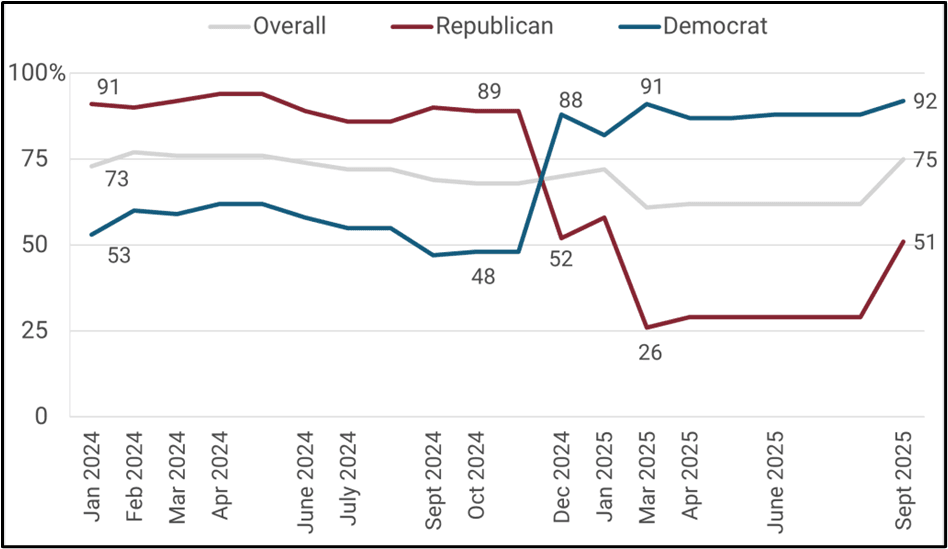
A survey from AP-NORC has found that pessimism among Republicans about the direction of the country has spiked for the first time since President Trump’s second inauguration. “In June, 29% of Republicans said the country was heading in the wrong direction. That number is now 51%.”
- AP notes, “Among Republicans, there are notable differences by age and gender: those under 45 are more likely than older Republicans (61% vs 43%) to say the country is off track, and Republican women are more likely than men (60% vs 43%) to share that view.
- AP adds, “Views on Donald Trump’s handling of the issues are highly partisan. Trump’s best issues are border security (55% approve) and crime (46%). Roughly 4 in 10 approve of his handling of health care, trade, the economy, the conflict between the Israelis and Palestinians, foreign policy, and immigration. Overall, 39% of adults approve of the way Trump is handing his job as president and 60% disapprove.”
- Silver Bulletin notes that while "Trump’s overall approval rating looks about the same today as it did in mid-July, his approval on issues related to the economy has fallen more consistently."
- Silver Bulletin's Eli McKown-Dawson notes, "approval of how Trump is handling inflation has fallen so rapidly that I've had to extend the y-axis on our issue approval chart below -30."
Figure 1: “Generally speaking, would you say things in this country are heading in the…?” (% saying wrong direction)
Source: AP-NORC


