EMISSIONS: EU End-Of-Day Carbon Summary: EUAs, UKAs Falls on Selling Pressure
EUAs Dec26 are falling toward first technical support at 83.52, the intraday low on 20 Jan, amid pot...
Want to read more?
Find more articles and bullets on these widgets:
Historical bullets
US TSY FUTURES: BLOCK: Large Mar'26 5Y Sale
- -25,000 FVH6 109-12.5, sell through 109-12.75 post time bid at 1041:01ET, DV01 $1,099,000.
- The 5Y contract has since rebounded, trades 109-14.5 last.
FED: Permanent FOMC Voters Lean More Dovish (2/2)
As for the 8 permanent voting members of the FOMC, we haven't heard from many of them since the December meeting (just 3) but we continue to believe they are the driving force behind signaling further cuts.
- Gov Waller, currently one of the most dovish FOMC members, said on Dec 17 that his 2026 rate dot submission was below the FOMC median (of 3.4%) at "about three", saying "maybe we're 50 to 100 basis points off of neutral. We still got some room" to ease. But "We're not seeing a dramatic decline of labor market going off a cliff...I don't think we have to do anything dramatic. If you have to do something dramatic, it's too late."
- After dissenting in favor of 50bp cuts at each of the last 3 meetings, Gov Miran said on Dec 22 he hasn't decided on whether to push for a 25bp or 50bp cut at the January meeting - he "could see voting for" 25 given that with rates having come down 75bp at the last 3 meetings "the need for me to dissent for 50 becomes less", but "I do think it's important we continue steadily reducing the policy rate". Of course, that could be Miran's last meeting if he is replaced after his term ends at the end of January.
- NY Fed Pres Williams - who recall reignited December rate cut pricing in a speech he gave in November signalling unusually clearly that he saw room for a further cut in the "near term" - said on Dec 19 that “I don’t personally have a sense of urgency to need to act further on monetary policy right now because I think the cuts we’ve made have positioned us really well."
- The latest major data reports have been downplayed as factors driving monetary policy thinking, with Williams noting that the latest soft CPI print as well as the tickup in the unemployment rate in November were distorted by technical factors.
- We haven't heard since the December meeting from Chair Powell, Gov Barr, Gov Bowman, Gov Cook, or Gov Jefferson. Four of those five (Barr being the exception) are more dovish leaning than the Committee as a whole.
- We use the term "permanent" to describe these 8 voters only in terms of their positions: three may not be voting too much longer including Powell (term as Chair ends in May, after which he may resign from the Board), Cook (Supreme Court hearing on Jan 21 over the White House's attempt to fire her), and Gov Miran.
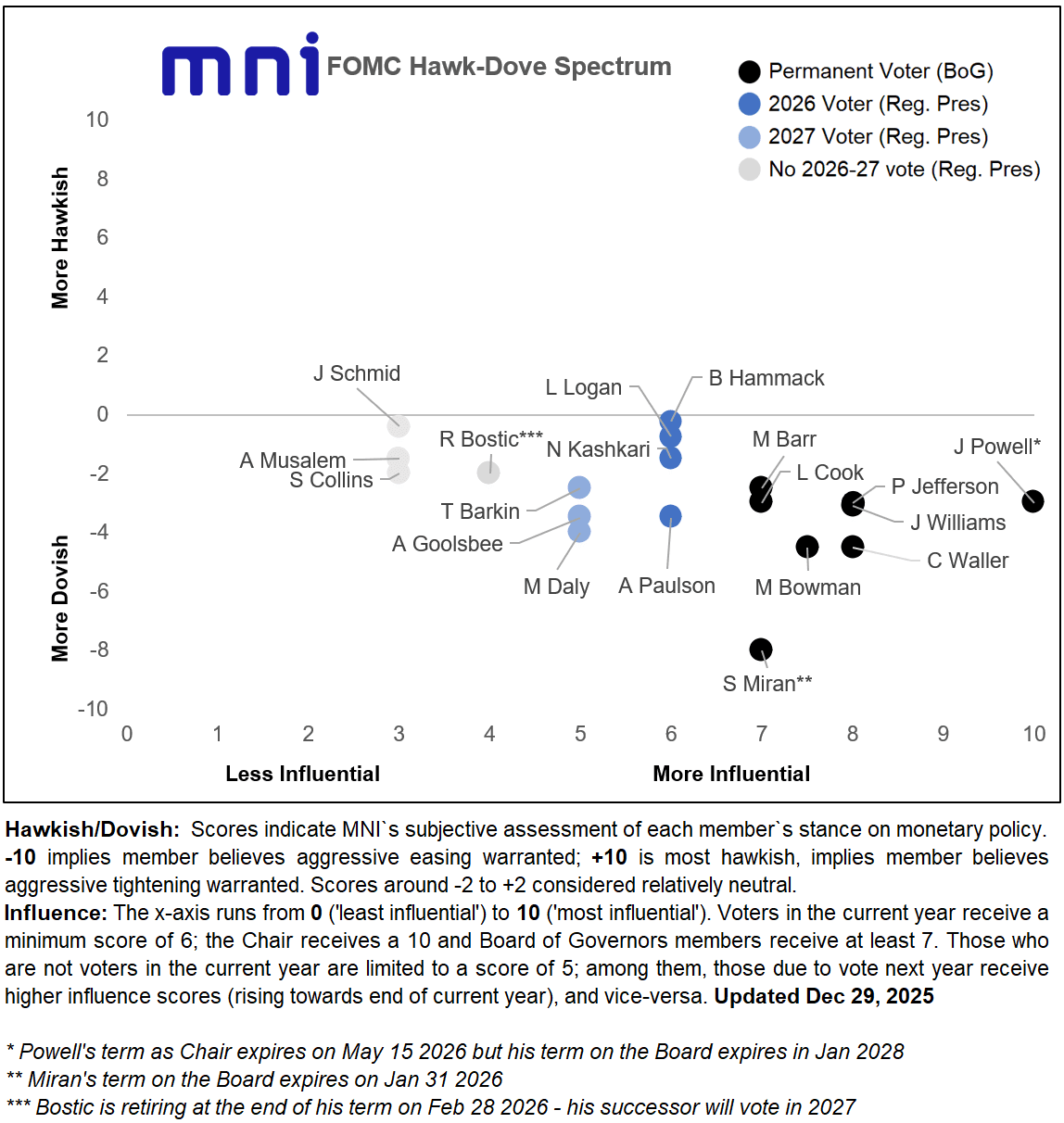
FED: MNI Hawk-Dove Spectrum Update: 2026 Voters Tilt Slightly More Hawkish (1/2)
MNI's FOMC Hawk-Dove Spectrum has been adjusted to reflect the change in the voting composition between 2025 and 2026. As is usually the case following the December meeting going into the minutes, there has been only limited FOMC participant commentary due to the holiday period, but what we have heard has largely reinforced where we thought participants were on the Hawk-Dove Spectrum going into the meeting.
- We'd characterize the 2026 Fed presidential voting slate as slightly more hawkish than the outgoing 2025 rotation, contrasting with a relatively dovish Board. First looking at the regional members:
- Philadelphia's Paulson is the most dovish of the 2026 regional Fed voters, saying on Dec 12 that "I am still a little more concerned about labor market weakness than about upside risks to inflation...I continue to see monetary policy as somewhat restrictive". Paulson didn’t reveal what action she supported at the December meeting but heavily implied she would have backed the cut and that she currently envisages more easing in 2026.
- Arguably the biggest dove among 2025 Fed presidents was Chicago's Goolsbee whose stance depends on the time horizon: he is wary of further near-term easing and was one of two hawkish dissenters in favor of a hold in December, but his base case is that rates come down substantially over the coming year. (For comparison, we characterize San Francisco Fed's Daly, a 2027 voter, as more dovish than him largely because she has had more appetite for immediate cuts.) Goolsbee on Dec 12: "if you look at the dot plot, I'm one of the most optimistic folks about how rates can go down in the coming year, I'm just uncomfortable with front loading the rate cuts assuming all of the inflation that we've seen be transitory."
- Also becoming voters in 2026 are Cleveland's Hammack and Dallas's Logan who are among the biggest 3 hawks on the Committee; they are comparable to KC's Schmid who dissented against the last two rate cuts. Hammack said on Dec 12 that "we've got policy that's in that range of neutral...I would prefer to be on a slightly more restrictive stance".
- The 4th regional voter is Minneapolis's Kashkari who hasn't made monetary policy commentary since the December meeting but we assume he has maintained his relatively cautious stance after saying in November that he wouldn't have supported the October rate cut. He's probably a little more hawkish than St Louis's Musalem and Boston's Collins, who in spite of some reservations especially in October and December voted in favor of the last 3 cuts.
- Atlanta's Bostic said on Dec 16 that he would have preferred to hold rates in December and didn't pencil in any cuts in 2026, but he is retiring at the end of February meaning that his last FOMC meeting is in January.
- We haven't heard from Richmond's Barkin, Logan, Kashkari, Daly, or Musalem since the December meeting.