CHINA: Could the CGB Curve be Steeper by Year End (Part 2)
- A potential upside for growth comes from the policy announcement this week for subsidy plans on loan interest for individuals and businesses aimed at improving consumption. According to estimates from the CEIC, consumption represents about 40% of the broader economy and has been dragged downwards by the decline in property markets. Consumption patterns for investment products show that risk aversion remains with bond fund growth robust and term deposit levels high. The new policy focuses on subsidies on interest for qualifying personal loans and eligible business loans located within the service sector. Official data shows that retail sales of consumer goods increased 5 percent year on year in the first half of 2025, and retail sales of services rose 5.3 percent, providing strong support for the sustained growth of the Chinese economy and this plan is aimed to boost it further.
- 2025 is a pivotal year in China’s policy cycle, marking the close of the 14th Five-Year Plan and the lead-up to the 15th, which will chart the country’s course from 2026 to 2030.
- A potential headwind for growth comes from lending data showing that New Loans in July contracted for the first time in twenty years. Households repaid over CNY300bn of short-term loans this year, including consumer credit. Yet there is some seasonality to consider here as July is the start of a new quarter and typically when holidays interrupt. A further measure, Aggregate Financing, did increase in July yet the boost was underpinned by government bond issuance.
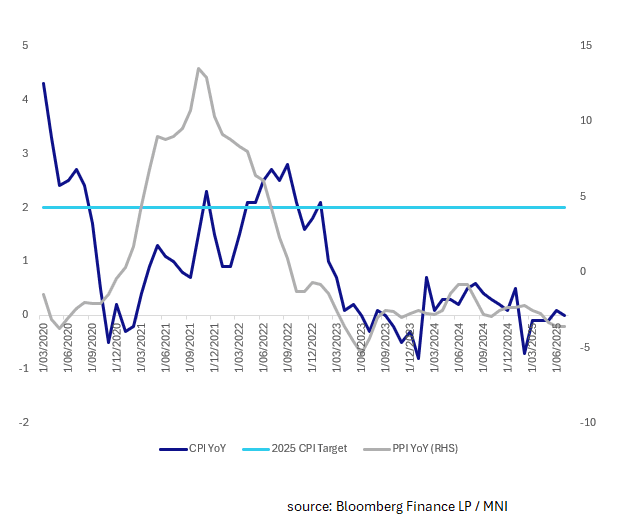
- At the heart of it is the ongoing deflationary pressures as witnessed by the July CPI and PPI remaining firmly in contraction, well below 2025 targets.
Fig 1: China YoY CPI vs PBOC Target & PPI YoY (rhs)
- A recent domestic poll of analysts / strategists expect the PBOC ease monetary policy further, with favored time frame being the fourth quarter. This will be the follow up to the May policy action where interest rates and bank's reserve requirement ratio were cut, both of which challenge the profitability of bond ownership also.
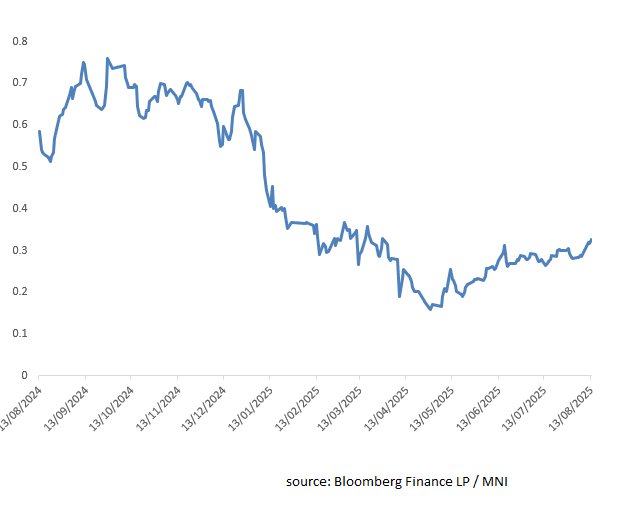
The 2s10s CGB curve remains flat relative to recent trends. The potential for monetary policy changes later in the year, and the subsequent 15th Five-Year Plan may bring about positive changes in the market and the potential for curve steepening.
Fig 2: China CGB 2s10s Curve
Want to read more?
Find more articles and bullets on these widgets:
Historical bullets
JAPAN: Long Dated Yield Surge Continues, With Election Driving Uncertain Outlook
As Japan's upper house elections approach (held July 20), focus remains on the relentless rise in longer-dated JGB yields. The 30yr is up a further +4bps today, last around 3.21%. This is a fresh high on record (since it was debuted in 1999, per BBG). The 10yr JGB yield was last near 1.60% with the 20yr around 2.64%. Concerns around fiscal slippage is a factor in the JGB sell-off. The 2/30yr JGB curve is at +241bps, just off recent highs and near multi-decade highs
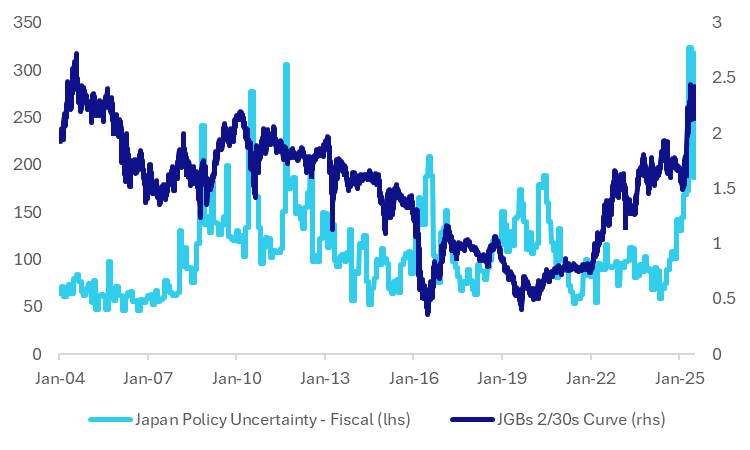
- The chart below plots the JGBs 2/30s curve against a policy uncertainty index, related to fiscal policy. June saw fiscal policy uncertainty edge down per this metric (which is a monthly indicator), but it remains elevated by historical standards. The index ticker on BBG is EPUCJNFP <Index>.
- To be sure, there are lots of episodes where the JGB curve has been steep, whilst fiscal policy uncertainty is low. However, at the moment, the correlations between the two series are running at close to 80% (using the last 12 months as a sample window).
- A number of onshore media outlet are reporting that the ruling coalition is at risk of losing its majority with the upper house elections, helping fuel fiscal policy uncertainty, but with a skew towards a stronger fiscal impulse going forward.
- Rtrs adds: "All three of the leading opposition parties espouse some form of consumption tax cuts, with the populist, right-wing Sanseito party proposing a phasing out of VAT altogether. The policy has gained sway with the public as well: a recent poll by the Asahi newspaper showed 68% of voters thought a sales tax cut was the best way to cushion the blow from rising living costs."
- It quotes analysis from Barclays: "Barclays calculates that the rise in 30yr yields currently factors in about a three percentage-point cut to Japan's 10% consumption tax rate. "Even if the ruling parties retain their majority in the upper house, they would still be unable to pass budget bills, including the upcoming supplementary budget, without the cooperation of the opposition parties."
- Japan PM Ishiba has favoured cash handouts to provide cost-of-living relief so far, but it remains to be seen if this is sustained post the election result.
- Note on July 23rd we have 40y debt auction, as potentially the first litmus test after the election result.
Fig 1: JGBs 2/30yr Curve & Fiscal Policy Uncertainty Index
Source: Bloomberg Finance L.P./MNI
JGBS AUCTION: Poll: 5-Year Climate Transition JGB Auction
*JAPAN 5Y CLIMATE BOND SALE MAY HAVE CUT-OFF YIELD 1.1%: POLL - Bloomberg
AUSSIE BONDS: Modestly Cheaper, Consumer Confidence UP
ACGBs (YM -2.0 & XM -2.0) are modestly cheaper with narrow ranges.
- The July Westpac consumer confidence index rose 0.6%m/m, putting the index at 93.1 (from 92.6 in June). The edge higher comes despite last week's surprise RBA on hold decision. Sentiment is up from recent lows, but still below recent highs, leaving us within recent ranges.
- In terms of the CSI sub-indices, the time to buy a major household item fell by 2.6% (after gaining 7.5% in June). The buy a dwelling question fell by 5.1% (after a 3.6% gain in June). Family finances improved from a year ago and for the year ahead.
- Cash ACGBs are 1-2bps cheaper with the AU-US 10-year yield differential at -5bps.
- Today’s Jun-54 auction result extended the recent trend of firm pricing for ACGBs, with the weighted average yield printing 0.24bps through prevailing mids, according to Yieldbroker. Moreover, demand improved, as reflected by a cover ratio of 3.2133x, up 2.8433x from the previous auction.
- The bills strip weaker, with pricing -2 to -4.
- RBA-dated OIS pricing is firmer across meetings today. A 25bp rate cut in August is given a 90% probability, with a cumulative 57bps of easing priced by year-end.


