US DATA: Continued Rise Of Unit Labor Costs Poses Headwinds To Disinflation
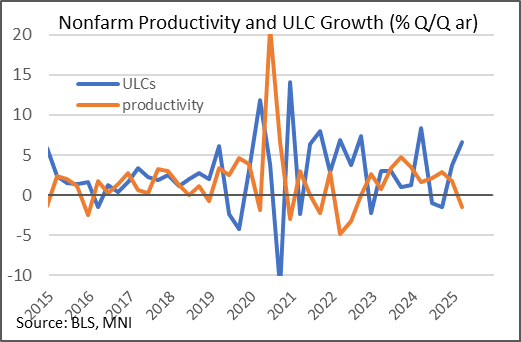
Unit labor costs (ULCs) were revised substantially higher in the Bureau of Labor Statistic's Q1 final release, rising 6.6% Q/Q SAAR (rev from 5.7% prelim, and up from 3.8% prior). This was a 4-quarter high, coming alongside a downward revision to nonfarm productivity to -1.5% Q/Q SAAR (-0.8% prelim), an 11-quarter worst.
- ULCs, which were revised up 0.9pp, are a combination of two variables: the aforementioned productivity contraction which was 0.7pp worse than initially thought, and hourly compensation, which was 0.2pp upwardly revised to 5.0% Q/Q SAAR.
- On productivity, hours worked grew more than twice as quickly as originally estimated (1.3% Q/Q SAAR vs 0.6% previously published), with output failing to keep pace (falling 0.2% Q/Q SAAR, vs -0.3% previously published). Productivity was slightly softer than thought in the manufacturing sector (4.4% vs 4.5% prelim), but non-manufacturing business productivity was substantially revised lower to -1.8% (-1.1% prelim), driving the overall revision.
- We should note that Q4 saw substantial revisions as well: while labor productivity registered the same 1.7% Q/Q SAAR as previously published, hourly compensation was revised up to 5.5% from 3.7%, boosting ULCs to 3.8% (from 2.0% previously published) for the quarter.
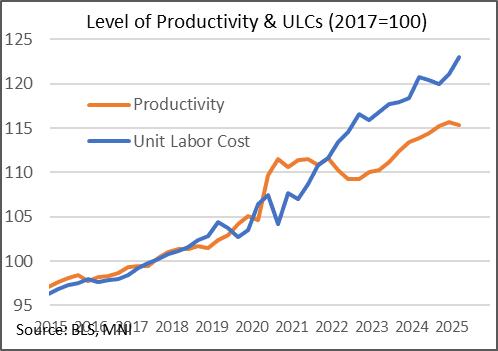
- The bigger picture is that productivity over the "current business cycle" (which BLS identifies as starting in Q4 2019) has risen 1.8% annualized, "far higher" than the 1.5% in the previous 2007-2019 cycle, though below the 2.1% rate since Q1 1947.
- In the nearer-term though, the continued rise of unit labor costs point to a headwind to the disinflationary process.
Want to read more?
Find more articles and bullets on these widgets:
Historical bullets
GERMANY: Merz Faces Second Chancellor Confirmation Vote Shortly
Freidrich Merz faces a second vote in the Bundestag shortly at 1515CET (0915ET, 1415BST) as he seeks the required absolute majority to be confirmed as Germany's new chancellor. In a day of high political drama, in an earlier vote Merz won the backing of just 310 lawmakers, short of the 316 required. Should he prove unsuccessful in the second vote a third vote will take place immediately afterwards, in which a simple majority will suffice to see him elected.
- FAZ reports "SPD party leader Lars Klingbeil was the first to speak: "It is important that Germany gets a reliable government." He expected "that the necessary majority will be achieved in the second round of voting for Friedrich Merz to be our country's next Chancellor.""
- The unprecedented nature of the unsuccessful vote (none of Germany's post-war chancellors have ever failed to win a first-round absolute majority) has meant a significant amount of speculation regarding the timing of the second vote, with initial expectations that it could take place this coming Friday proved wrong as Merz's centre-right Christian Democratic Union/Christian Social Union and the centre-left Social Democrats secured support from opposition groups for an expedited election process.
- Even if Merz wins in the second round, the initial failure to secure a majority will cast a shadow over the new gov't and highlights divisions within both participating groups. Some on the left of the SPD remain opposed to a deal with the conservatives, while Merz also has pockets of opposition within his own party.
BUNDS: Little Reaction To News Of Second Merz Vote
German paper is wider vs. Tsys across the curve, despite this morning’s political headlines out of Germany.
- German yields 0.5bp lower to 2.5bp higher, curve twist steepens.
- Bund futures around the middle of their 39-tick session range after respecting yesterday’s low, last 130.90.
- There hasn’t been much reaction to news that there will be a second vote in CDU leader Merz’s bid to become Chancellor later today (15:15 CET/14:15 BST)..
- A reminder that the move away from session lows that came after Merz’s failure to win enough support in the first vote was only shallow, signalling that the market either believed that he would still become Chancellor at some point or that the most viable alternatives wouldn’t have much of a downside impact on German fiscal spending.
- Looking at the voting backdrop, J.P.Morgan note that “one theory is that a few members of the CDU/CSU (and possibly SPD) were disgruntled by either the coalition treaty itself or because they missed out on some government/parliamentary roles. Perhaps such individual decisions by a few members of the parties exceeded the coalition’s majority in an unintentional way. Having sent that signal, they may now support Merz in a second vote. However, this is only speculation making the rounds in the German press”.
- They note that “this matters for the government’s stability in future. If this morning’s opponents are more structural in nature, rather than a protest vote to send a signal, they may also oppose the government in votes on general government policy. That would be a more significant problem”.
MNI: US REDBOOK: APR STORE SALES +6.7% V YR AGO MO
- MNI: US REDBOOK: APR STORE SALES +6.7% V YR AGO MO
- US REDBOOK: STORE SALES +6.9% WK ENDED MAY 03 V YR AGO WK


