US: CNBC-Bessent To Propose Reform Of Council Monitoring Systemic Financial Risk
CNBC reports that Treasury Secretary Scott Bessent is set to propose an overhaul to the Financial Stability Oversight Council (FSOC). The Council was set up in the wake of the 2008 Great Financial Crisis by the Dodd-Frank Act of 2010 tasked with "identifying risks to the financial stability of the United States; promoting market discipline; and responding to emerging threats to the stability of the U.S. financial system."
- CNBC: "Whereas the agency’s focus had been tightening regulations and oversight of the institutions it oversees, the new approach will switch that, and push for looser regulation and a freer approach...The plan also lines up with the Trump administration’s focus on deregulation, but represents a switch from the commission’s longstanding tilt towards stronger regulation."
- As noted in MNI's US Daily Brief (US-Venezuela Tensions Spike Amid Tanker Op) Bessent is set to chair a meeting of the Council later today, where he will present an "update on the Council's workstreams and an update on the Council’s interpretive guidance on nonbank financial company determinations and the Council’s analytic framework for financial stability risk identification, assessment, and response."
Want to read more?
Find more articles and bullets on these widgets:
Historical bullets
US: MNI POLITICAL RISK - End Of Government Shutdown In Sight
Download Full Report Here
- President Donald Trump will participate in a Veterans Day ceremony at 11:00 ET 16:00 GMT.
- Secretary of State Marco Rubio will join a G7 meeting in Canada today, becoming the most prominent US official to visit the country since Trump terminated trade talks last month.
- The Senate passed a funding package to end the longest federal government shutdown in US history. The House of Representatives could pass the package as soon as tomorrow.
- China took another step towards fulfilling the terms of the US-China trade deal, adding thirteen fentanyl precursors to a list of controlled exports.
- The US is nearing trade deals with India and Switzerland.
- A nonpartisan budget watchdog found Trump's tariff cheques would cost far more than tariffs are projected to bring in.
- A federal judge in Utah ruled in favour of a 2026 Congressional map that is likely to net Democrats an additional House seat.
- The White House was 'blindsided' by Trump's 50-year mortgage proposal.
- Electricity supply is struggling to keep up with AI data centre demand.
- The Senate Agriculture Committee released a draft of its crypto market structure bill.
- The US military carried out two more lethal strikes on alleged drug boats.
- The first phase of the Gaza peace deal nears its end without clarity on progressing to the next phase of the agreement.
- The Trump administration paused sanctions on Syria after a landmark White House meeting.
- Poll of the Day: Americans are increasingly convinced the economy is moving in the wrong direction.
Full Article: US DAILY BRIEF
US TSYS: Weekly ADP Employment React
- Treasuries extending recent highs after weekly ADP "employment pulse" data comes out weaker than expected.
- Currently, the Dec'25 10Y contract trades +6.5 at 112-28.5 (H). A short-term bear theme in Treasuries remains in place, however.
- Attention is on a reversal trigger at 112-06, the Sep 25 low, and the 100-DMA, at 112-08. A clear break of these price points would expose a trendline support at 112-02. The trendline is drawn from the May 22 low. Resistance to watch is 113-02, the Nov 5 and 7 high. Clearance of this level would highlight a potential bullish reversal.
- Bbg US$ index dips -0.24 at 1218.47; SPX eminis softer -13.75 at 6843.0.
INTERNATIONAL TRADE: Weak Chinese Domestic Demand Weighs On EZ Trade Balance-ECB
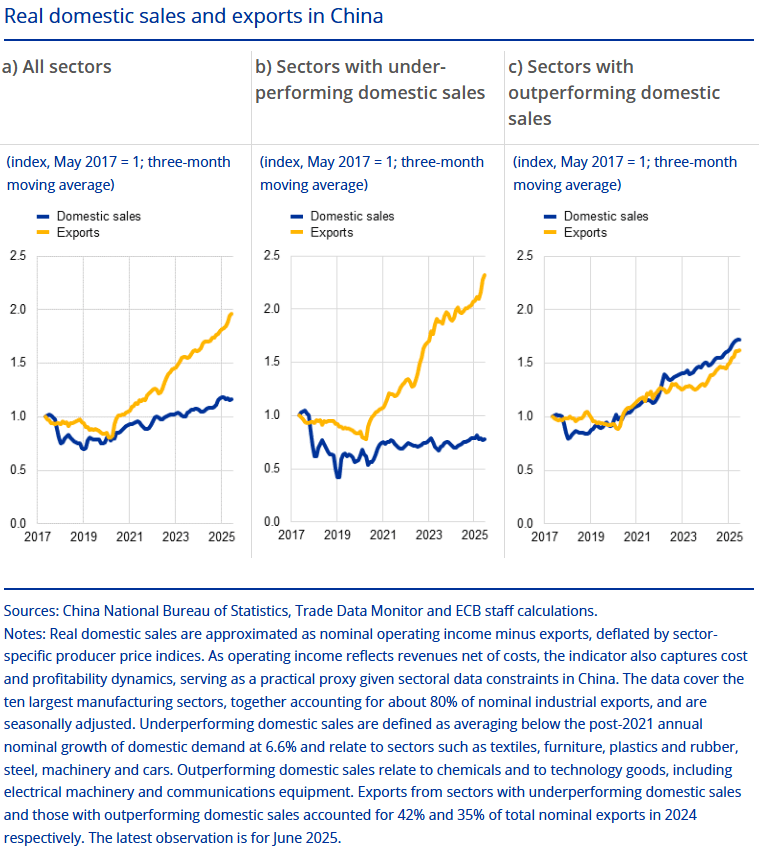
MNI (London) - China's weak domestic demand rather than U.S.-China trade tensions is the key factor for the strong rise of exports to Europe and the stagnation of imports, the European Central Bank published in its latest Economic Bulletin on Tuesday.
- China’s real estate downturn and policies promoting self-reliance under “Made in China 2025” have eroded household demand and curbed imports, particularly of consumer and intermediate goods, with weak domestic sales and falling export prices prompting firms to seek foreign markets - notably in sectors such as motor vehicles and steel, where exports have grown by about 75% since 2022, the ECB said.
- The Bulletin adds to previous reports (1, 2) suggesting China has built significant manufacturing overcapacity in recent years, indicated by domestic supply rising faster global demand, rising numbers of lossmaking industrial firms in the country, as well as declining capacity utilization, which may weigh on demand for German products.
- Back to more specific EU implications from today's study: "Weak domestic demand appears to be the missing link in explaining China’s strong exports to Europe – more so than tariff-related trade diversion. Escalating trade tensions between the United States and China might result in a further diversion of Chinese exports to Europe. However, the rise in China’s exports to the EU predates the latest tensions and coincides instead with the onset of weakness in domestic demand in China."
- In 4Q24 "the average monthly value of domestic sales was around four times higher than total exports and over 28 times larger than exports to the United States. This suggests the pool of goods that could be redirected to the EU is much broader than trade data alone would suggest. Redirecting even a small share of domestic sales abroad could boost overall exports – including to the EU – more than a sizeable diversion of exports from the United States."