BONDS: Closed With A Bear-Flattener, NZ-US 10Y Diff Looks Too Low
NZGBs closed showing a bear-flattener, with benchmark yields flat to 2bps higher.
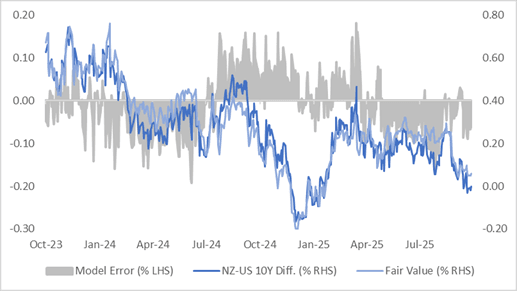
- On a relative basis, the NZGB 10-year has underperformed its US tsy counterpart, with the NZ-US yield differential 2bps higher at flat. (see chart)
- A simple regression of the 1Y3M forward swap spread against the 10-year yield differential over the past 18 months suggests the current differential is 6bps below its estimated fair value of +6bp
- “NZ's central bank considered Hayley Gourley as a potential board member and recommended that option to the government before she was appointed to the MPC.” – BBG
- “NZ is relaxing climate reporting rules due to concerns over the cost to businesses, with companies listed on the NZX only having to provide disclosures if their market capitalisation is NZ$1 billion or more.” - BBG
- Swap rates closed little changed.
- RBNZ dated OIS pricing closed little changed across meetings. 25bps of easing is priced for November, with a cumulative 39bps by February 2026.
- The local calendar will be empty until next Tuesday's release of Filled Jobs data for September.
- On Thursday, the NZ Treasury plans to sell NZ$225mn of the 4.50% May-30 bond, NZ$175mn of the 4.25% May-36 bond and NZ$50mn of the 5.00% May-54 bond.
Figure 1: NZ-US 10-Year Yield Differential
Source: Bloomberg Finance LP / MNI
Want to read more?
Find more articles and bullets on these widgets:
Historical bullets
JGBS: Futures At Lows At Lunch
At the Tokyo lunch break, JGB futures are weaker and at session lows, -12 compared to the settlement levels.
- See the full MNI BoJ Review here.
- The BOJ kept rates at 0.5%, but two members dissented in favour of a 25bp hike, arguing the price target is “more or less achieved” and rates should move “closer to neutral,” highlighting stronger hawkish voices within the board.
- Ueda remained balanced, noting “underlying inflation is approaching 2%, but the 2% level has not yet been reached” and that there is “little sign of tariff having impact on Japan’s economy,” while emphasising ongoing global uncertainty and data dependency.
- Views diverge—some expect a hike in October following the Tankan Survey and LDP leadership election, while others see January 2026 as the base case. Political risks (e.g., dovish LDP candidates) and Fed-driven yen appreciation could delay tightening.
- Cash US tsys are 1-2bps cheaper in today’s Asia-Pac session after Friday’s modest sell-off.
- Cash JGBs are slightly weaker across benchmarks, led by the futures-linked 7-year (+2.3bps). The benchmark 10-year yield is 0.6bp higher at 1.651% versus the cycle high of 1.653% set on Friday.
- Swap rates are 1-2bps higher. Swap spreads are mostly wider.
STIR: BOJ-Dated OIS Firmer Than Pre-MPM Levels
Markets had been positioned for a cautious, wait-and-see approach from the BoJ at this meeting.
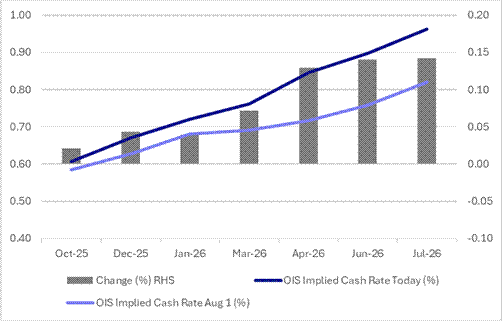
- Nevertheless, at the time of writing, BOJ-dated OIS pricing was ~5bps firmer across meetings versus Friday’s pre-MPM levels.
- Moreover, post-MPM moves leave 2026 meetings 4-15bps firmer than early August levels.
- Current OIS pricing implies just a 50% probability of a 25bp hike in October, rising to 62% by November and 86% by December.
Figure 1: BOJ-Dated OIS – Today Vs. August 1, 2025
Source: Bloomberg Finance LP / MNI
MACRO UPDATE: South Korea Exports Give Warning Sign For Global Trade
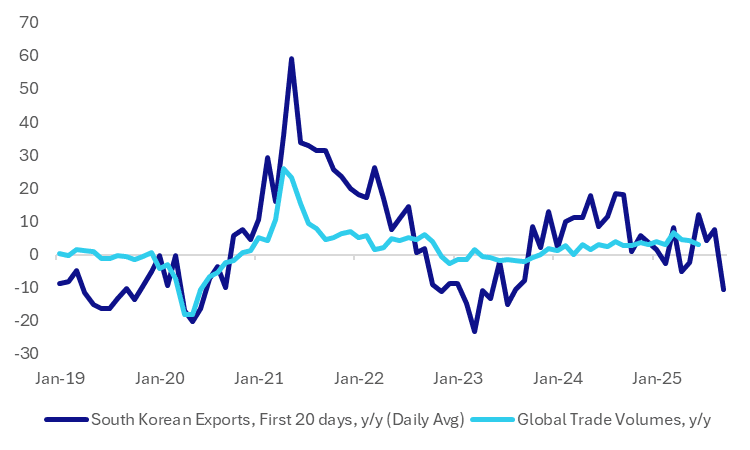
The earlier first 20-days of September trade data for South Korea flashed a warning sign for global trade growth (albeit with caveats on the data). The chart below plots the daily average of the first 20-days export growth in y/y terms against global trade volumes, also in y/y terms.
- The daily average which takes into account differences in working days between years, fell to -10.6%y/y in Sep, the weakest print since late 2023. The last time we were this soft global trade volumes was also in negative territory.
- Arguably the result may not surprise the market too much, given higher tariff levels are expected to weigh on trade growth as we progress towards the end of 2025.
- Also via BBG: "Monday’s trade data show a larger-than-usual gap between seasonally adjusted and unadjusted figures because of the shifting Chuseok holidays... The real question is how much momentum can be sustained after the Chuseok holidays.”
- The headline figure was much stronger at +13.5%y/y for the first 20-days of Sep.
- This will be a watch point for the local authorities, given President Lee is keenly focused on boosting growth. More broadly, given South Korea's key role in global supply chains, the data will be watched for signs of broader trends in the global trade outlook.
Fig 1: South Korea First 20-days Exports Y/Y (Daily Average) and Global Trade Volumes Y/Y
Source: Bloomberg Finance L.P./MNI


