AMERICAS OIL: Americas End of Day Oil Summary: Crude Rises
US OIL: October 6 - Americas End of Day Oil Summary: Crude Rises
WTI crude oil prices are trading higher to reverse some of the decline last week in a relief rally following OPEC’s decision to raise November output by 137k b/d, counter to some expectations for a larger hike. Initial firm resistance has been defined at $66.42, the Sep 29 high. Clearance of this level would highlight a reversal.
- According to Bloomberg there were some dissenting views with Russia arguing that prices needed to be supported and Algeria that demand could weaken but Saudi arguing for a larger target increase.
- The group is trying to regain market share, but most members have limited spare capacity except Saudi Arabia, and so the impact of output decisions on physical supply is unclear. RBC says the November increase will be less than half the headline figure.
- Saudi Aramco has maintained its OSPs for Super Light, Extra Light and Light crude for November loading to Asia, according to Argus Media’s Bachar El-Halabi.
- Russia’s ability to divert crude to the global market is diminishing as crude export capacity has fallen after recent refinery attacks, according to Bloomberg.
- Ukraine says it has attacked an oil terminal in Feodosia, Crimea overnight resulting in a large fire.
- Libya's Waha Oil Company has repaired a leak in the Zaggut-Sidra oil pipeline after a brief shutdown after detecting a leak on Friday.
- Nigeria’s crude oil production rose to 1.68m b/d in September, the highest in five years, Bayo Ojulari, CEO of NNPC said on Monday, cited by Bloomberg.
- The North Sea Buzzard oil field remained shut as maintenance extends into October, according to operator Cnooc International on Oct. 3.
- HSBC maintains a Brent crude forecast for Q4 25 and 2026 at $65/bbl, according to Reuters on Oct. 6
- Higher financing costs could shift any potential contango deeper than in previous oil market gluts, according to Bloomerg’s Javier Blas.
- The 285kb/d El Segundo refinery will be making operational adjustments to meet Southern California's fuel demands after a fire on Thursday, Chevron said.
- WTI futures have pulled back from their recent highs. Yesterday's sell-off resulted in a move through key support and the bear trigger at $60.85, the Aug 13 low. Clearance of this level strengthens a bearish theme and paves the way for an extension towards $57.50, the May 30 low. Initial firm resistance has been defined at $66.42, the Sep 29 high. A break of this level would highlight a reversal.
- Cracks ended mixed with the gasoline crack higher, offsetting some of last week’s decline.
- WTI Nov futures were up 1.4% at $61.69
- WTI Dec futures were up 1.4 at $61.34
- RBOB Nov futures were up 2.2% at $1.90
- ULSD Nov futures were up 0.3% at $2.24
- US gasoline crack up 0.8$/bbl at 18.15$/bbl
- US ULSD crack down 0.6$/bbl at 32.56/bbl
Want to read more?
Find more articles and bullets on these widgets:
Historical bullets
LOOK AHEAD: US Macro: PPI (Wed) and CPI (Thu) Inflation
US PPI inflation is released on Wednesday before CPI inflation on Thursday, an unusual ordering that should see core PCE implications dialled in after the CPI release rather than the usual wide range waiting for specific PPI details. PPI will be watched more closely than usual this month after a far stronger than expected jump in last month’s July report fired a warning short over tariff-based cost pressures starting to feed through. That included a 0.6% M/M increase in our preferred core series of PPI ex food, energy & trade services, which strips out items such as the then booming portfolio management & investment advice category following the strength in equity markets. It's too early to gauge an accurate sense of analyst expectations for August.
CPI inflation on Thursday will then be the last major release ahead of the Sep 17 FOMC decision. Consensus looks for core CPI at 0.3% M/M after the 0.32% M/M in July, another monthly increase comfortably above a pace consistent with 2% inflation. August should in theory start to see the largest tariff impacts along with September and possibly October. Returning to July’s report, core goods inflation was softer than expected, at a still solid (by core goods standards) 0.2% M/M for a second month running but about half that of 0.4% expected by analysts. Instead, non-housing core services surprised higher. The latter was a “dangerous” development in the words of a usually dovish Chicago Fed’s Goolsbee (’25 voter), who speaking after Friday’s payrolls report is still undecided on a September cut whilst looking for August inflation data “to get more information”.
LOOK AHEAD: US Macro: Payrolls Preliminary Benchmark Revisions (Tue)
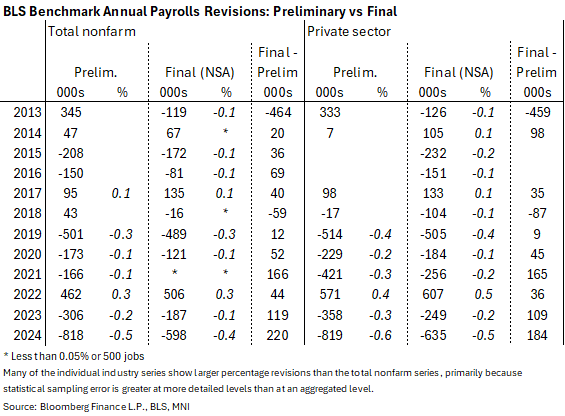
- The BLS on Tuesday will publish preliminary estimates of benchmark revisions, based off QCEW data for Q1.
- These will give an indication of the actual benchmark revisions on the Mar 2025 level of payrolls due with the Jan 2026 payrolls report released in early February.
- Bear in mind that the final benchmark estimate tends to nearly always be more negative than the preliminary figure – see historical values to the right.
- That doesn’t mean they can’t be large again after last year’s historically negative revision that lowered the level of payrolls by ~600k. Initial estimates we’ve seen look for another large downward revision, with the smallest being worth -550k but with wide ranges higher.
FED: Barclays Adds A Cut To 2025 Fed View
Barclays analysts now expect three Fed cuts in the remainder of the year, adding October to their pre-existing call for 25bp reductions in September and December. "Given the disappointing August employment report, we expect the FOMC to see more elevated downside risks to the employment side of the mandate."
- As for a 50bp September cut, "we think that the FOMC will view [that] as sending too strong a signal that labor market conditions are deteriorating. Indeed, we think that participants such as Powell understand that the slower pace of payroll employment reflects at least, in part, slower labor supply, which does not translate into increased labor market slack."
- For 2026 they continue to expect 25bp cuts in March and June to 3.00-3.25%, but "we do not think the FOMC will be able to cut rates more than twice next year, as we think that activity will show some slight acceleration, with the economy adapting to the new tariff environment and fiscal policy providing some support, and the unemployment rate will revert down amid limited increase in labor supply."


