JGB TECHS: (Z5) Tilts Higher
- RES 3: 140.08 High Jun 13
- RES 2: 139.05 High Aug 4
- RES 1: 137.30 - High Sep 8 and key short-term resistance
- PRICE: 136.08 @ 15:53 GMT Nov 6
- SUP 1: 135.61 - Low Oct 08
- SUP 2: 135.39 - 1.618 proj of the Aug 4 - Sep 2 - Sep 8 swing (cont.)
- SUP 3: 134.69 - 2.000 proj of the Aug 4 - Sep 2 - Sep 8 swing (cont.)
Prices started last week well, growing the gap with next support into the 135.61 Oct 08 low. Despite this stability, prices remain inside the firm downtrend that’s dominated prices since mid-September, and prices will need to challenge resistance before signaling any broader reversal. Key short-term resistance has been defined at 137.30, the Sep 8 high. Further weakness would open 135.39 next, a Fibonacci projection.
Want to read more?
Find more articles and bullets on these widgets:
Historical bullets
JAPAN DATA: August Labor Earnings Below Forecast, Adding To Recent Softness
Japan data notably below expectations, real earnings remaining entrenched in negative territory, at -1.4%y/y. This also follows the July outcome being revised to negative (from +0.5%y/y). Not a firm labor earnings picture in recent months. USD/JPY hasn't reacted much to the print, we sit around 152.00, close to session highs. More details to follow
NZD: NZD/USD - What Happens If The RBNZ Cuts By 50bps
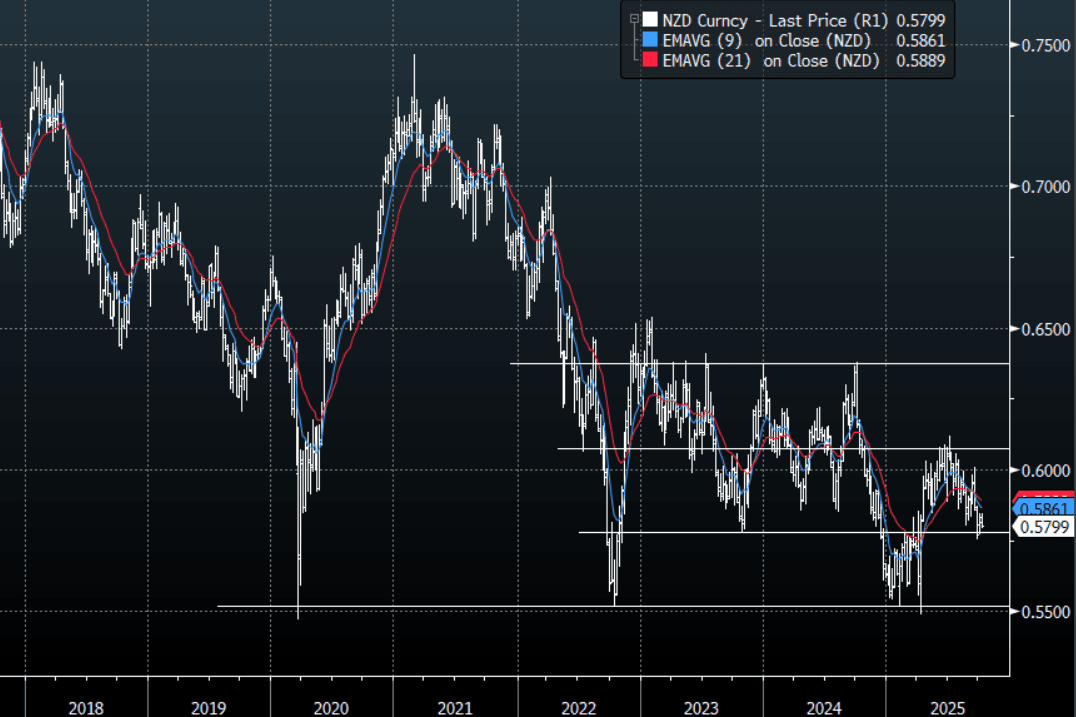
The NZD has been trading heavy ever since the very poor growth data came out mid September. A dovish 50bps cut today is likely to increase the headwinds for the NZD and could be the catalyst it needs to sustain a break sub 0.5750/0.5800. Should NZD/USD break through this support the focus will turn toward the multiple bottoms toward the 0.5500 area. The market will likely be going into this meeting with a dovish skew so there is also a risk the RBNZ could disappoint which would then see an initial knee-jerk higher. If this eventuates, upside focus for NZD/USD will be back towards the 0.5850/0.5900 area where I would suspect sellers return.
Fig 1: NZD/USD Spot Weekly Chart
Source: MNI - Market News/Bloomberg Finance L.P
LNG: European Refilling Stalls, Prices Supported By Approaching Winter
US and European gas prices were supported by buying as winter heating demand approaches. Europe rose 0.8% to EUR 33.385 after a high of EUR 33.635 early in the session to be 6.3% higher this month. European storage is almost 83% full but progress towards 90% appears to have stalled making it vulnerable to any supply disruptions or increased demand from other regions.
- Qatar, the third largest LNG exporter, reported a navigational malfunction, which has happened at a time when Europe is still trying to increase inventories ahead of winter. Bloomberg says that tankers continue to load according to its ship tracking data.
- Ukraine is looking to increase gas imports by around 30% this winter due to Russian attacks on its energy infrastructure, which remain vulnerable especially as temperatures drop. This adds to competition for global supplies.
- US natural gas rose 4.8% to $3.519 on Tuesday to be up 6.5% this month driven by forecasts for cooler weather in the eastern and western US around mid-October, according to Atmoshperic G2, which should boost heating demand.
- The US EIA revised down its January 2026 price forecast by $0.50 to $4.10 due to an upward revision to US production expectations. It also sees US LNG export capacity rising 5Bcf/d over 2025 and 2026 as Plaquemines LNG and Corpus Christi LNG Stage 3 become operational.


