IRAN: *US SEEKS TO RESTART HORMUZ MISSION AS EARLY AS THIS WEEK: WSJ
*US SEEKS TO RESTART HORMUZ MISSION AS EARLY AS THIS WEEK: WSJ...
Want to read more?
Find more articles and bullets on these widgets:
Historical bullets
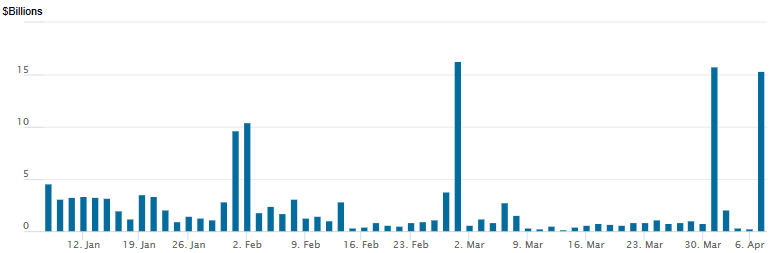
US: FED Reverse Repo Operation
RRP usage rebounds to $15.345B with 22 counterparties this afternoon vs. $0.227B Monday. Compares to last year's highest excess liquidity measure: $460.731B on June 30.
GBPUSD TECHS: Bearish Trend Sequence
- RES 4: 1.3575 High Feb 26
- RES 3: 1.3479 High Mar 23
- RES 2: 1.3389 50-day EMA
- RES 1: 1.3312 20-day EMA
- PRICE: 1.3245 @ 16:42 BST Apr 7
- SUP 1: 1.3159 Low Mar 31 and the bear trigger
- SUP 2: 1.3125 Low Nov 26 ‘25
- SUP 3: 1.3038 Low Nov 20 ‘25
- SUP 4: 1.3010 Low Nov 4 & 5 and a key M/T support
A bearish trend structure in GBPUSD remains intact. MA studies are in a bear mode position highlighting a dominant downtrend. The recent breach of support at 1.3219, the Mar 13 low, strengthens a bear theme and confirms a resumption of the downtrend. Sights are on 1.3125, the Nov 26 ‘25 low. Key resistance to watch is at the 50-day EMA, at 1.3389. A clear break of it would undermine the bearish theme. First resistance is 1.3312, the 20-day EMA.
FED: Goolsbee Sees Inflation Similarities With 2021/22, Cautious On Economy
Chicago Fed’s Goolsbee (’27 voter, historically dovish but a hawkish dissenter in Dec 2025) mentioned the eery current similarities with the 2021/22 inflationary episode. He deems the labor market to be stable but not great whilst attributing the high youth unemployment rate to low hiring rather than AI-directly. Combined with being cautious/nervous about the economy at the moment, he is still trying to work out what is the appropriate action.
- On inflation similarities with 2021/22: “My concern at this immediate time is that we've got to get our heads around an oil shock, which is going to drive up prices in a stagflationary way, potentially before the other one [from tariffs] has gone away. So the prices spiked from tariffs and they were supposed to go away. And this is now hitting before that went away. And that's eerily reminiscent of that period where the Covid supply shock damage happened driving up inflation. And then the war breaks out in Ukraine before that's fixed itself. And it's another supply shock on top of it. So this is how persistent this is going to be I think is going to have a major impact on how you view the economy.”
- On stable but not great labor market: “I think the job market is basically stable but not great. Unusual in that there's very low hiring, which feels like a recession, but there's very low layoffs, which normally is the opposite of a recession. So it's strange for those both to be happening at the same time. I think that's what happens when businesses are uncertain and they say, we're just going to sit on our hands until we figure out is the war, is this going to be a temporary shock? Since the 70s - if you're old enough you might remember the awful economic outcome from high oil prices in the 70s - we've gotten less oil-using as an economy since then. And we’ve become a much bigger energy producer since then. So if this sustains, there is likely to be at least some part of the economy that's rebounding and producing energy. But in summary I'm cautious/nervous about it in the moment.”
- On JPMorgan and BofA heads on stickiness of inflation, perhaps at 4%: "We’ve been above the 2% inflation target for five years consecutively now. We were making progress and then kind of stalled out and now it’s been inching itself up the other way. We got down almost to 2%, now it’s been 3% and if we’re headed to 4% that’s not stable. The longer you go and the higher you are above the 2% target, the more it just gets ingrained into cost plus contracts. So I hope they’re not describing that. Yet I still can't get past, it doesn’t look like a regular recession. They're not describing a regular recession. We're all still trying to work out what is the appropriate action."
- On AI impacts: "In the right now impact, I am a skeptic that almost anything we've seen in the job market or in the economy is due to AI, because the adoption simply hasn't been great enough. [When then pushed on the high u/e rate of young graduates] The hiring rate is extremely low. And any time the hiring rate is low, the most impacted group of going to be new graduates because they're disproportionately trying to get hired."


