GILTS: /STIR: Sell-Side Still Sees Gilt Outperformance, Dovish Bias In GBP STIRs
The latest round of sell-side notes that we have read continues to focus on the potential for cross-market outperformance and a bias for flattening re: gilts. Further forwards, there is a dovish bias in GBP STIRs heading into the upcoming MPC meeting (aided by the recent hawkish move), with Goldman Sachs initiating a long SFIU6 recommendation on Friday:
- Goldman Sachs: UK front-end yields have increased in recent weeks, boosted in part by incrementally stronger survey data and some degree of labour market stabilisation. We think there is compelling risk-reward to receive. Our economists expect further weakening in the labour market and a bigger inflation decline than the BoE forecast. This week’s BoE meeting will be an important test of the MPC’s assessment of the likelihood of further cuts, but we think the risks to current pricing are asymmetric - go long SFIU6. Although we think the rebuild of political risk and global spillovers to Gilts will prove temporary, we are closing our long Gilt vs ASW recommendation, for a gain of 12bp. We continue to recommend belly longs, which offer attractive carry, in cross-market expressions against short Bunds. The asymmetry for long positions arises from either front-end-led rallies, if activity weakens further, or via compressed risk premium if growth improves and reduces fiscal risks.
- J.P.Morgan: We expect the BoE to keep rates on hold at the February meeting at 3.75% with a 7-2 vote (Dhingra and Taylor dissenting dovishly) and no change to the forward guidance language. We also expect the BoE to keep the door open for a March ease both in the commentary and with near-term forecast revisions, although the MPC’s tone and messaging will likely be particularly sensitive to the outcome of the 2026 Agents pay survey. We stay received Mar ‘26 MPC OIS from a risk-reward standpoint. We remove our fronts/reds SONIA curve flattening bias/ Keep tactical 2s/10s gilt curve flattener, with the curve remaining a few bp too steep on our RV framework. The directionality of the 2s/10s gilt curve with the 2s/10s U.S. curve has continued to decline and the political noise around Mayor Burnham as a potential parliamentary candidate has dissipated. 10-Year swap spreads look too wide vs. high frequency drivers.
- TD Securities: Markets are positioned for the BoE to remain on hold at the February meeting. Beyond this, conviction remains low, with markets currently pricing the next rate cut only around June 2026. The key focus for markets will remain the trajectory of inflation as well as the skew of votes/opinions. However, we also believe that the BoE will maintain a noncommittal approach on the pace of rate cuts. While this may disappoint markets, we believe this is already reflected in the front-end pricing. We continue to prefer being long the March MPC contract. We also remain constructive on duration and maintain our long 10-Year gilt position.
Want to read more?
Find more articles and bullets on these widgets:
Historical bullets
US DATA: Dallas Fed Weekly Index Ends Year Tracking Solid Q4 GDP Growth
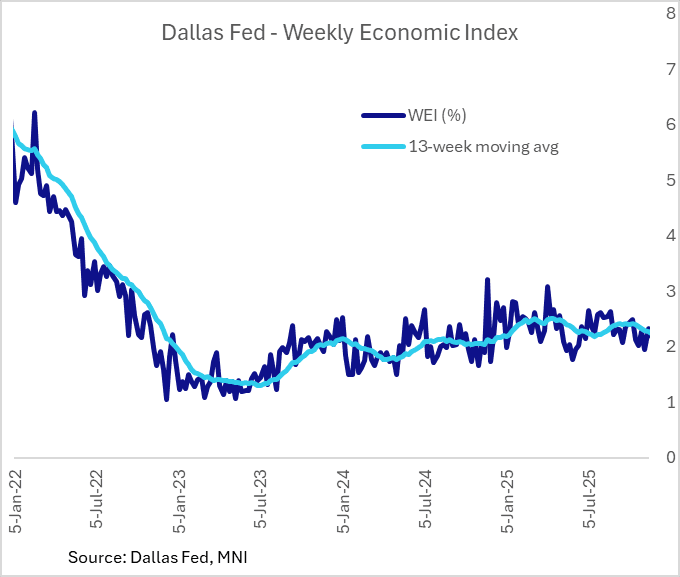
The Dallas Fed's Weekly Economic Index concluded 2026 on a bright note, with the 4-quarter-scaled GDP growth rate ticking up in the Dec 27 week to 2.23% Y/Y from 2.21% prior.
- This should be caveated slightly by the fact that railroad traffic, electricity output, and fuel sales were not released for the latest week due to holidays, but it kept the 13-week (ie quarterly) moving average rate at 2.24% for a 6th consecutive week between 2.24-2.25%.
- The WEI was consistent with real GDP growth of 4+% Q/Q SAAR in Q3, which was closer to the mark than most (the official reading was 4.3%).
- Its final reading of Q4 means it tracked the equivalent of 2.5-3.0% Q/Q SAAR growth for the quarter, a little below the Atlanta Fed GDPNow estimate of 3.0%. We get the next Atlanta Fed reading on Monday after the ISM Manufacturing release for December.
US PREVIEW: Payrolls Seen Steadying Out In December After Noisy Oct/Nov (2/2)
Next Friday's release of the December employment report is the highlight of the week's macro calendar. Our usual preview will be out early next week but early consensus expectations are for relatively steady readings vs November, with 55k nonfarm payroll gains (64k in Nov) and an unemployment rate of 4.5% (4.6% in Nov), with a slight moderation in participation and an uptick in hourly earnings growth.
- This is the last payrolls report before the FOMC's end-January meeting, at which participants would probably require substantially weaker-than-expected NFPs to spur even consideration of a another 25bp cut.
- That said the December data will carry more signal to the market and Fed than the highly unusual November report, which was both delayed and abbreviated (no October Household Report/unemployment rate) due to the federal government shutdown. Additionally, there were apparent distortions blurring the signal from the data, from the shutdown-driven jump in unemployment, to the new historical low for the household survey response rate and higher standard errors.
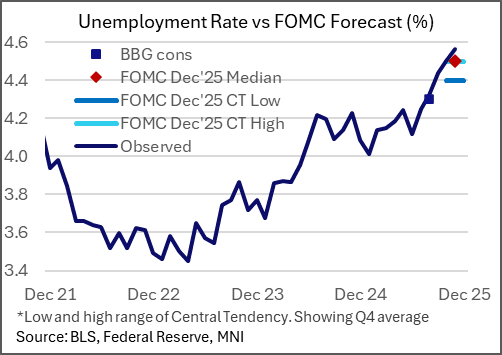
- Note that the FOMC's December 2025 median for the Q4 unemployment rate was 4.5% so a steady rate from November would imply a dovish "miss" to the upside though the significance will be muted by the noise in the household data. That said with Fed Chair Powell stating last month that nonfarm payroll gains are overstated by 60k/month, the consensus expectation will - to the leadership of the FOMC - imply only continued softness in the labor market, keeping further rate cuts in play this year.
- So far, indicators point to a relatively steady labor market overall in December vs November. The Chicago Fed's advance estimate of December's unemployment rate is 4.56% - which would be unchanged from November's unrounded BLS reading.
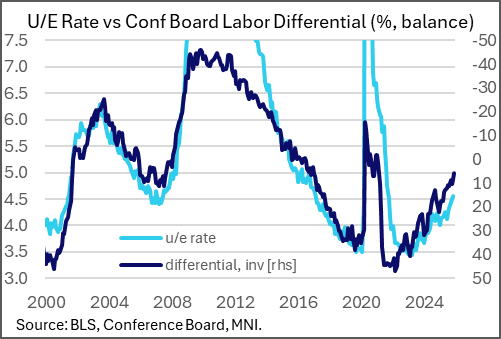
- The "labor differential" in the December Conference Board consumer survey its lowest since February 2021 at 5.9, pointing to a continued pickup in the unemployment rate, while the UMIchigan survey's expected job changes expected during the next year remains at levels consistent with meaningful monthly nonfarm payrolls contractions.
- However, jobless claims data for the reference week were on the lower side of the range seen in recent months' reference periods (initial 224k, continuing 1,913k in Dec 13 week).
EUROZONE ISSUANCE: EGB Supply – W/C 5 January
Germany, Spain, and France are scheduled to kick off auction issuance for the year in the upcoming week. We pencil in issuance of E55.5bln for the week, after this week saw no scheduled operations amid the holiday period. Slovenia will also hold a syndication in the week with syndications also possible from Austria, Belgium, Germany, Ireland, Portugal and the EFSF.
- Slovenia has already announced a mandate for a new 10-year SLOREP. We expect the transaction to take place on Monday 5 January with a E1.5bln size.
- Germany will be looking to kick off EGB auction issuance for the year on Tuesday with E6bln of the 2.00% Dec-27 Schatz (ISIN: DE000BU22114).
- Germany will return to the market on Wednesday with E6bln of the new Feb-36 Bund (ISIN: DE000BU2Z064). The coupon will be announced on Tuesday.
- Spain will come to the market on Thursday with a Bono/Obli/ObliEi auction, with the 2.70% Jan-30 Bono (ISIN: ES0000012O00), the 3.00% Jan-33 Obli (ISIN: ES0000012P74), the 3.45% Jul-43 Obli (ISIN: ES0000012K95) alongside the 1.15% Nov-36 Obli-Ei (ISIN: ES0000012O18) on offer. The combined auction size is to be confirmed on Monday.
- France will come to the market on Thursday to hold a LT OAT auction, selling a combined E11.5-13.5bln of the 3.50% Nov-35 OAT (ISIN: FR0014012II5), the 0.50% May-40 OAT (ISIN: FR0013515806), the 3.60% May-42 OAT (ISIN: FR001400WYO4) and the 3.75% May-56 OAT (ISIN: FR001400XJJ3).
NOMINAL FLOWS: The upcoming week will see no redemptions. Coupon payments for the week total E4.1bln of which E4.0bln are from Germany. This leaves estimated net flows for the week at positive E51.4bln, versus negative E1.4bln this week.


