US DATA: Solid Import Prices With Tariff Concessions In Rear View Mirror
Import price inflation was broadly as expected in the January report, a little softer than consensus...
Want to read more?
Find more articles and bullets on these widgets:
Historical bullets
PIPELINE: Corporate Bond Update: DB, BoA, Amex, Lloyds, Visa, UAL on Tap
- Date $MM Issuer (Priced *, Launch #)
- 02/03 $4B #EIB 10Y SOFR+43
- 02/03 $2B Black Pearl Compute 5NC2
- 02/03 $1B United Airlines 3NC
- 02/03 $Benchmark Deutsche Bank 6NC5 +120a
- 02/03 $Benchmark Bank of America 6NC5 +85a, 6NC5 SOFR+108, 11NC10 +100a
- 02/03 $Benchmark American Express 3NC2 +75a, 3NC2 SOFR, 6NC5 +90a, 15NC10
- 02/03 $Benchmark Lloyds 4NC3 +85a, 4NC3 SOFR, 21NC20 +105a
- 02/03 $Benchmark Visa 3Y +50a, 5Y +55a, 7Y +65a, 10Y +70a
- 02/03 $Benchmark National Rural Utilities 1.5Y SOFR+70a, 3Y
- 02/03 $Benchmark NextEra Energy 5Y +85a, 30Y +125a
- 02/03 $Benchmark PacifiCorp 30.5NC5.25 7.5%a
- 02/03 $Benchmark McCormick 3Y +80a
EGBS: OAT Performance Unremarkable Consdering Positive Fiscal Data
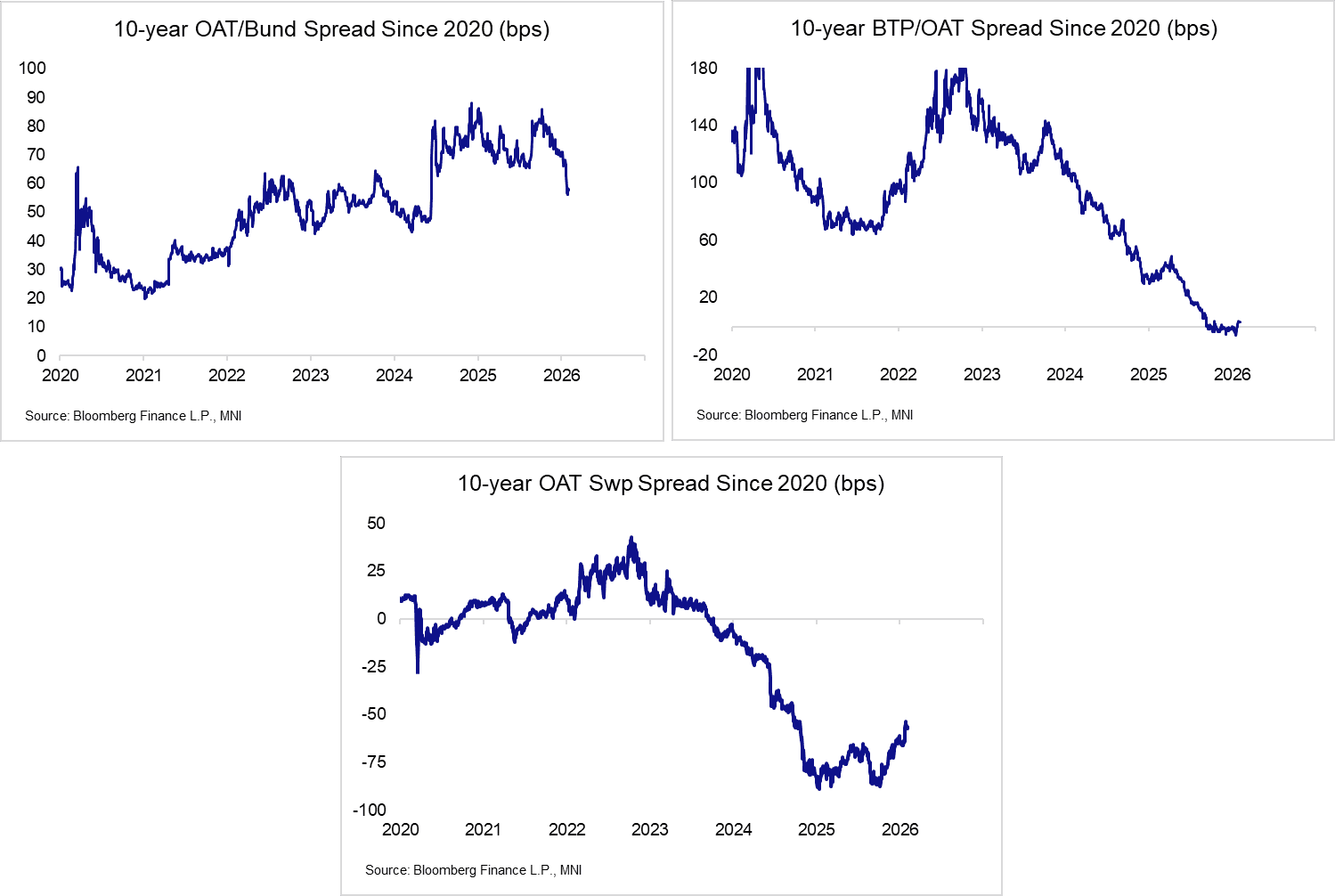
The 10-year OAT/Bund spread is 0.5bps narrower today at 57.5bps, performing similarly to EGB peers. That’s despite this morning’s positive state budget data for December. We would argue that the fiscal developments are important, and with the 2026 budget having finally been passed through the National Assembly (and PM Lecornu surviving associated censure motions), there may be scope for a resumption of OAT outperformance on a near-term basis.
- Core state budget data for December (recorded on a cash basis) implied a budget deficit of ~4.2% GDP, far smaller than the 4.7% GDP estimate in the original LFI and also the 4.5% GDP in updated estimates. This points to downside risks to the Government’s 5.4% deficit target, albeit with timely estimates of the social security budget still outstanding. See our full write-up here
- Morgan Stanley have reduced their 2025 deficit forecast to 5.0% GDP as a result. They note that “the likely better starting point in 2025 (i.e. -5.0% vs -5.4%) is a positive base effect for 2026, but we are cautious about the magnitude of the consolidation implied by the budget. All in all, we now see the 2026 public deficit at -4.9% of GDP vs -5.1% previously. Accordingly we also update 2027 to -5.1% of GDP vs -5.3% of GDP previously.”
- Of course, France still faces significant medium-term fiscal and political risks. A 5.0% deficit for 2025 still keeps debt/GDP on a rising path, and 2027 budget negotiations/Presidential election speculation will be at the forefront in H2 2026. UniCredit wrote this morning that “we see limited scope for more [OAT/Bund] spread tightening. A repricing back towards early‑2024 levels (45-50bp) appears inconsistent with the country’s weakened political landscape and lingering fiscal challenges”.
TARIFFS: India To Maintain Some Agri Protection In US Trade Deal - USTR Greer
United States Trade Representative Jamieson Greer has confirmed to CNBC that India will “maintain some protection around agricultural goods,” in the new US-India trade deal announced by US President Donald Trump yesterday.
- The comment appears to suggest that US negotiators recognised that tariff-free access for US agricultural exports would have been politically impossible for New Delhi, despite hardline rhetoric from Commerce Secretary Howard Lutnick throughout last year. Softening of the US position on agricultural access makes final ratification of the agreement significantly more likely.
- Greer noted that “India's industrial goods tariffs will go to zero from 13.5%,” but India will maintain, “some protection around agricultural goods.”
- The comments support those from India’s Trade Minister Piyush Goyal, who told reporters this morning that “sensitive agricultural and dairy sectors have been protected.”
- The full terms of the trade deal have yet to be fleshed out. Notably, Indian Prime Minister Narendra Modi’s statement on the deal declined to confirm Trump’s assertion that India agreed to halt the purchases of Russian oil.
- There is also uncertainty over Trump’s assertion that India will buy, “$500 BILLION DOLLARS of U.S. Energy, Technology, Agricultural, Coal, and many other products,” with one analyst noting it would amount to about 85% of the annual Indian federal budget, per Semafor.
- Secretary of State Marco Rubio will meet Indian External Affairs Minister Subrahmanyam Jaishankar at the Department of State at 15:30 ET 20:30 GMT. There is expected to be a short press availability at the top of the meeting.


