AUSTRALIA DATA: Slight Q3 Net Export Detraction As Trade Surplus Narrows
Net exports detracted 0.1pp from Q3 quarterly GDP growth, which with the inventory print would normally pose a downside risk to consensus’ forecast of +0.7% q/q but public demand’s 0.4pp contribution is an upside risk.
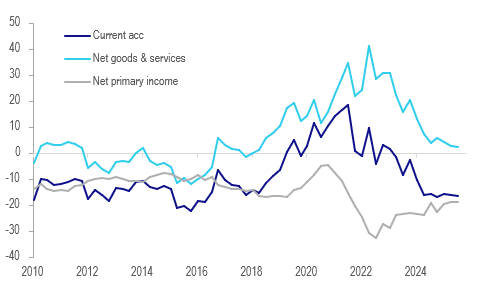
- Q3 balance of payments was also released and not only did the current account deficit widen, when a narrowing was forecast, but it was revised substantially higher in Q2 to $16.2bn. Q3 was $0.4bn higher at $16.6bn, the highest since Q4 2024, as the trade surplus narrowed.
Australia current account A$bn
Source: MNI - Market News/ABS
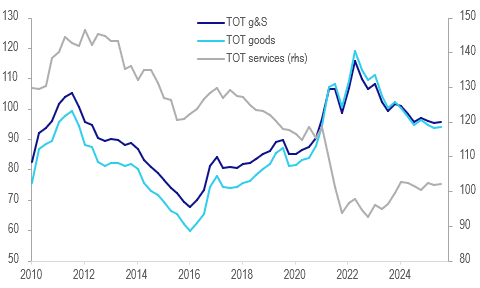
- The Q3 terms of trade rose 0.3% q/q but was still down 0.2% y/y. It has been trending lower since H2 2022. Export prices fell 0.1% q/q but import prices were down 0.4% q/q due to the stronger AUD but prices were higher for key bulk commodity exports. There was a slight quarterly increase in both the goods and services terms of trade.
Australia terms of trade
Source: MNI - Market News/ABS
- Goods exports rose 0.9% q/q, due to coal and ores, and services +1.0% q/q, while goods imports increased 1.4% q/q, driven by fuels, and services +0.5% q/q. Annual growth in goods shipments rose 3.9%, the first increase since Q1 2023, boosted by sharply higher gold prices increasing the value of non-monetary gold exports.
- The primary income deficit narrowed $0.3bn to $18.69bn due to higher profits for Australian direct equity investments and ongoing robust returns on overseas portfolio investments.
- There were also strong overseas inflows into Australian debt and equities in Q3 with $66.6bn of domestically issued debt securities purchased, highest since Q4 2023, driven by ACGBs.
Want to read more?
Find more articles and bullets on these widgets:
Historical bullets
AUSSIE 10-YEAR TECHS: (Z5) Returns Lower
- RES 3: 95.982 - 76.4% retracement Sep’24 - Nov’24 downleg
- RES 2: 95.960 - High Apr 7 (cont.)
- RES 1: 95.900 - High Oct 17
- PRICE: 95.670 @ 16:16 GMT Oct 31
- SUP 1: 95.510 - Low Sep 3
- SUP 2: 95.415/95.300 - Low May 15 / Low Jan 14
- SUP 3: 95.275 - Low Nov 14 (cont) and a key support
Aussie 10-yr futures slipped lower Wednesday on the back of hotter-than-expected Australian inflation. This returned prices lower despite nascent signs of a technical recovery as recently as last week. The sustainability of the pullback will be dependent on prices holding above key short-term support at 95.510, the Sep 3 low. Near-term resistance remains 95.780, the Sep 12 high. A clear break of this level signals scope for a continuation higher and opens 95.960, the 76.4% retracement level for the Sep’24 - Nov’24 downleg.
AUSSIE 3-YEAR TECHS: (Z5) Struck by Strong CPI
- RES 3: 97.796 - 1.618 proj of the Sep 3 - 12 - 15 price swing
- RES 2: 96.780 - High Jun 26 (cont)
- RES 1: 96.700 - High Sep 12
- PRICE: 96.375 @ 16:13 GMT Oct 31
- SUP 1: 96.280 - Low May 15 (cont.)
- SUP 2: 95.900 - Low Jan 14 (cont.)
- SUP 3: 95.760 - Low 14 Nov ‘24
Having bounced well on the back of the mild US CPI print, Aussie 3-yr futures reversed course Wednesday on strong domestic inflation data containing RBA cut pricing through 2026. This keeps prices well below prior resistance at 96.615, the Sep 12 high, and refocuses attention on 96.280 as the next major support.
FED: Gov Waller: Still Advocating For A December Rate Cut
Gov Waller, one of the FOMC's more prominent doves, makes clear in an appearance on Fox Business that he supports a follow-up rate cut in December. He makes reference to Chair Powell's press conference comment that the Fed could skip a cut at the December meeting due in part to a lack of official government data during the federal shutdown (Powell: “what do you do if you are driving in the fog? You slow down").
- Waller says today: "Right now, we know that the labor market has been weak... We know inflation is going to come back down. Inflation expectations are anchored, and in that world, the standard of central bank wisdom is to look through it and proceed with worrying about the labor market. So in my view, we should just look at what the data is telling us and proceed on policy that way.... So this is why I'm still advocating that we cut policy rates in December, because that's what all the data is telling me to do. The fog might tell you to slow down. It doesn't tell you to pull over to the side of the road. You still have to go. You may want to be careful, but it doesn't mean to stop, and ... the right thing to do with policy is to continue cutting."
- This is of particular interest since he appeared to suggest he would have a more cautious outlook on further easing after cutting in October.


