JGBS AUCTION: Poll: 20-Year JGB Auction
*JAPAN 20Y GOVT BOND AUCTION MAY HAVE 96.15 LOWEST PRICE:POLL - BLOOMBERG...
Want to read more?
Find more articles and bullets on these widgets:
Historical bullets
EUR: EUR/USD - Pulls Back From Top Of Range Above 1.1800
The EUR/USD range Friday night was 1.1765-1.1849, Asia is currently trading around 1.1755. The pair failed again to hold above the 1.1800 resistance as momentum stalls, we gapped lower on the open but have since filled most of that in. The market wants to sell USD’s but perhaps it needs to hold off for now as the market works through paring back some of last week's overzealous enthusiasm to pile back into risk. We are now pulling back from the top-end of the range toward the 1.1850 area and I suspect we should continue to find it tough going up here in the short-term, or until we get any real agreement reached. First support on the day is toward 1.1700 and then the 1.1600-1.1650 area, where USD bears will be looking for buyers to reemerge to have another crack at the 1.1850 area at some point.
- MacroEdge: “The Dutch cabinet will activate the first phase of the national emergency oil crisis plan on Monday.”
- EndGame Macro on X: “What This Really Means. This is the Dutch state admitting they may not absorb a Hormuz shock cleanly if the disruption lasts. Phase 1 is the point where an oil story becomes a state capacity story. The public message is no immediate shortage. The internal message is to prepare for one. And if the disruption drags on, the hardest economic damage will likely come with a lag. Inflation and transport costs hit first. Margins and output come next. Labor pain usually comes later, once firms stop treating the shock as temporary.”
- “There is no neat formula that turns lost barrels of oil into lost jobs one for one, but the broader pattern is clear. When oil prices stay high long enough, oil importing economies usually see weaker hiring, softer employment, and rising unemployment over the following quarters as higher energy costs squeeze margins, slow production, and hit demand. That is why the Dutch move should be read as a signal that policymakers think this may be moving beyond a temporary price shock and toward a serious supply shortage.” https://x.com/onechancefreedm/status/2046016980730421481?s=20
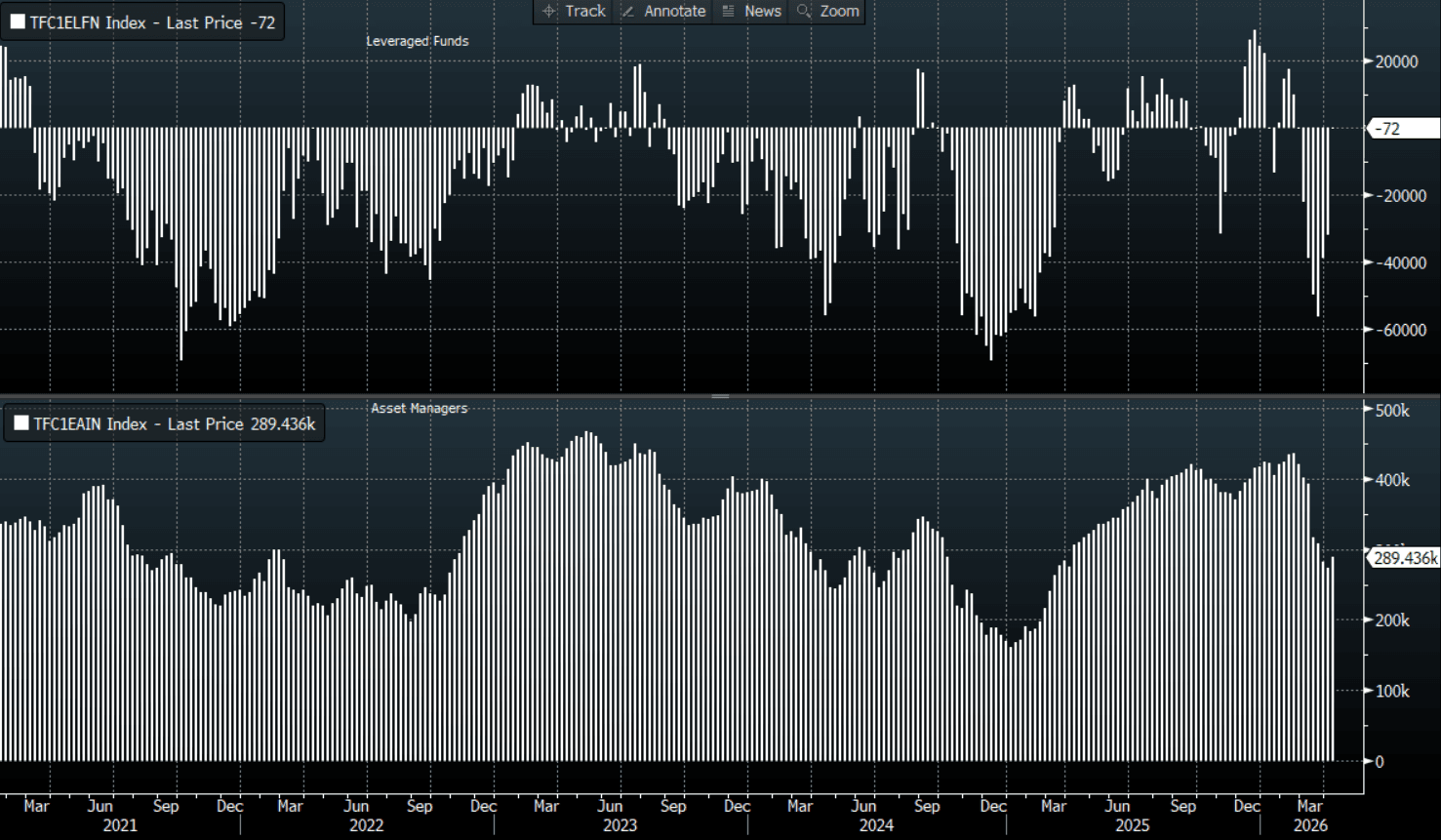
- CFTC Data up to 14/04/26 shows the Leveraged community aggressively to reducing their recently acquired short EUR exposure back to flat, -72(Last -31777). Asset managers started adding back their recently reduced core longs, +289 436(Last +273 833).
- Options : Closest significant option expiries for NY cut, based on DTCC data: 1.1600(EU1.52b), 1.1700(EU691m), 1.1750(EU1.76b). Upcoming Close Strikes : 1.1650(EU3.98b April 23), 1.1825(EU3.69b April 23), 1.1850(EU2.46b April 22) - BBG
- The EUR/USD Average True Range for the last 10 Trading days: 67 Points
Fig 1 : EUR CFTC Data
Source: MNI - Market News/Bloomberg Finance L.P
STIR: Will Market Fade Front End Pricing: RBNZ Vs RBA
While the next move by the RBA and RBNZ is most likely tightening, potential divergent timelines in our opinion have created a relative value opportunity in the OIS market.
- The RBA is expected to front-load tightening, driven by its view that demand has been too strong and is behind the recent inflation rise. It appears less data-dependent in the near term and inclined to reverse prior easing.
- The RBNZ, in contrast, has been signalling patience and gradualism, with future moves heavily dependent on incoming data. RBNZ Governor Breman was very clear that the MPC is focused on the medium-term and that the OCR path will depend on how growth and expectations develop and impact medium-term inflation.
- While markets broadly align with expectations of rates returning to around 3%, they appear to pricing hikes too aggressively and too early, with a full hike by July versus a more RBNZ-consistent September timeframe.
- This mismatch creates a potential opportunity: NZ front-end rates look too hawkish relative to the RBNZ’s guidance, especially versus Australia.
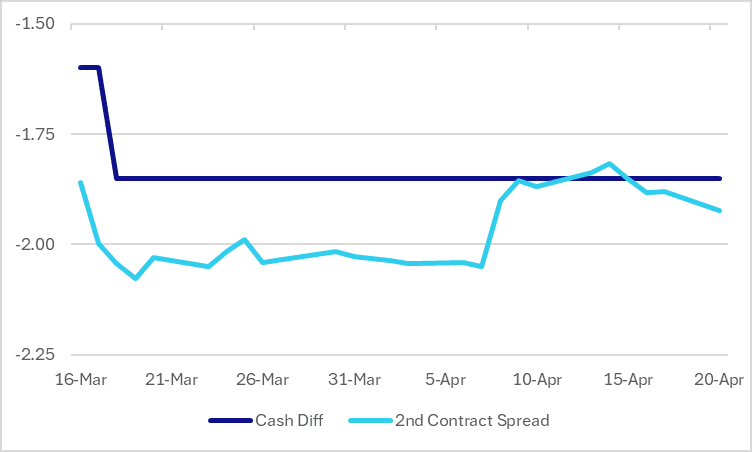
- One possible expression that could be considered is to fade front-end RBNZ pricing versus the RBA by way of the 2nd meeting date contract spread. A paid viewpoint of the Jun-26 RBA versus Jul-26 RBNZ OIS spread around current levels (-192bps), with scope to gravitate towards -210bps possible if the above macro views unfold.
Figure 1: NZ-AU – Cash Differential Vs. 2nd Meeting Date Contract Spread
Source: Bloomberg Finance LP / MNI
NEW ZEALAND: Little Iran Impact Expected In Q1 CPI Data, Consensus At 2.9%
Q1 CPI prints on 21 April with the RBNZ’s measure of core from its sector factor model following later that day. Given materially higher fuel prices due to the Iran War were not seen until mid-March, there’s likely to be little impact on Q1. The RBNZ forecast Q1 inflation of 2.8% y/y in February but revised that to 3.0% at its April decision given recent data and geopolitical developments. Q2 CPI data are likely to show a larger effect from the conflict with the RBNZ forecasting headline at 4.2% but there will be updates at the 27 May meeting. It is focused on the medium-term effect though.
- Bloomberg consensus is forecasting Q1 headline CPI to rise 0.8% q/q and 2.9% y/y following Q4’s 0.6% q/q & 3.1% y/y, just above the top of the RBNZ’s 1-3% band. Projections range from 0.7-1.1% q/q and 2.8-3.3% y/y.
- Most quarterly forecasts are around 0.7-0.8% q/q. ANZ and Westpac expect 0.7% q/q with annual inflation rising 2.9% and 2.8% respectively. ASB and BNZ project 0.8% q/q but 2.9% and 3.0% y/y. Kiwibank is higher at 3.1% y/y.
- ASB believes that inflation will remain around 4% for most of this year with it not returning to the target band until mid-2027. As a result, it is forecasting rates hikes at every meeting from September until the OCR reaches 3.25% in February 2027.
- In February, the RBNZ forecast Q1 non-tradeables inflation to rise 1.0% q/q and 3.4% y/y. ANZ is in line with the central bank but the others are lower with ASB & Westpac expecting 0.8% q/q and BNZ 0.9% q/q.
- Tradeables CPI projections are in a wide range of 0.2% to 0.8% q/q with consensus at 0.6%. BNZ is in line with consensus, while ASB is higher at 0.7% but ANZ and Westpac expecting 0.4% and 0.2% q/q respectively.


