CHINA: More of the Same for Policy in 2026
- An article in the China Securities Journal assess policy in 2025 describing it as 'supportive' suggesting that since the beginning of the year various policy tools have worked together to guide financial institutions to increase their support for the real economy, whilst 'anchoring the goal of stable financial markets.
- Looking at the potential for policy in 2026, the article points to more of the same with the continuation of the current 'moderately loose' monetary policy, adhere to precise policy implementation whilst using flexible tools like RRR cuts and interest rate cuts to promote overall social financing costs.
- On social financing costs, the article points to overall social financing costs being at historical lows with lower loan interest rates thanks to cuts in the 7-day reverse repo rate, whilst lower housing provident fund loan rates are lower also. The weighted average interest rates for new corporate loans was 30bps lower than a year ago.
- The recent Central Economic Work Conference clearly stated that various policy tools, such as reserve requirement ratio (RRR) cuts and interest rate cuts, will be used flexibly and efficiently in what appears to leave room for further RRR and interest rate cuts in 2026.
- The focus on financing costs and banks willingness to lend will support the government's goal of improving domestic demand and target innovative industries viewed as important to the future development of the economy.
- It appears from this article that there is no imminent change to come, rather more of the same as the economy remains on track to achieve the 5% GDP growth target.
- Instead, it appears now that the already 'supportive' policy provides a backstop and could be altered if needed.
- Going forward we continue to monitor social financing costs and lending data as a key insight for future direction of policy.
Want to read more?
Find more articles and bullets on these widgets:
Historical bullets
GOLD: Gold - Drops Back, Support Seen Back Toward The $$3,900-$4,000 Area
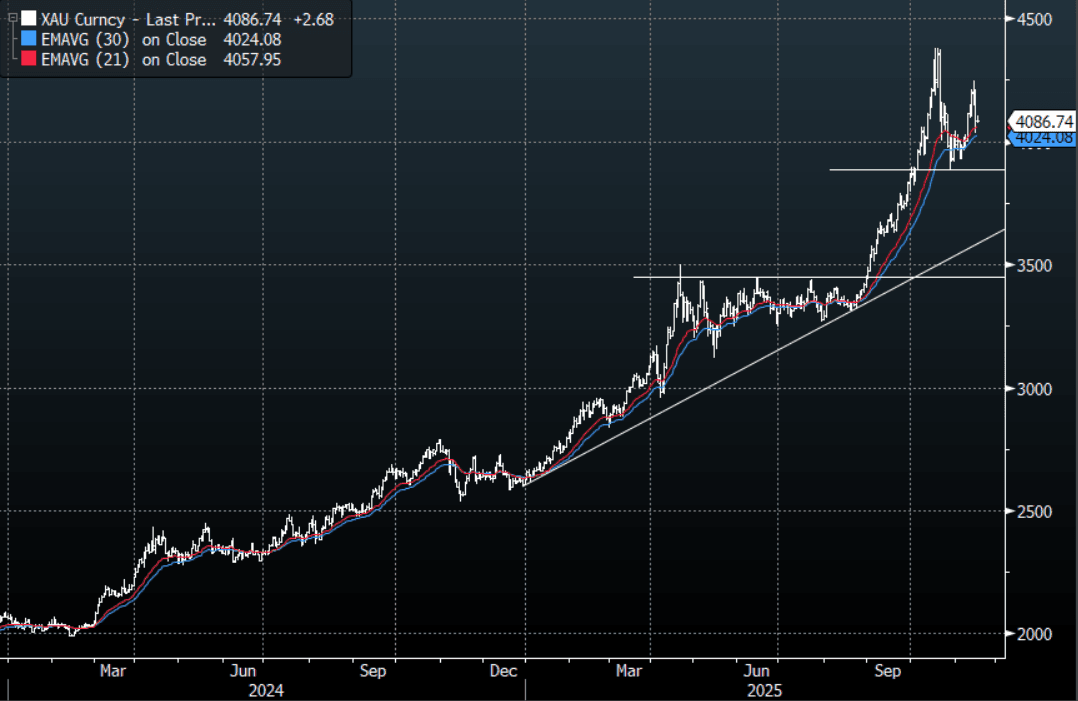
The range Friday night for gold was $4,032.31/oz - $4,186.98/oz, Asia is currently trading around $4,090/oz, +0.15%. Gold slipped lower on Friday as the market looked toward eventually having a look at some US data starting this week and the implications of a Fed that seems to be pushing back on a December rate cut for the moment. Gold has technically put in a lower high now around the $4,250/oz area but strong support is seen back toward the $3,900/oz area. The market is trying to form a base from which to test higher again, while the $3900-$4000 area continues to hold dips should continue to be supported.
- Otavio Costa of Crescat Capital reiterated he believes more cuts in the US to come on X, “The Cass Freight index is now back to levels last seen during the pandemic. Unlike the labor data, this can’t be spun as an AI-displacement narrative. It’s a clear sign that economic activity is deteriorating sharply. Major rate cuts are still ahead of us, in my view.”
Fig 1 : Gold Daily Chart
Source: MNI - Market News/Bloomberg
CHINA PRESS: China Strong Dim-Sum Bond Issuance This year
China has issued CNY979.4 billion in dim-sum bonds so far this year, a continuation of the strong expansion that began in 2022, Securities Daily reported. According to Ming Ming, chief economist at CITIC Securities, issuance has been underpinned by the internationalisation of the yuan, the growing offshore renminbi liquidity pool and mainland enterprises’ increasing need to diversify financing channels. Looking ahead, the dim-sum market could be further expanded by strengthening market infrastructure, improvements to bond-trading platforms and cuts to transaction costs, Ming Ming said. He added that tax incentives could also boost participation from offshore investors. Dim-sum bonds are offshore yuan-denominated bonds issued outside mainland China.
CHINA PRESS: Banks Direct Real Estate Sales Increasing
Banks have stepped up the direct sales of real estate as the market downturn has led to collateralised properties being repossessed and placed into auction channels, industry insiders told Yicai. Repayment or loan renewal has become increasingly difficult as property prices fell below loan value, creating gaps that many borrowers are unable to cover, Yicai reported. On JD.com and Alibaba’s asset auction platforms, listings from some banks now exceed 1,000 units, with disposal activity accelerating markedly, Yicai said. Assessing the impact on the banking sector, Liu Chengxiang, chief banking analyst at Kaiyuan Securities, said real estate–related risks in first- and second-tier cities appear largely manageable, though asset quality for some regional commercial banks requires close monitoring.


