MNI: Nonbank Loans Threaten New Global Financial Crisis: G30
Rapid lending growth outside regulated banks is creating the risk of another global financial crisis like the one seen in 2008 according to the G30 group of former central bankers, who called for tougher oversight.
Opaque risks and a fragile global economy boost the risk of financial instability within non-bank lending that grew to USD260 trillion as of the end of 2024 according to the report led by Agustin Carstens and Klaas Knot, former FSB and Dutch central bank chief.
“Delaying reform could leave the global financial system exposed to a crisis of unprecedented scale,” said Carstens, who held top positions at the BIS and Mexico's central bank.
There have already been market runs in the U.S. and UK involving non-bank lending and ongoing dangers include "liquidity mismatches, high leverage, and numerous interconnections with core bond markets and banks" the report found. The G30 recommends central banks have more tools to provide liquidity to non-bank lenders to help avoid the need for broader intervention, and for private lenders to face tougher surveillance.
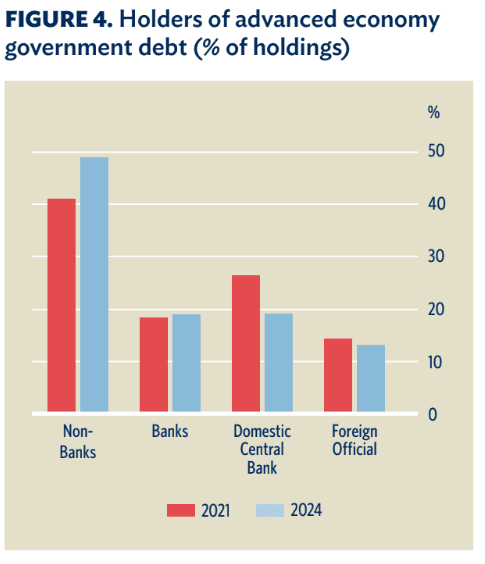
Key government bond markets are also vulnerable because "hedge funds and other globally active firms dominate trading, often holding large, highly leveraged, and short-term funded positions" the report said. The Bank of Canada has warned about such dangers and the U.S. Treasury department has recently called a meeting to discuss emerging risks.
"Monetary policy must internalize, to a greater extent, the risk-taking and buildup of vulnerabilities in NBFI and clarify its communication," the report said. (See: MNI INTERVIEW: Canadians Dodge Mortgage Woes With Longer Loans)
Regulators could also mandate larger "haircuts" in repo markets and expand the use of stress tests, the G30 recommended. The group is chaired by former Reserve Bank of India Governor Raghuram Rajan and other members include former European Central Bank chief Jean-Claude Trichet.
"The global financial system already exhibits significant vulnerabilities," the report said. "Highly expansionary fiscal and monetary policies in advanced economies have encouraged excessive risk taking."