MNI EUROPEAN MARKETS ANALYSIS: RBA Cautious On Inflation
- As market sentiment trended down ahead of the FOMC, all eyes in the APAC region were on the Reserve Bank of Australia’s last meeting for the year. Leaving rates at 3.60% was expected , but the RBA noted that risks to inflation are tilted to the upside. However they tempered this by saying that it may take a little longer to assess the persistence of inflationary pressures.
- Equity markets in the region were generally weaker with profit taking / de-risking ahead of the FED the primary driver. In a slow day for economic data, markets had little to distract them from waiting for the FED.
- President Donald Trump granted Nvidia Corp. permission to ship its H200 artificial intelligence chip to China in exchange for a 25% surcharge, a move that lets the world’s most valuable company potentially regain billions of dollars in lost business from a key global market. Tech stocks generally across the region were weaker with some key names down over 1%.
- Ahead for markets is the German trade balance and US JOLTS job openings, which will be the focus for markets prior to the start of the FOMC.
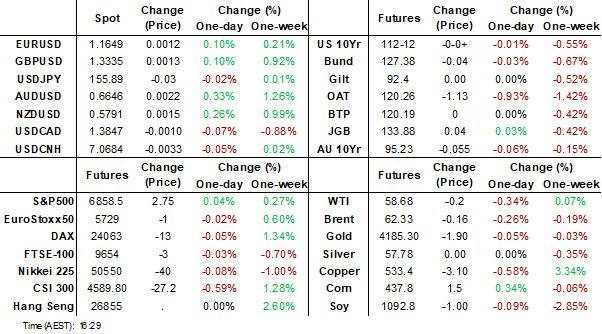
MARKETS
US TSYS: Yields Trend Higher in Afternoon Trade
Bond futures turned down in the afternoon with the US-10-Yr falling to 112-06. Having traded up at 112-11 it lost ground in the afternoon session. TYH6 is at the mid-point between the 100-day EMA of 112-14+ and the 200-day EMA of 111-29+.
Cash was weak with yields up to +1.3bps higher in the mid-part of the curve.
- The 2-Yr is up +0.9bps at 3.586%
- The 5-Yr is up 1.2bps at 3.76%
- The 10-Yr is up 1.2bps at 4.178%
- The 30-Yr is up +1.0bps at 4.813%
The 10-Yr remains in the 4.00% -4.20% range that has held in recent weeks. A more hawkish outlook from the FED could see new ranges established, particularly for the 10-yr.
Tuesday Data Calendar in the US: ADP Weekly, Redbook and JOLTS for Sep/Oct; Treasury auctions include $39B 10Y note reopen.
Tonight sees a US$75bn 6-week bill auction and a US$39bn 10-Yr auction.
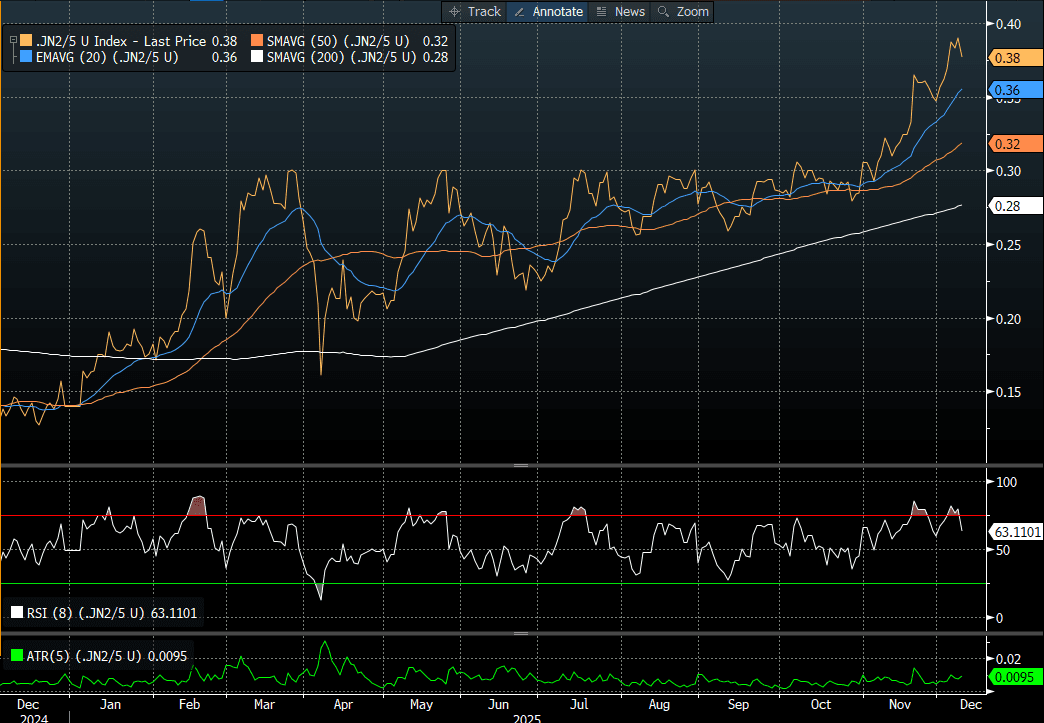
JGBS: Little Reaction To 5Y Auction, 2/5 Curve At Steepest Since 2009
JGB futures are stronger, +10 compared to settlement levels, after dealing in a narrow range in today’s session.
- Today’s 5-year JGB auction delivered lacklustre demand signals. The low price was slightly below expectations at 99.81, the bid-to-cover ratio fell to 3.1676x from 3.3258x, and the tail widened to 0.04 from 0.03.
- The result contrasts with the strong results seen at this month’s 10-year and 30-year auctions, but is consistent with last month’s poor 2-year auction.
- Ahead of that 2-year auction, Reuters reported that the Japanese government will increase issuance of 2-year and 5-year JGBs from January as part of its stimulus-funding plan. Issuance is expected to rise by around 100bn each for the 2-year and 5-year tenors. Reuters also noted that there are no changes to the planned issuance for 10-40-year tenors.
- Cash US tsys are slightly cheaper in today's Asia-Pac session.
- Cash JGBs are flat to 1.7bps lower across benchmarks, with the 5-year leading.
- Nonetheless, the 2s/5s curve is holding near its cycle high of 39bps, the steepest since late 2009 (see chart).
- Swap rates are flat to slightly higher, with a flattening bias.
- Tomorrow, the local calendar will see PPI data.
Source: Bloomberg Finance LP/ MNI
AUSSIE BONDS: Market Cheapens During RBA Governor Presser
ACGBs (YM -11.0, XM -6.5) cheapened sharply during Governor Bullock’s post-meeting press conference. While markets initially took the decision and accompanying statement in stride, her comments were interpreted as distinctly more hawkish, prompting a swift repricing
- Bullock signalled that inflation risks have shifted to the upside, with recent data suggesting more economic tightness than previously thought. The RBA is cautious about over-interpreting the new monthly CPI but is alert to any broad-based pickup in inflation.
- The Board did not consider rate cuts and does not expect them in the foreseeable future.
- Overall, downside risks have faded and upside risks have grown. The policy debate is now between an extended pause or potential hikes, with the Board uncomfortable about current inflation and guided strictly by incoming data.
- Cash ACGBs are 6-11bps cheaper, with the AU-US 10-year yield differential at +58bps.
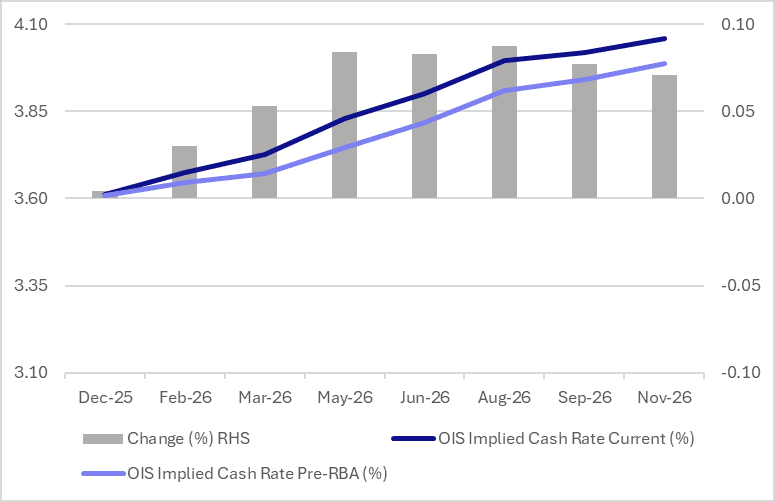
- The bills strip has bear-steepened, with pricing -2 to -13.
- RBA-dated OIS pricing is 1-8bps firmer versus pre-decision levels. Tightening expectations are seen across all meetings, with the probability of a 25bp hike rising from 28% for February to 119% by June and 190% by December 2026.
- Tomorrow, the local calendar will be empty.
source: Bloomberg Finance LP /MNI
RBA: Discussion Around Prolonged Pause Or Hike Given Upside Inflation Risks
Governor Bullock clarified that a rate cut was not considered or even suggested as an option at the December meeting and that the 2026 discussions are likely to be around whether to leave rates at 3.6% or increase them. The Board is uncomfortable with where inflation is and private demand is now taking over from the public sector and so further easing is not “on the horizon for the foreseeable future”. Rates will continue to be decided on a meeting-by-meeting basis and be driven by the data.
- A rate hike wasn’t explicitly considered in December but the Board discussed what needs to happen for it to occur, which includes quarterly CPIs showing more inflation persistency signalling that there are greater capacity pressures and less restrictive financial conditions. She noted that with growth likely around potential, there isn’t much room to grow without price pressures.
- The Board is now more focussed on inflation. If it stays high, then it will have to do “something”. It is particularly looking at market services, new dwelling and durable goods prices.
- Bullock observed that the market is trying to predict the RBA’s reaction function and is reacting to the data. She said that the market is right that the Board is thinking about upside risks and that it is alert but wants more evidence. She wouldn’t comment on the timing of market priced hikes.
- 6 months ago risks were to the downside, which have abated, but upside ones have been “generated” and therefore there was no consideration to cut. Bullock noted that the Board needs to be flexible as conditions change.
RBA: More Concerned About Inflation & Its Drivers, Waiting For Q4 CPI
In a unanimous decision, the RBA’s Board decided to leave rates at 3.6% where they have been since August, which was expected. While it remains “cautious”, the statement shifted slightly hawkish with more concern regarding rising inflation but it needs “longer to assess the persistency of inflationary pressures”. It noted that there was “uncertainty” around monthly CPI data given it is new signaling that the Board was content this month to wait for Q4 CPI on 28 January ahead of the next decision on 4 February. Governor Bullock speaks to the press at 1530 AEDT.
- In terms of inflation, the RBA noted that the October CPI suggested “some signs of a more broadly based” increase in inflation and it could be “persistent” and needs “close monitoring". It also added to the guidance paragraphs that risks have now “tilted to the upside”.
- There was also concern around inflationary drivers. It pointed out that it is the WPI that has peaked while “broader measures” were strong and that unit labour cost growth remains “high”.
- Capacity utilisation was also said to be above its “long-run average” and reiterated that firms are finding it difficult to source labour. Consistent with this, Bullock said to the senate last week that while it is difficult to estimate, she believes that the output gap has closed.
- The Board no longer sees policy as “a little restrictive” but added the degree of restrictiveness to the list of uncertainties.
- It is also waiting for the full effect of 2025’s 75bp of easing to “flow through fully to demand, prices and wages”. But the recovery continues and private demand growth remains stronger than the RBA expected.
AUSTRALIA DATA: Q4 Conditions Up On Q3, Q4 Business Inflation Series Moderate
November NAB business conditions moderated to 7 from an upwardly-revised 10, while the more volatile confidence fell to 1 from 6, the lowest since April. Conditions remained in line with Q3 outcomes and at this stage looks like normalisation rather than slowing as the sharp rise in WA in October unwound. With hard data showing a pickup in domestic demand and inflation above the top of the RBA’s 2-3% band, this data is unlikely to change the RBA’s expected cautious tone when it announces its decision at 1430 AEDT today.
Australia NAB business conditions signal solid Q4 GDP growth
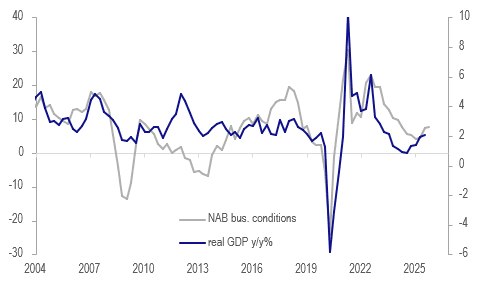
- In line with Governor Bullocks assessment that the output gap had likely closed, the NAB capacity utilisation measure rose to 83.6%, the highest in a year and a half. Capacity constraints could put upward pressure on already elevated inflation.
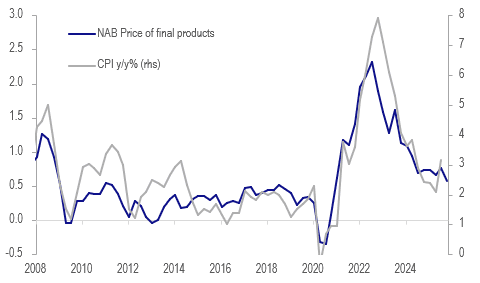
- The November price/cost components signalled that pressures may have eased in Q4. While November costs rose 1.3% 3m/3m up from October’s 1.0% it is below Q3’s 1.4%. Q4 average final product prices are up 0.6% after 0.8% in Q3.
- Trading and profits drove the decline in conditions down 6 and 5 points respectively, while labour demand was slightly higher at +1 point to 4. Labour cost growth at 1.4% in November continued to ease from July/August’s 1.8%.
- Forward orders fell 2 points to +1, slightly higher than the Q3 average. Exporters sales were down to -1 from +3.
- It looks like investment intentions remained robust in Q4 after private GFCF rose 2.9% q/q in Q3. NAB capex was steady at 10, 1 point above the Q3 average.
Australia NAB final product prices signal possible Q4 headline inflation moderation
Source: MNI - Market News/LSEG
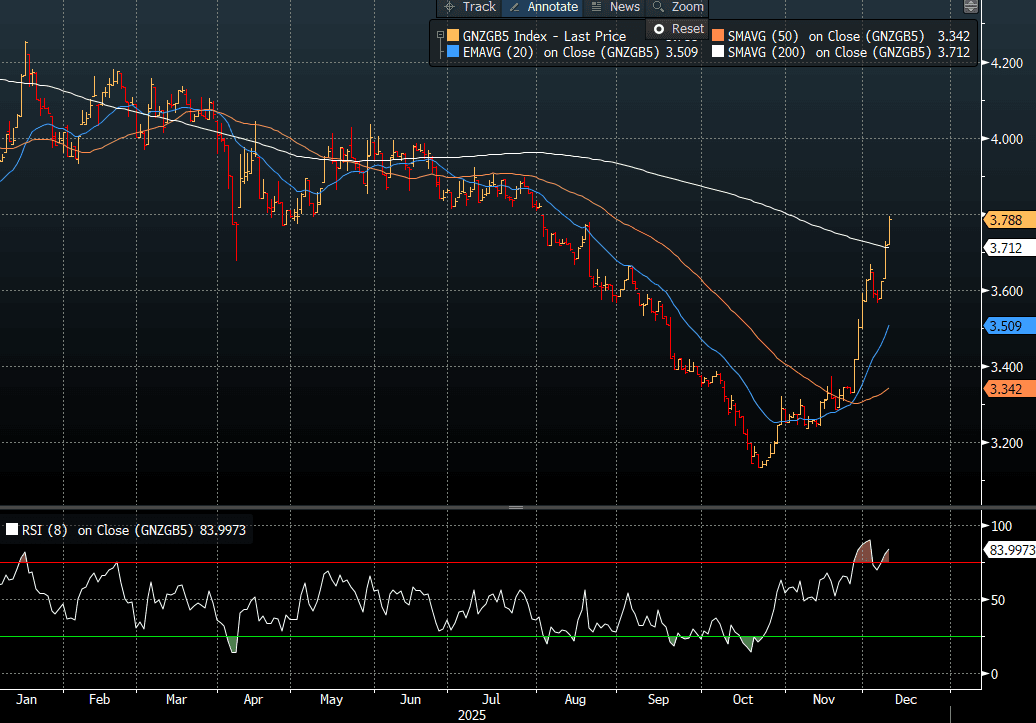
BONDS: NZGBS: Post-RBNZ Sell-Off Keeps Extending, 5YY Up +45bps
NZGB benchmark yields closed 6-7bps higher, but slightly below session highs (see chart).
- On a relative basis versus the $-bloc, NZGBs also had a heavy session, with the NZ-US and NZ-AU 10-year yield differentials 2-3bps higher. However, it is worth noting that the RBA decision was delivered with the local market closed. Accordingly, any market reaction will be reflected in tomorrow’s open. That said, at this stage, the reaction has been muted, with the RBA noting that inflation risks have shifted higher and that it wanted more time to judge how persistent these pressures are.
- (Bloomberg) “Westpac New Zealand is raising interest rates on fixed-term home loans of two years or longer. Effective Wednesday, a two-year special home loan will carry a 4.75% rate up from 4.45%.”
- Swap rates closed 4-6bps higher, with the 2s10s curve flatter.
- RBNZ-dated OIS pricing closed flat to 11bps firmer across meetings. No change is priced for February, while November 2026 assigns 56bps of tightening.
- Tomorrow, the local calendar will see RBNZ Governor Breman host a media Q+A alongside Net Migration data.
- On Thursday, the NZ Treasury plans to sell NZ$175mn of the 4.50% May-30 bond, NZ$200mn of the 3.50% Apr-33 bond and NZ$75mn of the 5.00% May-54 bond.
source: Bloomberg Finance LP / MNI
FOREX: USD - BBDXY Consolidates Overnight Gains
The BBDXY has had a range today of 1213.40 - 1214.57 in the Asia-Pac session; it is currently trading around 1213, -0.05%. The USD has traded sideways in a quiet Asian session. US yields continued to extend higher as we approach the FOMC, and overnight both risk and the USD started to react. The USD continues to see decent demand back toward the 1210-1211 area and it looks like the range 1210-1230 could be here for the moment, or at least until the FOMC. On the day look for resistance again back towards the 1215-1217 area where sellers should remerge initially, a break above here would imply a test of the pivot around 1219-1222. Support remains toward 1210 which needs to be worked through and then the more important 1205 area.
- EUR/USD - Asian range 1.1635-1.1649, Asia is currently trading 1.1645. The pair continues to consolidate around the 1.1650 area. On the day it looks like dips back toward 1.1580-1600 should be supported initially, looking to retest the 1.1680 area again eventually.
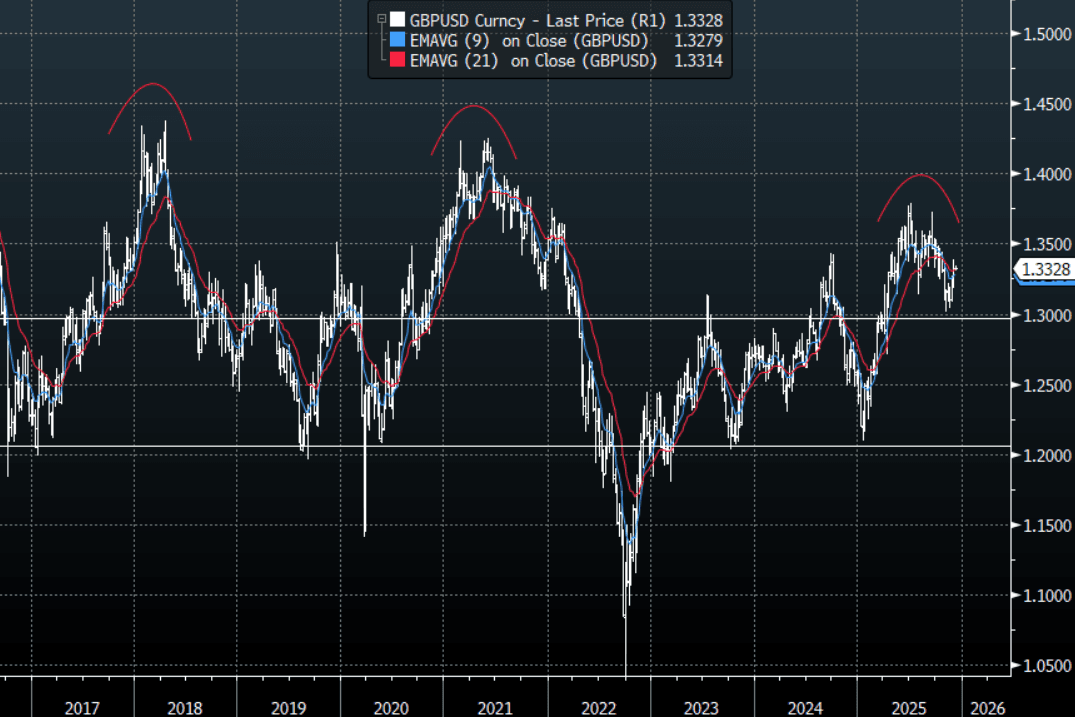
- GBP/USD - Asian range 1.3319-1.3335, Asia is currently dealing around 1.3330. The pair is consolidating on a 1.33 handle. I remain skewed toward shorts but patience is required and we are now approaching levels where I will be watching for any signs of potentially topping out. On the day GBP should see support back toward the 1.3260-1.3290 area, while above here look for the market to test the 1.3370-90 area again at some point.
- Cross asset : SPX +0.10%, Gold $4195, US 10-Year 4.166%, BBDXY 1213, Crude Oil $58.75
- Data/Events : Germany Trade Balance SA
Fig 1: GBP/USD Spot Weekly Chart
Source: MNI - Market News/Bloomberg Finance L.P
JPY: USD/JPY - Largely Unchanged, Consolidating Below 156.00
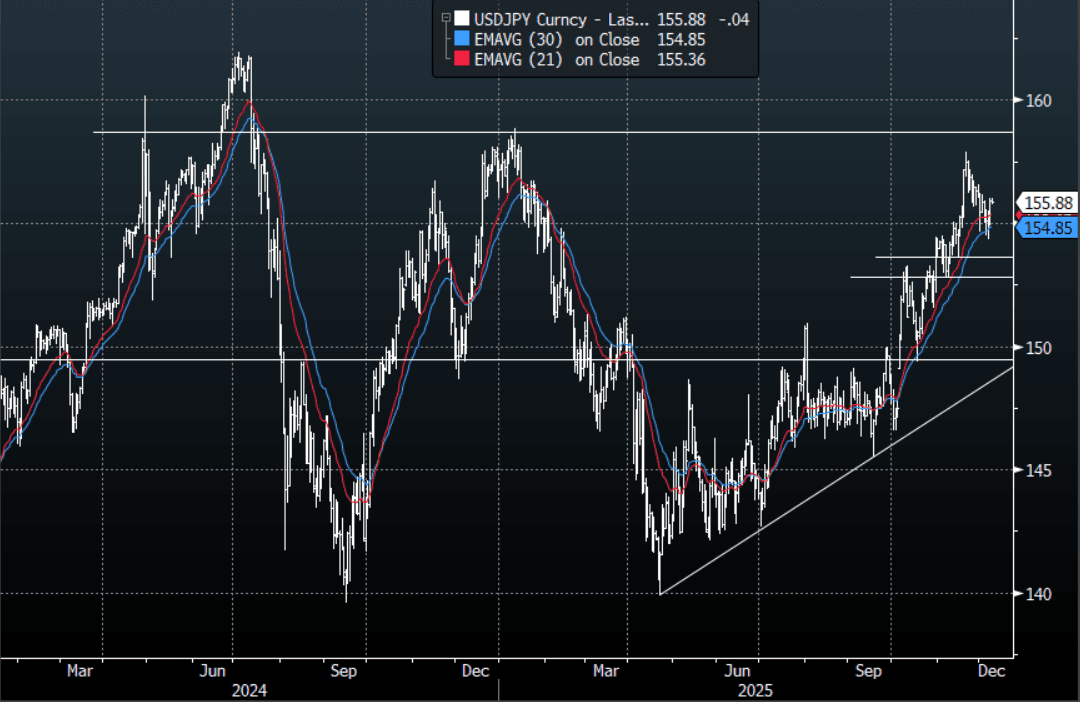
The USD/JPY range today has been 155.74 - 156.04 in the Asia-Pac session, it is currently trading around 155.90, +0.05%. The pair has traded sideways with little direction in a quiet session. The move overnight was supported by the sell-off in treasuries which has seen US yields move quite a bit higher as we approach the FOMC. The market is pricing in the fact that the Yen move looks likely to force the BOJ into action in December. This has stalled the upward momentum for the moment and could keep it contained in the short-term but I suspect the market will still look for opportunities to express a long USD at the right levels. Technically USD/JPY is still in an uptrend, the first big support back toward the 153-155 area has held on very well upon first examination. On the day, the market will be watching to see if there is any follow-through on this constructive price action. First support on the day is back toward 155.30-50, looking for a test of 156.20-40, a break of which would open up a move back to the 157.00 area.
- Bloomberg - “Foreign investors now dominate Japan’s $7.4 trillion government bond market, accounting for roughly 65% of monthly transactions, up from 12% in 2009. The BOJ’s retreat, coupled with PM Sanae Takaichi’s spending plans, have driven yields to multi-decade highs, sparking concerns of market volatility.”
- "AKAZAWA: SEE NO PARTICULAR CHANGE IN CHINA RARE EARTH CONTROLS" - BBG
- Options : Close significant option expiries for NY cut, based on DTCC data: 155.50($589m), 157.00($425m). Upcoming Close Strikes : 155.00($1.1b Dec 12), 156.00($1.77b Dec 11), 159.00($1.4b Dec 12) - BBG.
- The USD/JPY Average True Range(ATR) for the last 10 Trading days: 91 Points
Fig 1 : USD/JPY Spot Daily Chart
Source: MNI - Market News/Bloomberg Finance L.P
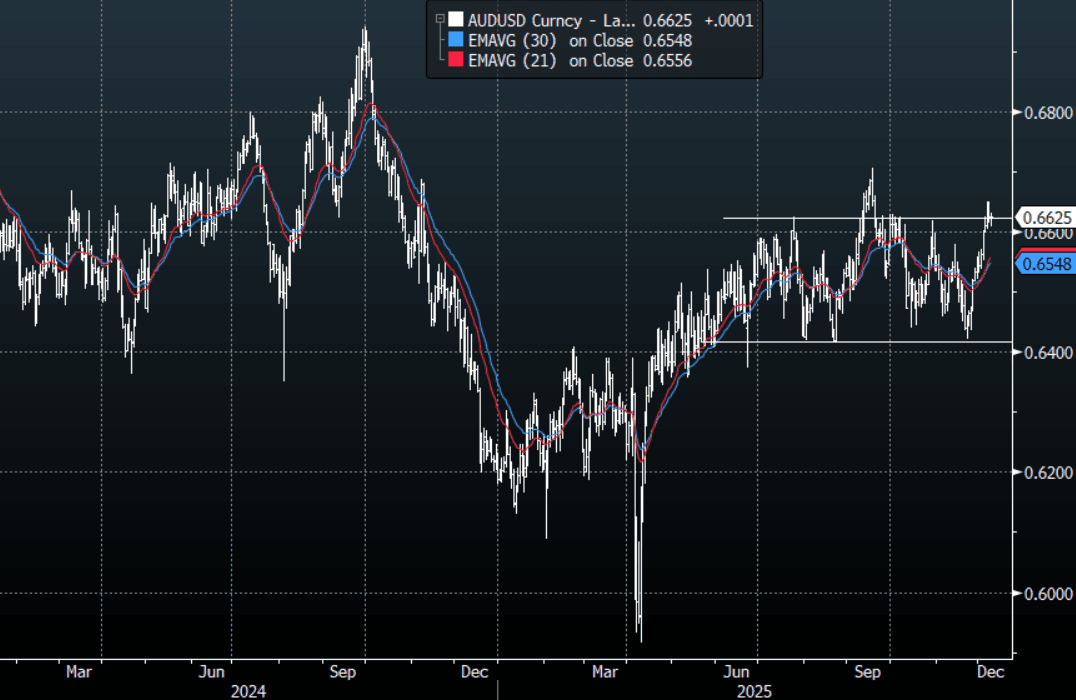
AUD/USD-Holding Above 0.6600, Market Hoping Press Briefing More Hawkish
The AUD/USD has had a range today of 0.6609 - 0.6631 in the Asia- Pac session, it is currently trading around 0.6625, +0.02%. The AUD/USD tried lower on the RBA as the market was looking for something more to confirm their hawkish skew, this added to the headwinds from the pullback in the USD overnight. While the AUD remains above 0.6500-0.6550 I suspect dips should continue to be supported. On the day attention will now turn to the press conference where the hawkish tilt the market was looking for could still be expressed. It has come a long way very quickly so a pullback is not out of the question if the market does not get any love from the press conference, first support is toward 0.6570/90 where we should see demand reappear. Ultimately the AUD is looking to rebuild momentum to have another look back toward the 0.6700 area at some point.
- MNI AU - RBA: Rates On Hold, Upside Risks To Inflation Indicated. The RBA left rates at 3.6% at its December decision but noted that risks to inflation are tilted to the upside. The labour market remains “a little tight” and the private domestic economic momentum stronger.
- MNI AU - Q4 Conditions Up On Q3, Q4 Business Inflation Series Moderate: November NAB business conditions moderated to 7 from an upwardly-revised 10, while the more volatile confidence fell to 1 from 6, the lowest since April. Conditions remained in line with Q3 outcomes and at this stage looks like normalisation rather than slowing as the sharp rise in WA in October unwound. With hard data showing a pickup in domestic demand and inflation above the top of the RBA’s 2-3% band.
- Options : Closest significant option expiries for NY cut, based on DTCC data: 0.6630(AUD621m), 0.6635(AUD714m). Upcoming Close Strikes : 0.6550(AUD1.59b Dec 11) - BBG
- The AUD/USD Average True Range for the last 10 Trading days: 36 Points
Fig 1: AUD/USD spot Daily Chart
Source: MNI - Market News/Bloomberg Finance L.P
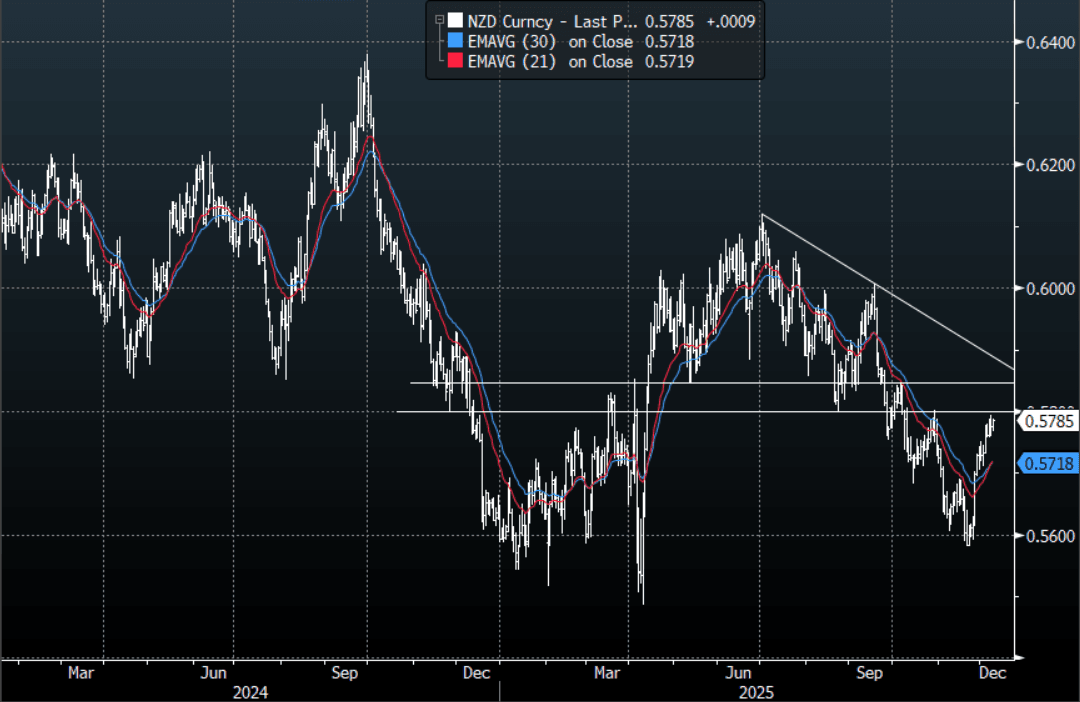
NZD/USD - A Little Higher Looking To Test 0.5800 Again
The NZD/USD had a range today of 0.5767-0.5788 in the Asia-Pac session, going into the London open trading around 0.5785, +0.15%. The NZD/USD has drifted a little higher having a look back toward the 0.5800 area once again in our session. On the day, watch the price action back toward 0.5780-0.5800 if price cannot retake the highs we could see a potential reversion back to the mean. Support is around 0.5735-0.5755 area first up and then the more important 0.5670/0.5700 area. Some tough resistance approaching in the 0.5800-0.5850 area, I suspect sellers could fade a move here initially.
- Bloomberg - “Westpac New Zealand is raising interest rates on fixed-term home loans of two years or longer, the lender says in an emailed statement. Effective Wednesday, a two-year special home loan will carry a 4.75% rate up from 4.45%. Five-year special rate rises to 5.29% from 4.49%. Says fixed rates are mainly driven by movements in wholesale interest rates rather than the OCR and wholesale rates have lifted materially.”
- Options : Closest significant option expiries for NY cut, based on DTCC data: none. Upcoming Close Strikes : 0.5700(NZD557m Dec 10), 0.5700(NZD306m Dec 12) - BBG
- The NZD/USD Average True Range for the last 10 Trading days: 33 Points
Fig 1: NZD/USD Spot Daily Chart
Source: MNI - Market News/Bloomberg Finance L.P
ASIA STOCKS: FOMC Stalls Markets, NIFTY 50 Through Key Tech Level
A generally weak day for Asia's equity markets today with the biggest falls from Hong Kong and India. As the world awaits the FOMC decision on rates, attention turns to the forward guidance as the markets are now set for a December cut. The pathway for rates in 2026 has become less certain now with investors set to pour over every part of the FOMC output. This uncertainty has given rise to profit taking / de-risking ahead of the FOMC. Even the tech sector took a breather today with key names like SK Hynix in Korea and TSMC in Taiwan falling. In Japan, expectations of a potential interest-rate hike have pushed up bond yields and strengthened the yen , which tends to weigh on export competitiveness and investor sentiment in nearby markets.
- The NIKKEI has managed to stay positive today, gaining by +0.07% whilst the KOSPI fell by -0.36% with key tech stocks lagging.
- China's bourses were heavy with the Hang Seng leading the falls, down -0.85% as other indexes falls were muted in a generally risk off day with some local commentators suggesting that profit taking was evident.
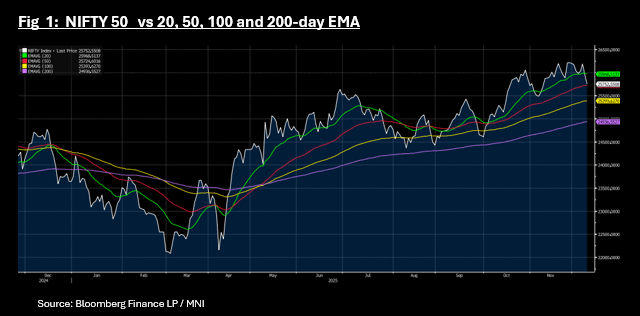
- India's NIFTY 50 finished Monday on the back foot and has started Tuesday with galls of -0.75% to be at 25,758. The falls in recent days has seen the NIFTY trade through the 20-day EMA of 25,968 and is now near the 50-day EMA of 25,724. It last traded below the 50-day EMA in early October.
- The FTSE Malay KLCI is down -0.20% and the Jakarta Composite -0.40% on a generally weak day whilst the SE Thai bucked the trend and rose 0.45%
OIL: Crude In Narrow Range But Holds Losses As Waits For Outlook Updates
Oil has held onto Monday’s losses of just over 2% during today’s APAC trading but has moved in a very narrow range. WTI is down 0.3% to $58.72/bbl after rising to $58.90 earlier, while Brent is 0.2% lower at $62.36/bbl close to the intraday low. With a Ukraine peace deal again looking elusive and Russia likely to continue to find ways around sanctions, the market is focused on the supply outlook with a record market surplus forecast for 2026. Updated projections are published this week.
- The EIA short-term energy outlook is published later today with OPEC & IEA reports on Thursday. The IEA is already projecting a record surplus in 2026 and oil prices are likely to be pressured by an upward revision. OPEC and non-OPEC supply is forecast to grow and recent reports indicated elevated seaborne crude.
- Key risks stem from ongoing Ukrainian attacks on Russian fuel facilities and India succumbing to US pressure to cut its imports of Russian crude which would increase demand for non-sanctioned supplies.
- This week US officials are in India to negotiate a trade deal and its imports of Russian crude will be on the agenda given the US’ punitive 25% tariff due to its purchases. Refiners have signalled that the latest sanctions make it harder to purchase Russian crude.
- US industry-based inventory data are also released Tuesday.
- Later US September/October JOLTS jobs data, September lead index, November NFIB small business sentiment, as well as Germany October trade print. The ECB’s Buch speaks and BoE Board members appear before parliament.
PRECIOUS METALS: Gold - Drifts Lower As The USD Finds A Bid Approaching The FOMC
The range overnight for gold was $4,176.42/oz - $4,217.28/oz, Asia is currently trading around $4,190/oz, +0.05%. Gold slipped lower overnight with the USD rebounding as we approach the FOMC this week. Gold has been chopping around sideways within a $4,140 - $4,260/oz range. The market is trying to regain the momentum to once again test higher but for now it seems to be stalling above $4,200/oz. Support lies back toward the $4,130-$4,150/oz area; a break below here could signal a deeper pullback toward the more important $4,050-$4,100/oz support.
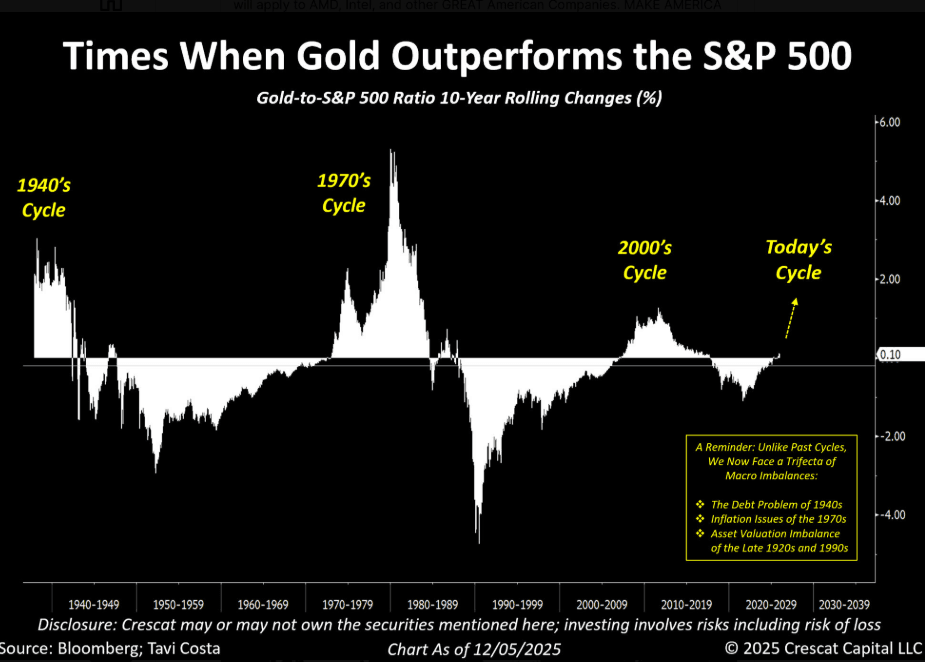
- Otavio Costa of Crescat Capital via X argues the cycle higher is just beginning, “Some argue that gold’s recent outperformance relative to the S&P 500 was a temporary anomaly. I disagree. This dynamic follows very long-term cycles, and I believe we’re likely only in the early stages of this one. A key reminder: Unlike past cycles, however, we now face a trifecta of macro imbalances:”
- “The Debt Problem of the 1940s”
- “Inflation Issues of the 1970s”
- “Asset Valuation Imbalance of the Late 1920s and 1990s”
- The XAU Average True Range(ATR) for the last 10 Trading days: $48.96
Fig 1 : Gold to S&P 500
Source: MNI - Market News/Bloomberg/@TaviCosta
UP TODAY (TIMES GMT/LOCAL)
| Date | GMT/Local | Impact | Country | Event |
| 09/12/2025 | 0700/0800 | ** |  DE DE | Trade Balance |
| 09/12/2025 | 1000/1000 | * |  GB GB | Index Linked Gilt Outright Auction Result |
| 09/12/2025 | 1100/0600 | ** |  US US | NFIB Small Business Optimism Index |
| 09/12/2025 | - | US | FOMC Meetings with S.E.P. | |
| 09/12/2025 | 1355/0855 | ** | US | Redbook Retail Sales Index |
| 09/12/2025 | 1415/1415 | GB | BOE Lombardelli, Ramsden, Dhingra, Mann at TSC | |
| 09/12/2025 | 1500/1000 | *** | US | JOLTS jobs opening level |
| 09/12/2025 | 1500/1000 | *** | US | JOLTS quits Rate |
| 09/12/2025 | 1700/1200 | *** | US | USDA Crop Estimates - WASDE |
| 09/12/2025 | 1800/1300 | ** | US | US Note 10 Year Treasury Auction Result |
| 09/12/2025 | - |  CA CA | Bank of Canada Meeting | |
| 10/12/2025 | 0130/0930 | *** |  CN CN | CPI |
| 10/12/2025 | 0130/0930 | *** | CN | Producer Price Index |
| 10/12/2025 | 0700/0800 | *** |  NO NO | CPI Norway |
| 10/12/2025 | 0700/0800 | ** |  SE SE | Private Sector Production m/m |
| 10/12/2025 | 0900/1000 | * |  IT IT | Industrial Production |
| 10/12/2025 | 1000/1000 | ** | GB | Gilt Outright Auction Result |
| 10/12/2025 | 1000/1000 | GB | Chancellor Reeves Testifies at TSC on Budget | |
| 10/12/2025 | 1045/1045 | GB | BOE Bailey Pre-recorded Chat on Financial Stability | |
| 10/12/2025 | 1055/1155 |  EU EU | ECB Lagarde Interview on Currencies/Digital Euro | |
| 10/12/2025 | 1200/0700 | ** | US | MBA Weekly Applications Index |
| 10/12/2025 | 1200/0700 | ** |  BR BR | Brazil Final CPI |


