MNI: Canada Trims Budget Deficits And Girds For Slowdown

Canadian Finance Minister Chrystia Freeland pared budget deficit projections Thursday as stronger growth and inflation boost government coffers for now, while largely holding the line on new spending as a global slowdown looms.
The deficit for the fiscal year that began in April was slimmed to CAD36.4 billion from an earlier estimate of CAD52.8 billion. That’s down from CAD113.8 billion last year and the record CAD327.7 billion the year before during the height of the pandemic.
This year's improvement reflects about a CAD30 billion boost from stronger growth and inflation, CAD5 billion of new spending and CAD1 billion set aside to cover the cost of any bigger economic slowdown. That spending profile is a switch from Freeland's full budget in April that spent more than half the windfall as the economy re-opened.
While not using the word recession in reference to Canada, Freeland told Parliament the risks of a global slump have increased as central banks hike to tackle global inflation and because of Russia's invasion of Ukraine. Canada's extra spending is now more targeted to assisting the most vulnerable and to avoid making BOC Governor Tiff Macklem's job harder, she said.
"Canada cannot avoid the global slowdown, any more than we could have avoided COVID once it had begun infecting the world," she said. She mentioned inflation nine times in her speech and said at 6.9% it remains too high. "Interest rates are rising as the central bank steps in to tackle inflation," Freeland said, "and that means our economy is slowing down."
Even with the slowdown, momentum from the rebound following lockdowns boosts the measure of nominal GDP used to estimate federal finances by an average of CAD54 billion a year over the five-year projection. That reduces the deficit for the fiscal year starting next April to CAD30.6 billion from CAD39.9 billion, and means a CAD4.5 billion surplus in 2027-28, which would be the first since 2007-08.
That kind of surplus would come after the next federal election, and Justin Trudeau's Liberals have already added new spending such as expanded dental coverage to uphold a deal to remain in power until 2025. Another spending pressure is Freeland's announcement the next full budget will lay out major plans to keep Canadian firms competitive in response to the U.S. Inflation Reduction Act that offered subsidies for climate-friendly projects.
Freeland also announced a new 2% tax on corporate share buybacks to take effect at the start of 2024, also mirroring a recent U.S. move. That's expected to raise CAD2.1 billion over five years, and is also in line with NDP demands to tax corporations. Other new measures include eliminating interest on federal student loans and a new quarterly benefit for 4.2 million low-income workers.
The budget plan was based on private sector economists surveyed in early September. With risks building since then the government developed a downside scenario including a mild recession starting early next year that would increase this year’s deficit to CAD49.1 billion. The new economist survey cut 2023 growth to 0.7% from 3.1% and said inflation will top 3% for longer than previously expected.
"Maintaining our fiscal firepower, the government is ensuring that it will have the capacity to act if needed," the budget said. Freeland reiterated she's sticking to a goal of lowering debt as a percentage of GDP each year, a goal business groups and economists have said is too passive.
Other highlights:
- Consultations on digital currencies are starting today, the government said, while noting new forms of money “have been used to avoid global sanctions and fund illegal activities.”
- Bond sales for 2022-23 are being reduced by CAD21 billion and the year-end treasury bills stock has been reduced by CAD21 billion from what was outlined in the 2022-23 Debt Management Strategy. Real Return Bond sales are being halted amid low demand and to consolidate funding sources to improve liquidity.
- “There is no country in the world better placed than Canada to get through the coming global slowdown," Freeland said.
- "The global green transition calls for an industrial transformation comparable in scale only to the Industrial Revolution itself—and Canada is blessed with the talented people and the natural resources and the manufacturing base needed to drive that transformation," she said.
- The report noted global USD strength and said “the recent depreciation of the Canadian dollar should partially offset the impact of weaker global activity on non-commodity exports.”
- Economists saw inflation slowing to 2% in mid-2024, sooner than the BOC’s view it won’t happen until the end of that year.
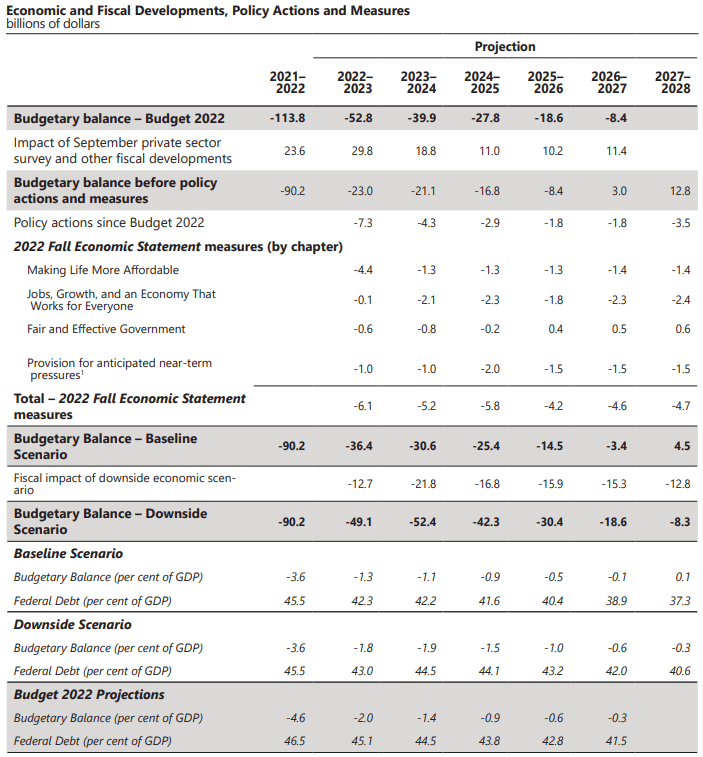
Source: Department of Finance


