GLOBAL MACRO: IP Growth Rises In March, Outlook Uncertain
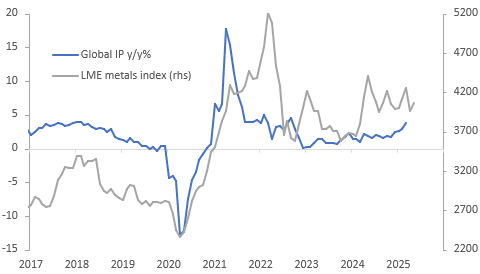
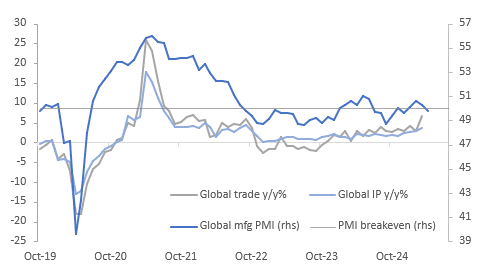
CPB data showed that global IP volumes rose 0.5% m/m to be up 3.7% y/y in March after 0.8% & 2.9% y/y respectively. This was the fastest annual growth rate since September 2022, a time when the global economy was recovering from Covid. The pickup in IP seen since December has lagged global trade growth. The global manufacturing PMI suggests that IP is likely to slow in the coming months but metal prices suggest that it could strengthen before stabilising.
- Some of the frontloading of trade to beat US tariffs may be coming out of inventories and thus IP hasn’t picked up to the same degree. Thus, IP may not slow as much in the second half of the year consistent with metal prices remaining at elevated levels.
Global IP vs LME metal prices
- The S&P Global manufacturing PMI signalled slightly positive growth in activity in Q1 2025 but it fell to 49.8 in April from 50.3 signalling a slight contraction. The US’ reciprocal tariffs were announced on April 2 and likely weighed on the index. There could be some unwind in the May PMI, released on June 3, due to the tariff delay.
- Central banks assume that even if trade agreements are reached by July, uncertainty in H1 2025 will weigh on demand. If deals aren’t agreed, then global growth could be significantly lower.
Global growth
Want to read more?
Find more articles and bullets on these widgets:
Historical bullets
US TSYS: Extraordinary Measures And Cash Look Sufficient To Head Off X-Date
Treasury has about $164B in "extraordinary measures" available as of April 23 to avoid hitting the debt limit, per its regular report out Friday. That's out of a maximum total of $375B (they have used $211B).
- With Treasury cash looking healthy (around $600B), that's a fair amount of dry powder to get through the summer months to wait out the debt limit impasse. Tax receipts have looked strong with tariff revenues also starting to boost cash flows, further reducing the near-term urgency to adjust bond issuance.
- This has also helped push back analyst “x-date” expectations to later in the summer/September. We expect to hear from Treasury about its own x-date assumptions next week.

US TSYS: Treasury Market Trading Stayed Orderly In April: Fed Report
Liquidity across financial markets including the Treasury market deteriorated after President Trump's April 2 reciprocal tariffs announcement but market functioning was generally orderly, according to the Federal Reserve's semiannual report on financial stability, released Friday. (PDF link is here)
- Treasury market liquidity has been poor for years and yields were particularly volatile in early April, contributing to a deterioration in market liquidity, the Fed said.
- Nevertheless "trading remained orderly, and markets continued to function without serious disruption," according to the report, which looked at information available as of April 11.
FED: Ex-Gov Warsh: Fed Has Failed To Satisfy Price Stability Remit
From our Washington Policy Team - Some fairly sharp words today from ex-Fed Governor Warsh on the central bank (who for what it's worth is seen by betting markets as by far the frontrunner for the next Fed Chair):
- The best way for the Federal Reserve to safeguard its independence is for policymakers to avoid expanding the institution's role over time, including wading into policy areas that are outside its core mission, former Fed Governor Kevin Warsh, a leading contender to replace Jerome Powell as chair next year, said Friday.
- "I strongly believe in the operational independence of monetary policy as a wise political economy decision. And I believe that Fed independence is chiefly up to the Fed," Warsh said in a speech at a Group of Thirty event on the sidelines of the IMF meetings. "Institutional drift has coincided with the Fed’s failure to satisfy an essential part of its statutory remit, price stability. It has also contributed to an explosion of federal spending." His speech made no mention of Trump's tariffs or the appropriate monetary policy to deal with them.
- He said the ideas of data dependence and forward guidance widely adopted by Fed officials are not especially useful and might even be counterproductive.
"We should care little about two numbers to the right of the decimal point in the latest government release. Breathlessly awaiting trailing data from stale national accounts -- subject to significant, subsequent revision -- is evidence of false precision and analytic complacency," he said.
"Near-term forecasting is another distracting Fed preoccupation. Economists are not immune to the frailties of human nature. Once policymakers reveal their economic forecast, they can become prisoners of their own words. Fed leaders would be well-served to skip opportunities to share their latest musings."


