CANADA DATA: Goods Sector Employment Gets Rare Reprieve, But Services Stay Weak
In keeping with the largely-static headline employment data in March's Labour Force Survey, the indu...
Want to read more?
Find more articles and bullets on these widgets:
Historical bullets
BONDS: 10-year Bund Yields Through Monday’s High
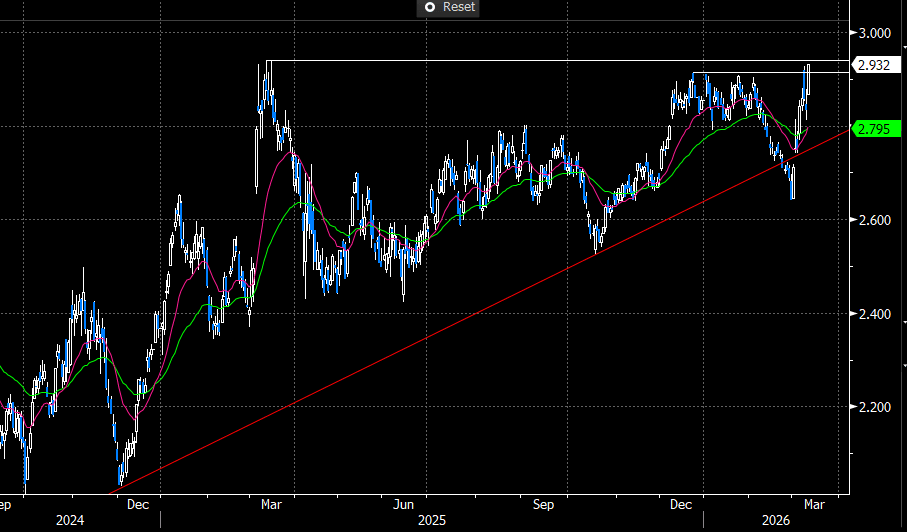
Continued upward pressure in global core FI yields sees 10-year Bunds pierce Monday’s 2.928% high. Yields are now up 9.5bps on the session, with the March 2025 high at 2.940% the immediate topside focus.
- Yields have been biased higher through the session, with the Middle East conflict and associated energy market frictions likely to persist for at least few more weeks. In an interview with Axios, US President Trump noted that the war with Iran will end “soon”, but the same article stated that officials were preparing for at least two more weeks of strikes.
- Announcements of strategic oil reserve withdrawals from various countries, following IEA guidance this afternoon, have done little to stem rises in crude futures today.
- Meanwhile, this afternoon’s US CPI report had somewhat firm core PCE implications. US Tsys yields are up 5.5bps today at 4.21%.
- The German curve remains bear flatter, with Schatz yields up 12.5bps to 2.377%. A reminder that ECB’s Kazimir provided characteristically hawkish rhetoric this morning, suggesting rate hike could come sooner than previously thought. Other ECB speakers including Schnabel have provided less explicit signals, stressing that policy remains in a good place and that the Governing Council still needs time to monitor the persistence of the energy shock.
Figure 1: 10-year Bund Yields (Source: Bloomberg Finance L.P)
GERMANY: Coalition Under Pressure Ahead Of Rhineland-Palatinate Election (1/2)
Chancellor Friedrich Merz and the wider governing federal coalition are under notable political pressure ahead of Germany's next election, taking place in the western state of Rhineland-Palatinate on 22 March. Merz's centre-right Christian Democratic Union (CDU) and its junior coalition partner, the centre-left Social Democrats (SPD), suffered disappointing and catastrophic results, respectively, in the 8 March election in the southwestern state of Baden-Wurttemberg.
- The CDU had been hoping to emerge as the largest party in the state for the first time since 2011. It had led in state-wide polling since 2023, and secured 31.6% of the vote in the state in the 2025 federal election, compared to just 13.6% for the Greens. However, a late surge in support saw the centre-left environmentalist Greens emerge with 30.2% of the vote to 29.7% for the CDU. The increase in Green support came largely at the expense of the SPD, which recorded just 5.5% support. This is the party's lowest-ever level of support in a state election.
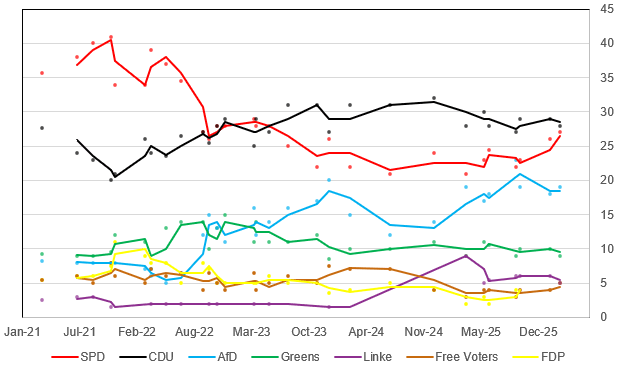
- Rhineland-Palatinate has been governed by an SPD-Green-Free Democrat (FDP) 'traffic light' coalition since 2021, but it appears that this formulation looks set to lose its overall majority.. Polling in late February showed the CDU and SPD vying for first place, with the far-right Alternative for Germany (AfD) in a strong third. If the FDP, regionalist Free Voters and far-left Die Linke all cross the electoral threshold of 5% it will severely limit the prospect of a two-party coalition being possible post-election.
Chart 1. State Election Opinion Polling, % and 2-Poll Moving Average
GERMANY: Coalition Under Pressure Ahead Of Rhineland-Palatinate Election (2/2)
While the results in Baden-Wurttemberg and Rhineland-Palatinate were/will be down to local issues, Politico notes "As political pressure rises, both the SPD and [the] CDU are being pushed to reframe a series of policies — from reforms meant to restore economic competitiveness to the government’s stance on the war in Iran — to appeal to their bases. That could well make the divergent coalition far more fractious."
- Major rifts over gov't spending (CDU supports lower welfare spending to aid competitiveness, the SPD raising the social safety net), the constitutional debt brake (both sides support increased defence spending, but the SPD wants the gov't to go further while Merz's CDU opposes), and the war in Iran (CDU has offered tacit support to US/Israeli strikes, SPD is opposed) risk damaging coalition relations, which could have a negative impact on the gov'ts ability to formulate policy at the federal level.
- Data from the predictions market site Polymarket shows bettors assigning a 17% implied probability that the 'grand coalition' breaks up before 2027 (it should be noted that this is in an extremely small, illiquid market).


