ASIA: Coming Up In Asia Pac Markets On Wednesday
May-05 21:21
------------------------------------------------------------------------------ 2345BST 0645HKT 084...
Want to read more?
Find more articles and bullets on these widgets:
Historical bullets
GLOBAL POLITICAL RISK: Trump Renews Threats To Iran Power Plants
Apr-05 21:13
(Bloomberg) - "President Donald Trump issued a series of increasingly fiery threats to destroy Iran’s power plants starting Tuesday and bring “Hell” to the country after US forces rescued an airman from Iran more than a day after his fighter jet was shot down." https://blinks.bloomberg.com/news/stories/TD177JT9NJL
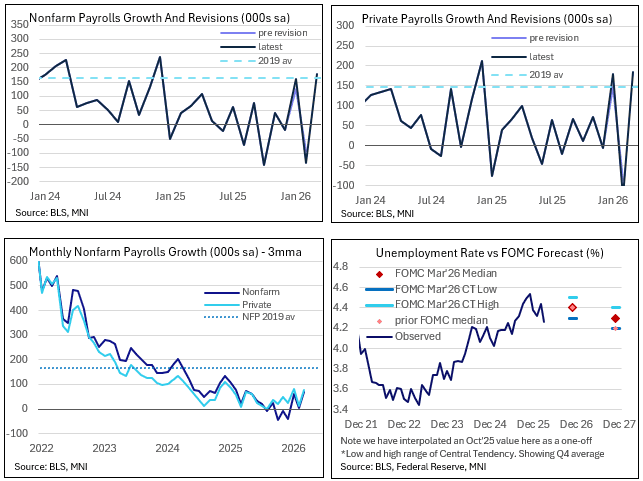
US LABOR MARKET: MNI US Employment Insight: Strong Bounce Alleviates Concerns
Apr-03 16:01
We've just published our latest U.S. Employment Insight: Download Full Report Here
US LABOR MARKET: Strong Payrolls Report, But Supply Vs Demand Debate To Go On
Apr-03 14:59
March's BLS employment report was undoubtedly strong in the main readings, and will have allayed concerns that February's pullback in payrolls portended a renewed leg of weakness in the labor market.
- The 178k headline gains in the Establishment survey easily beat the 70k MNI dealer median, with private payrolls up 186k vs the 75k expected. And the dip in the unemployment rate to a 9-month low 4.26% (consensus 4.4%, 4.44% prior) in the Household Survey suggested that the headline payroll gains were no fluke.
- But while this was a better than expected report, it comes in the context of significant volatility in month-to-month figures, including major revisions to February's reading (-113k vs -92k, offset by a +34k upside revision to January). And the rebound, while impressively broad across sectors, was still heavily driven by healthcare employment and other sectors that appeared impacted by one-off factors in February.
- Stepping back, the 3-month change in payrolls has been a solid if more modest +68k (an 11-month high), with the 6-month average gains rising to 15k from -2k in Feb for the highest since in 6 months. So, an improvement in trends, but not enough to suggest that employment gains are doing anything but treading water. Payrolls have grown by just 0.2% Y/Y.
- Indeed while the unemployment rate drop was suggestive of reduced labor market slack, it was flattered by a decline in the size in the labor force as well as falls in the participation and employment-to-population ratios, as well as the weakest response rate in survey history.
- Additionally, growth in average hourly wages continued to decline to fresh post-2021 lows on a Y/Y basis and well off post-pandemic highs.
- Taken together, the FOMC will probably be relieved that it has another month to assess the fallout from the Middle East war without being unduly concerned about an imminent collapse in the labor market (for which evidence of near-term war impact is so far scant).
- The Committee will continue to see a low-hiring, low-firing labor market that is indicative of being roughly in balance, with the underlying data meaning the debate is set to continue over whether it is weakness in labor supply or demand that has the upper hand.
- Indicative of this reinforced wait-and-see stance, market-implied Fed rate cuts were pared in the wake of the report, with Fed funds futures currently seeing just 1bp of cuts in 2026 as we head into the holiday weekend, vs around 5bp pre-report.